photo-1

From a press release:

“The Humanities Council of Washington, D.C. (HCWDC) is pleased to announce its popular House history workshops return. They will be held Saturday, September 21, 2013 at the Martin Luther King Jr. Memorial Library, 901 G St. NW in the Washingtoniana Division (3rd Floor). Two workshop sessions will
be held: Session I: 10:00 am – 12:30 pm and Session II: 12:30pm – 3:00 pm. This year’s House History Workshop will guide community historians, of any skill or knowledge level, through the DC Public Library Washingtoniana Division’s collections. Participants will learn how to research the history of their own home or any other historical property.

These workshops will feature presentations by professionals who will guide workshop participants on how
to navigate the collection of maps, building permits database, photo archives, microfilm records and the council’s DC Digital Museum. The House history workshops provide residents with an opportunity to explore the history of their homes including the date the home was built, architect, builder, dates of any improvements, former residents, and how the neighborhood evolved over time. House history research is powerful because it provides that personal connection to the past that few other types of historical research can; it allows anyone to forge a strong sense of connection with their neighborhood and their community whether they have called DC home for years, or just moved in last month.

Workshops are free and open to the public. Registration is required, to attend please sign up here.”

Ed. Note: You can see all events here and you can schedule your own event listing here.


9670741946_1a22db1103_z
Photo by PoPville flickr user NCinDC

NCinDC writes:

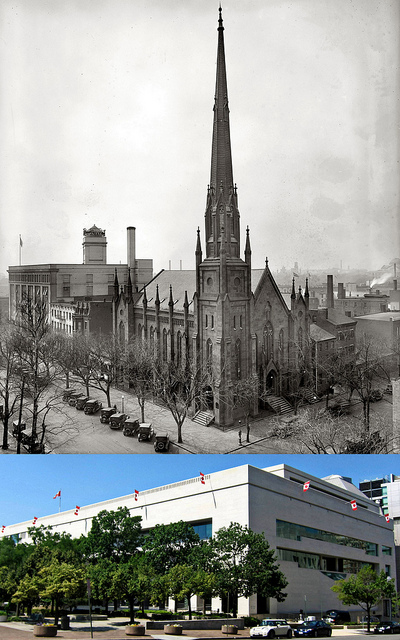
“The top photo is Metropolitan Methodist Church, ca 1924, taken by the National Photo Company. (via shorpy) The bottom photo is the Embassy of Canada, ca 2010.

———————

Facing southwest at the corner of C Street NW and John Marshall Park (where 4th Street would normally intersect) in the Judiciary Square neighborhood of Washington, D.C. The street on the left in the older photo was called John Marshall Place (also called 4 1/2 Street), but that no longer exists.

———————-

Construction of Metropolitan Methodist Church (the current church building is located on Nebraska Avenue NW) began in 1854, but due to the Civil War, wasn’t completed until 1869. The building was designed by the New York architectural firm Mundell & Teckritz. The 240-foot steeple wasn’t finished until 1872, although it was torn down in 1935; the rest of the church building was demolished in 1956.

The postmodern Canadian embassy was completed in 1989 to the designs of architect Arthur Erickson.”


9471287510_f2910a4134_z
Photo by PoPville flickr user NCinDC

NCinDC writes:

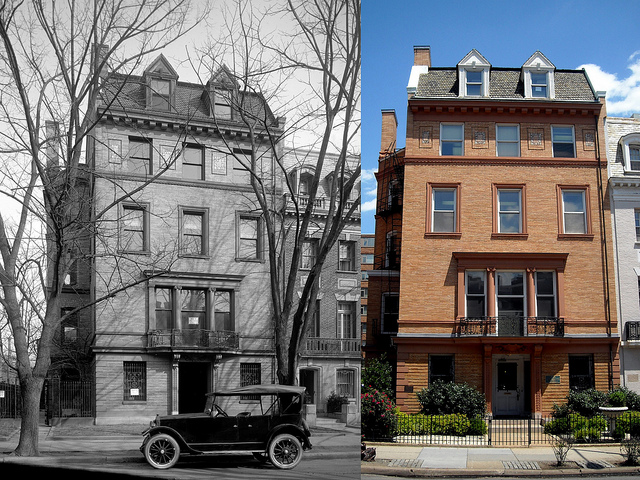
“The Mathematical Association of America’s headquarters located at 1529 18th Street, N.W., in the Dupont Circle neighborhood of Washington, D.C. Built in 1903, the Classical Revival style building served as the residence of Charles Evans Hughes when the photo on the left was taken in 1921. (via the Library of Congress) The building is designated as a contributing property to the Dupont Circle Historic District, listed on the National Register of Historic Places in 1978.

In addition to Hughes, previous occupants of the building include the Cuban Legation and its Minister Plenipotentiary Carlos Manuel de Céspedes y Quesada, Senator Frederic M. Sackett, the Association of Military Colleges and Schools of the United States, and the Association of the United States Army.

This is one of my older photos originally uploaded to Wikimedia Commons.”


dunbar_high_school
The new Dunbar High School

Jeff Tignor lives in South Manor Park. If you have a book you’d like to recommend/review please send an email to princeofpetworth(at)gmail with book review in the title. We discussed this summer’s general reading recommendations here.

Alison Stewart’s excellent new book First Class: The Legacy of Dunbar, America’s First Black Public High School, tells the story of a groundbreaking educational institution born in Washington, DC as a result of a unique set of circumstances and later hobbled by home rule politics, social class conflicts, and racial desegregation without integration. Ms. Stewart, an award-winning journalist who has worked as an anchor and reporter for several major commercial TV networks, as well as NPR and PBS, and whose parents graduated from Dunbar in the 1940s, uses Dunbar as a lens for examining the history of education in Washington, DC. The book covers three distinct eras: First, from 1807-1954, a detailed history of African-American education in Washington, DC and how Dunbar became America’s first African-American public high school; second, beginning with the 1954 Brown v. Board of Education and Bolling v. Sharpe decisions, a transitional period in the years surrounding school integration; and third, Dunbar’s post-1960 full transformation to the neighborhood school it is today, struggling with the challenges of urban education. As someone whose family history in Washington, DC dates to the post-civil war 1800s, I learned new facts about DC’s history and was struck by the irony of Dunbar alums arguing for desegregation at the Supreme Court and then seeing their prestigious and beloved alma mater fray as the unconstitutional system of segregation was dismantled. I was moved by the heartbreaking stories of students and educators trying to honor Dunbar’s past and simultaneously create a present and future that will allow the school to once again become a launching pad for great careers. (more…)


Screen Shot 2013-08-05 at 10.57.40 AM
Photos courtesy of Laura

“Dear PoPville,

When I moved my wife and two-year-old to 13th and T, across the street from the Whitelaw Hotel (the Whitelaw’s much-faded neon sign is still in my garage, no reasonable offer refused) U Street was a trench underneath which a subway line was allegedly being built. In one of the pictures, there’s a sign listing the businesses still open, I think it’s optimistic — I think we were down to Ben’s, Leon’s shoe repair and maybe a beauty shop. The street was so desolate, even the drug dealers and the homeless didn’t hang there, and you almost felt safer there than in the populated parts of the neighborhood, even though my father was once slapped in the face by a stranger because “all white men are faggots.”

Needless to say, my parents, and my in-laws thought we were crazy, and it did take a lot of squinting and gin to see something other than continued, inexorable decline peppered with random violence and some of the ugliest hookers in the history of the world’s oldest profession.

I have to go cranky old geezer for a moment on some of the PoP complaints about today’s Columbia Heghts, Petworth, Eckington, etc. Kids these days have it so easy. ;) It’s not just that the whole hipster economy springs up much faster in gentrifying neighborhoods today than they did back then — and then, as now, I’d rather have a cool bar within walking distance than a grocery store. It’s that real change seemed so much less inevitable then than it does today — we lost money on our house when we moved to Denver for two years — and there were a lot of long “holy shit, what have we done?” nights.

But, what the hell. We bought a real house for $200k, so there’s that. And had seven rich years with a diverse cast of characters, watching a fascinating and unique transformation, of which we claim some small part. (I missed living on the edge, but when I suggested Columbia Heights when we moved back from Denver in 1999, my wife announced “we’ve done our time” and so we moved to Mt. Pleasant instead).

One day early on, a friend and I went out to take some shots of the neighborhood (it’s too bad we didn’t have Pablo and PoP’s cadre of camera talent around back then to document the decline and nascent rebirth of U Street), and a couple of days ago she stumbled across these shots and passed them along for your perusal.

Irving (nee “T”) Streete.”

Screen Shot 2013-08-05 at 10.57.55 AM

More photos after the jump. (more…)


Streets of Washington, written by John DeFerrari, covers some of DC’s most interesting buildings and history. John is the author of Historic Restaurants of Washington, D.C.: Capital Eats, to be published this September by the History Press, Inc. John is also the author of Lost Washington DC.

The early 20th century was in many ways a golden era for casual restaurants. The rules of the business were changing rapidly, and those who could tell which way the wind was blowing had the opportunity for tremendous success. Lunchrooms had been proliferating since the 1890s, offering fast, inexpensive meals to working folk who could no longer easily go home for lunch and who didn’t feel comfortable patronizing saloons. Then Prohibition killed off the saloons altogether, and the demand only increased for simple, homestyle cooking served quickly and inexpensively. Cafeterias were one solution. The first American eatery to be called a cafeteria had opened in 1893 at the Columbian Exposition in Chicago, and it was an instant hit. As cafeterias gained in popularity over the coming decades, they nearly always sold the same basic, no-frills “comfort” fare—breakfast dishes, sandwiches, meatloaf, salads, cakes, pies, and the like.

Sholl's Cafes (1932)
Postcard from 1932 (Author’s collection).

Perhaps the best known in Washington was Sholl’s Cafeteria and Dining Room, opened by Evan A. Sholl (1899-1983) in 1928 at Connecticut Avenue and L Street NW. Sholl, the second-youngest of 13 children born to a Pottsville, Pennsylvania farmer, had started out in life with little to his name. He earned a hardscrabble living at an assortment of odd jobs—busboy, window washer, shoe factory hand—just as J. W. Marriott was doing at about the same time. At age 20 he opened his first restaurant, which quickly bankrupted him. After that he went to work for the Kresge retail chain, which transferred him to its Washington store at 7th and E Streets NW in 1927. He regained his financial footing there and, with more experience under his belt, set out on his own again with Sholl’s Cafeteria. This time it worked. (more…)


View More Stories