Streets of Washington, written by John DeFerrari, covers some of DC’s most interesting buildings and history. John is the author of Historic Restaurants of Washington, D.C.: Capital Eats, to be published this September by the History Press, Inc. John is also the author of Lost Washington DC.

One of the country’s most sophisticated scientific laboratory complexes, the National Bureau of Standards, once stood on a hill off of Connecticut Avenue at Upton Street, in the serene, semi-rural upper Northwest section of the city. Through much of the 20th century, this secluded and unassuming enclave quietly made countless important contributions to the safety and quality of the manufactured goods we take for granted today, including everything from airplane engines to kitchen crockery.

Bureau of Standards 01
Connecticut Avenue runs along the top of this circa 1930 view of the Bureau’s campus (Author’s collection).

The Bureau was founded in 1901, during a period of burgeoning industrial production and dramatic technological change. Telephones, automobiles, light bulbs, electrical machinery—it all needed practical, reliable standards based on methodical scientific testing. The new Bureau filled this need, greatly expanding on the mission of its predecessor, the Office of Weights and Measures, which had been set up in the Treasury Department in the early 19th century to ensure that standard measures were used when calculating customs duties on imported goods.

First housed temporarily in the old Office of Weights and Measures building on Capitol Hill, the fledgling Bureau in 1901 urgently needed space to build its own laboratory. The requirements were exacting. The laboratory had to be well outside the city proper, somewhere completely free from vibration, traffic disturbances, and the electrical interference caused by streetcar lines. It had to be solidly built, using twice the construction materials of an ordinary office building, heating and plumbing lines that were twice as complicated as an average building’s, and four or five times the usual amount of wiring. Some labs were to be fitted out with both running salt water and fresh water as well as dispensed crushed ice. Ancillary buildings would also be needed for engines, pumps, heavy machinery, and the fabrication of sensitive scientific instruments. (more…)


9074006982_d4a09b35eb_z

This is very cool. PoPville flickr user NCinDC writes:

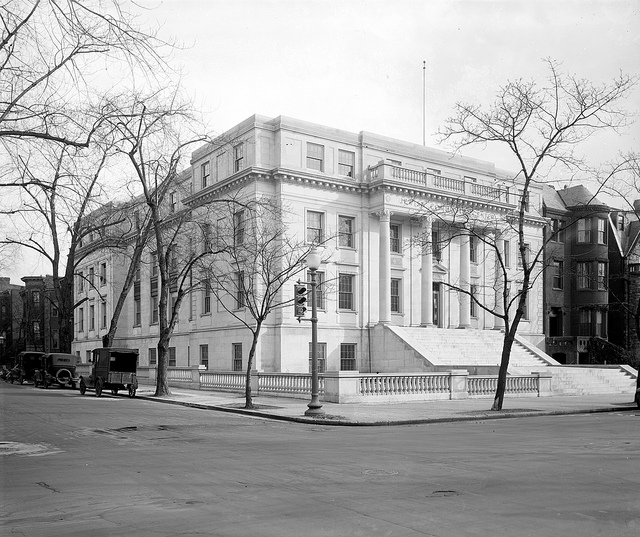
“The Washington, D.C. Jewish Community Center (DCJCC) in 1926, via the Library of Congress.

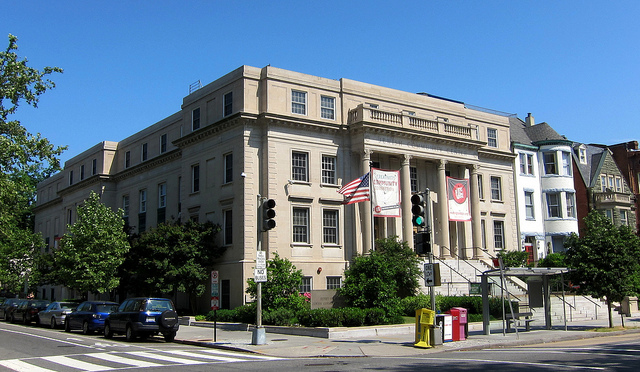
The DCJCC is located at 1529 16th Street, N.W., in the Dupont Circle neighborhood of Washington, D.C. Completed in 1926 to the designs of noted local architect B. Stanley Simmons, the neoclassical style building is designated as a contributing property to the Sixteenth Street Historic District, listed on the National Register of Historic Places in 1978.”

9074005446_145735a015_z
Photo by PoPville flickr user NCinDC


IMG_1878

Marlon Francisco Morales:

Officer Marlon Morales succumbed to a gunshot wound sustained three days earlier when he confronted a fare evader leaving the U Street-Cardoza Metro station in Washington, DC.

During the confrontation, the suspect suddenly pulled out a handgun and shot Officer Morales in the face. Officer Morales never had a chance to draw his weapon. The suspect then stole Officer Morales’ service weapon and two spare magazines of ammunition and fled the scene. Officer Morales was transported to a local hospital here he remained in critical condition for three days before succumbing to his wound.

The suspect was arrested in Philadelphia, Pennsylvania several days after the incident when he was stopped by officers for a traffic violation. After a brief struggle with officers, he was subdued and found to have Officer Morales’ service weapon and the magazines.

On May 24, 2004, the suspect was convicted on seven counts, including murder. He was sentenced to life in prison without the possibility of parole on July 30, 2004.

Officer Morales was a Gulf War veteran and had been employed with the Metro Transit Police Department for 6 months. He is survived by his wife, infant daughter, and two young sons.

Read more: http://www.odmp.org/officer/15717-officer-marlon-francisco-morales#ixzz2W6jQKm7p

IMG_1879


map_of_week_dc_popville
click map to enlarge. Source: Library of Congress

Map of the Week is written by David A., a systems librarian and map geek living in NoMa. David previously wrote about the Potomac River from 1861.

Title: Birdseye view of the National Capital, including the site of the proposed World’s Exposition of 1892 and Permanent Exposition of the Three Americas

image_681x709_from_0,210_to_1348,1614

I really like this 1888 bird’s-eye view of the National Mall and surrounding area. This map laid out plans for a permanent exposition and a world’s fair to celebrate the centennial of the U.S. Constitution and the 400th anniversary of Christopher Columbus’ arrival. Some interesting details include old-timey ships on the SW Waterfront, a presumably never-built tower bridge across the Potomac, a Star of David-shaped monument to Columbus and a strangely empty street grid in SW. Proponents made their case for a Washington-hosted world’s fair in a January 18, 1890 issue of the Evening Star newspaper. They were unsuccessful. Chicago ended up hosting a quadricentennial world’s fair in 1893 to great acclaim.


potomac
click map to enlarge. Source: Library of Congress

Map of the Week is written by David A., a systems librarian and map geek living in NoMa. David previously wrote about Alexandria County from 1879.

Title: Map of the Potomac River (1861)

This week’s hand-drawn map of the Potomac River and its tributaries comes from the Civil War era diary of Robert Knox Sneden, a map-maker for the Union Army. Railroad routes and stations feature prominently. The Library of Congress hosts 316 of Sneden’s maps on its website.


View More Stories