From the National Zoo:
“We are sad to announce that the smaller of the two panda cubs has died.
The panda team continues to monitor Mei Xiang and the larger cub. They are encouraged that this cub appears to be strong and behaving normally.”


From the National Zoo:
“We are sad to announce that the smaller of the two panda cubs has died.
The panda team continues to monitor Mei Xiang and the larger cub. They are encouraged that this cub appears to be strong and behaving normally.”

Photo via Smithsonian’s National Zoo and Conservation Biology Institute
From the National Zoo:
“Mei Xiang has not been a willing participant in the panda team’s efforts to switch the cubs since 2 p.m. yesterday afternoon. She has the larger cub in her possession. The panda team is caring for the smaller cub and will continue efforts to swap the cubs about every four hours. However, because the smaller cub has been away from Mei, the panda team is now managing it more intensely. The little cub’s behaviors are good. The team is concerned about its fluctuating weight since the cub is now more than 48 hours old. The most important thing for the panda team is to help the cub get enough fluids and nutrients. To accomplish this, they are bottle and tube feeding the cub. The cub has shown some signs of regurgitation which can lead to aspiration in such a tiny creature. To be prudent, the veterinarians are administering antibiotics to prevent possible infection. It’s very important to keep the cub hydrated so they are alternating an infant electrolyte solution with formula and administering fluids under the skin. The cub is urinating and defecating well. The veterinarians have not seen any sign of respiratory distress.
Our observations of the larger cub from yesterday indicate it is doing well and we’re confident Mei Xiang is taking very good care of it. We remain in a high-risk period.
We’ve received a lot of questions about the tiny size of the panda cubs. Bear cubs have the smallest infant-to-mother size ratio of any placental mammal at approx. 1 to 700. Mei Xiang currently weighs about 238 pounds. One of the cubs weighed 86 grams at birth, a 1 to 1,256 ratio of cub to mom. The larger cub weighed 138 grams at birth, a 1 to 783 ratio of cub to mom.”

Photo Credit: Jim and Pam Jenkins, Smithsonian’s National Zoo
Obviously the big panda news this weekend was word of Mei Xiang’s twins born on Saturday. But @NationalZoo reminds us:
“Happy birthday Bao Bao! She celebrated with a fruitsicle cake made w/ honey, apple, carrot & bamboo”

@NationalZoo tweets:
“Our panda team believes Mei Xiang is in labor! We’re hoping for a healthy cub.”
Update:
“Panda team has confirmed that Mei Xiang’s water broke. Hoping for healthy cub. May take a few hours.”
Update:
“Giant panda Mei Xiang (may-SHONG) gave birth to a cub at the Smithsonian’s National Zoo today, Aug. 22. The panda team witnessed the birth at 5:35 pm. Mei Xiang reacted to the cub by picking it up. The panda team began preparing for a birth when they saw Mei Xiang’s water break at 4:32 pm and she was already having contractions. The sex of the cub won’t be determined until a later date.”

Update:
@NationalZoo with even more good news:
“We can confirm a second cub was born at 10:07. It appears healthy.”
“The Smithsonian’s National Zoo and Conservation Biology Institute confirms one giant panda cub born at 5:35 p.m. and a second giant panda cub was born at 10:07 p.m., Aug, 22. Shortly after the second birth, a panda team of three keepers retrieved one of the cubs per the Zoo’s Giant Panda Twin Hand-Rearing protocol. The cub was placed in an incubator and cared for by veterinarians and panda keepers.
The panda team believes the first cub they retrieved was the second cub born at 10:07 p.m. This cub continues to vocalize very well and appears healthy. It weighed 138 grams last night and this morning weighed 132.4 grams. The cub has urinated and defecated – all good signs. The team fed the cub three times overnight at 2:20 a.m., 3:40 a.m., and 5:00 a.m. The cub received 30 – 40 percent of the serum it was hand-fed. The serum was banked from blood drawn from Mei Xiang last April during the artificial insemination. The nursing bouts were short but the team considers them successful. The goal was to give the cub antibodies (colostrum alternative) as it had not yet nursed on Mei Xiang. This cub has now been marked with a little green food coloring on its left hip.
At approximately 6:30 a.m. this morning, the panda team was able to swap cubs. The cub they had in the incubator this morning is believed to be the first born, and weighs 86.3 grams. It is vocalizing very well and appears strong. The panda team does not plan to feed this cub as it will be switched back to Mei Xiang in a couple of hours. However, they are prepared to feed the cub if it needed.
The Smithsonian’s National Zoo is one of a few zoos with expert nutritionists on staff. They have prepared formula and trained for this scenario. Formula ingredients include: water; human baby formula; and puppy formula. The ingredients are mixed together and strained to omit clumps. Our concern now is whether Mei Xiang will allow the panda team to consistently swap the cubs. The team developed a few different strategies and will continue to try different methods of swapping and hand-rearing. Much of their methods will be dictated by Mei Xiang.
The panda team will alternately swap the cubs, allowing one to nurse and spend time with Mei Xiang while the other is being bottle fed and kept warm in an incubator. The primary goal for the panda team is for both cubs to have the benefit of nursing and spending time with their mother. It is too early to guess about when the cubs will be placed together.
Giant pandas give birth to twins approximately 50 percent of the time. This is only the third time a giant panda living in the United States has given birth to twins. There are only two other female giant pandas around the world who have successfully reared twins and it required a lot of human support.”

via Smithsonian’s National Zoo
From the National Zoo:
“For the first time at the National Zoo, veterinarians detected something new during an ultrasound procedure this morning on giant panda Mei Xiang. They believe it is a developing giant panda fetus. Based on the size of the fetus, which is about four centimeters, veterinarians estimate that Mei Xiang could give birth early next week, or possibly in early September. In past years, veterinarians have only detected changes to Mei Xiang’s uterus, which occurs for both a pregnancy and pseudopregnancy. Historically, and since Aug. 7 of this year, Mei Xiang declined participating in ultrasounds at this stage, so it was a surprise when she responded to the panda keepers’ calls this morning.
There is a substantial possibility that Mei Xiang could resorb or miscarry a fetus. Scientists do not fully understand why some mammals resorb fetuses.
The Zoo’s panda team is monitoring Mei Xiang through the Zoo’s panda cams. She is continuing to spend more time in her den, sleeping more, body licking and cradling objects – all behaviors consistent with a pregnancy or pseudopregnancy.
“Today, we are cautiously optimistic,” said Dennis Kelly, director of the Smithsonian’s National Zoo. “We want a healthy cub for all the right conservation reasons. I am excited, but I have to say that we were prepared for a cub even before this morning’s ultrasound. Our expert team of keepers, scientists and veterinarians are going to do exactly what they are trained to do and I’ll just ask everyone to remain positive with us.”

Photo by PoPville flickr user Josh Bassett
From the National Zoo:
“Mei Xiang Spends More Time In Her Den
It has been 113 days since Mei Xiang’s artificial insemination, and she is entering the final stages of her pregnancy or pseudopregnancy. She is showing stronger behaviors consistent with both, which our panda team expects will continue during the next several weeks. She is sleeping most of the day, spending more time in her den, eating significantly less, and body licking.
As many veteran panda fans know, Mei becomes very sensitive to noise during the final stage of a pregnancy/pseudopregnancy. Our panda team made the decision to close the David M. Rubenstein Family Giant Panda Habitat surrounding her den starting today to reduce noise and increase the chances of a successful pregnancy. Visitors to the panda habitat can see Tian Tian and Bao Bao outside (usually in the morning), and Tian Tian inside the panda house in the afternoon.
Keepers are allowing Mei to rest and do (or not do) whatever she likes. She has chosen not to participate in her last two ultrasounds, which is normal for her. Our veterinarians will continue to attempt ultrasounds, but only if Mei is willing.”
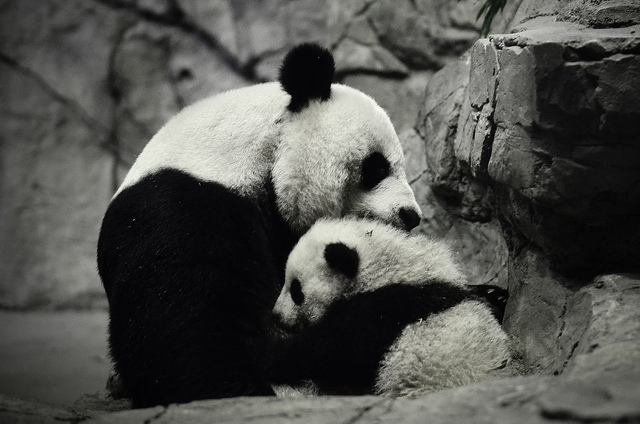
Photo by PoPville flickr user angela n.
@NationalZoo tweets the exciting possibility:
“Mei Xiang’s hormones are rising! She’ll have a cub or her pseudopregnancy will end in 30-50 days.”
More from an email:
“Smithsonian Conservation Biology Institute scientists have confirmed a secondary rise in giant panda Mei Xiang’s urinary progesterone levels. The slow rise started July 20 and indicates that she will either have a cub or experience the end of a pseudopregnancy within 30 to 50 days.
Scientists have been carefully tracking Mei Xiang’s hormone levels since she was artificially inseminated April 26 and 27. The inseminations used frozen sperm collected from Hui Hui, a panda living in China, and fresh sperm collected from the National Zoo’s Tian Tian.
Our panda team has been monitoring Mei Xiang very closely since the procedures. Vets will continue regular ultrasounds as Mei Xiang chooses to participate in them. They are monitoring changes in her reproductive tract and evaluating for evidence of a fetus. The only way to definitively determine if a giant panda is pregnant is to detect a fetus on an ultrasound. Scientists will also continue to monitor her hormone levels through daily analyses. Don’t forget to follow @smithsonianzoo on Instagram for behind-the-scenes photos and videos with the hashtags #PandaStory and #InstaScience.
A female’s behavior and hormones mimic a pregnancy even if she is experiencing a pseudopregnancy. Giant panda fetuses do not start developing until the final weeks of gestation, making it difficult to determine if there is a pregnancy. It may still be too early to detect a fetus on an ultrasound.
Mei Xiang has begun exhibiting behaviors consistent with a rise in urinary progesterone. She is nest building, choosing to spend more time in her den, sleeping more and eating less.”

Photo by PoPville flickr user Istvan Kerekes
Years ago we had a debate about the Red Pandas vs the Giant Pandas. So let’s just take all the pandas out of this debate – besides them what’s your favorite animal at the National Zoo?
I’m voting for the Orangutangs when they are using the sky bridge – or the giant fish in the amazon exhibit. And I do love the poison frogs, pictured here, in the Amazonia exhibit too.

“Tickets are on sale now for the National Zoo’s 11th annual Brew at the Zoo, held on Thursday, July 23, 2015 from 6 to 9 p.m. The event, hosted by Friends of the National Zoo (FONZ), will feature more than 70 craft beers on tap for the beer tasting extravaganza, all in support of wildlife conservation. Local favorites such as Port City Brewing Company and Atlas Brew Works will be joined by popular microbreweries including DC Brau Brewing Company, Flying Dog Brewery, and BadWolf Brewing Company.
In addition to sampling great hops, guests will be able to purchase food from local favorites including Ledo’s Pizza, and popular food trucks. Guests will be able to mingle with new and old friends while playing lawn games and enjoying live music by Bachelor Boys Band. (more…)

Photo by PoPville flickr user Eric P.
From the Smithsonian National Zoo yesterday afternoon:
“Mei Xiang had her first ultrasound this morning. Vets weren’t looking for a fetus at this early stage, they’re tracking changes in Mei’s reproductive tract and getting her comfortable having her belly touched.
Pandas experience something called a diapause, meaning that even if a female is pregnant the embryo doesn’t actually implant into the uterine wall (and start developing) until 17 to 20 days before she gives birth. The panda team will continue to perform ultrasounds—the only definitive way to tell if a panda is pregnant—throughout the summer as Mei chooses to participate. Today, Mei wasn’t very interested in participating in the ultrasound. After lying down in the training chute she sat up before vets had a good look at her uterus. They shifted Mei to her den where she could stand up. But again, after a few minutes, she decided to stop participating.
Our vets perform ultrasounds because female pandas’ hormones and behavior mimic a pregnancy even if they are not pregnant.”