The youtube description says:
“Movie of the 82 Streetcar Line running from Eckington in DC, through Woodridge, Mount Rainier, Brentwood, North Brentwood, Hyattsville, Riverdale Park, College Park and terminating in Branchville.”


The youtube description says:
“Movie of the 82 Streetcar Line running from Eckington in DC, through Woodridge, Mount Rainier, Brentwood, North Brentwood, Hyattsville, Riverdale Park, College Park and terminating in Branchville.”
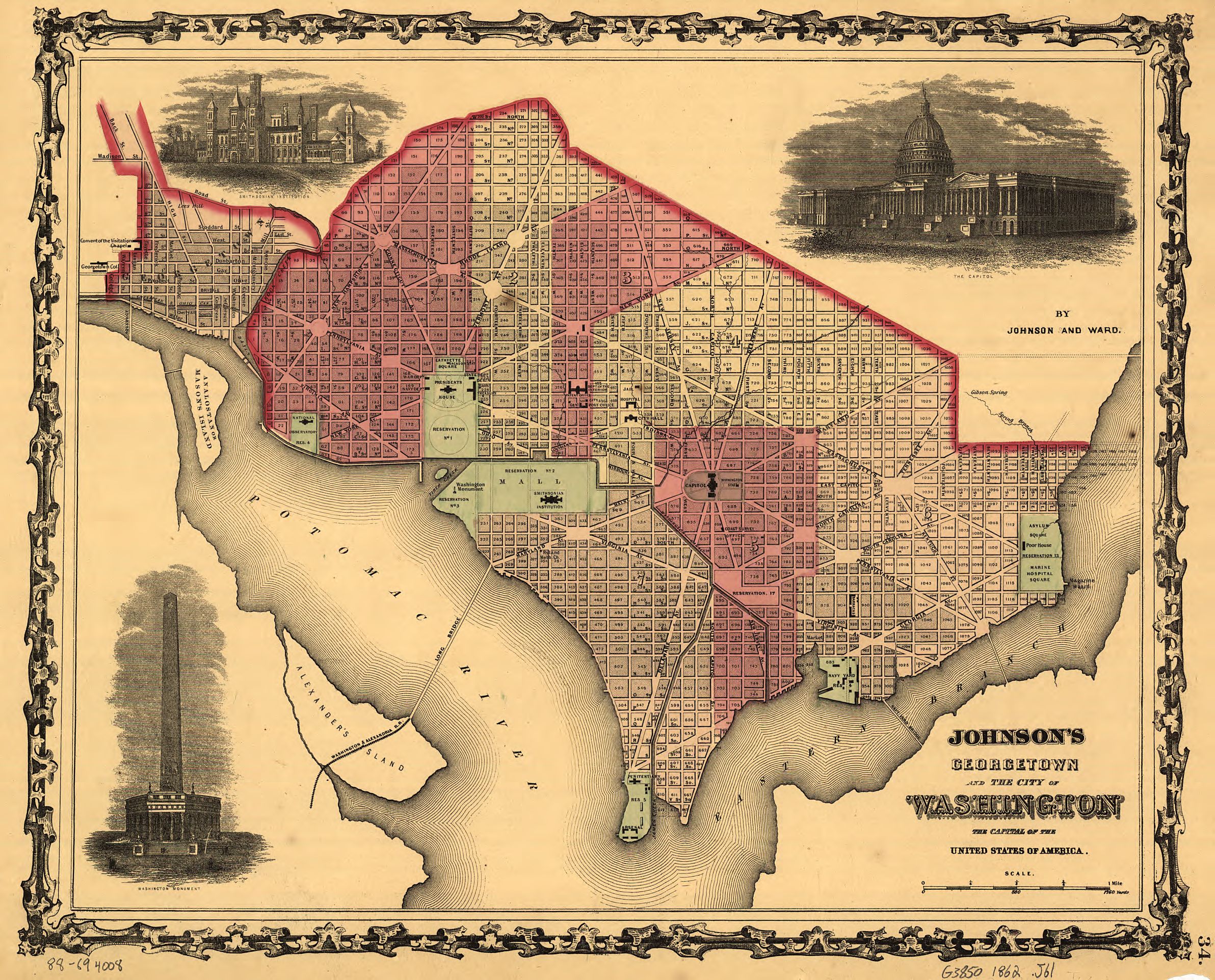
Click to enlarge. Source: Library of Congress
Map of the Week is a new feature by David A., a systems librarian and map geek living in Mt. Pleasant.
Title: Johnson’s Georgetown and the city of Washington : the capital of the United States of America
This 1862 map of Washington, DC and Georgetown was published in the midst of the Civil War. At this point in DC’s history, the Washington Canal ran down present-day Constitution Avenue, Washington Avenue and 2nd Street SE. Interesting features include various creeks running through the city and Georgetown’s original street names. Georgetown was bounded on its north edge by Road Street (present-day R Street). It remained a city independent from Washington until 1871, when the streets were renamed to conform with Washington’s lettered streets.

2009
We already noted the amazing transformation of the former ‘slum historique’ building at 9th and Q St, NW but I had to share one more old photo I found (above.)

2013

6625 Georgia Avenue, NW
I’ve driven past this sight probably 100 times. I finally walked past and was able to check out this incredible history.
From Wikipedia on the Battle of Fort Stevens:
The Battle of Fort Stevens was an American Civil War battle fought July 11–12, 1864, in Northwest Washington, D.C., as part of the Valley Campaigns of 1864 between forces under Confederate Lt. Gen. Jubal A. Early and Union Maj. Gen. Alexander McD. McCook. Although Early caused consternation in the Union government, reinforcements under Maj. Gen. Horatio G. Wright and the strong defenses of Fort Stevens minimized the military threat and Early withdrew after two days of skirmishing without attempting any serious assaults. The battle is noted for the personal presence of President Abraham Lincoln observing the fighting.
From Wikipedia on the Battleground National Cemetery:
After the battle, Quartermaster General Montgomery Meigs seized 1 acre (0.40 ha) of farm land to use for burying the dead. Under direction from President Abraham Lincoln and Meigs, forty were buried on the evening of July 12 on the battlefield site. That night, Lincoln came to the site to dedicate it as the Battleground National Cemetery.

Continues after the jump. (more…)
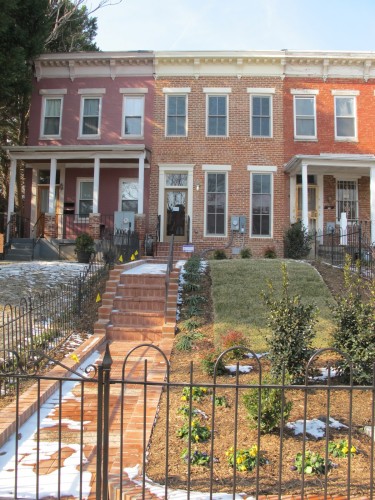
13th St, NW just south of Florida Ave.
If anyone has a photo of an area/building/lot that has changed please send me an email at princeofpetworth(at)gmail with ‘Remember When?’ in the subject line. Thanks!
In the summer of 2011 I noticed some permits for the long abandoned shell on the 13th Street just south of Florida Ave, NW. Turned out pretty nice. Remember when it looked like this:
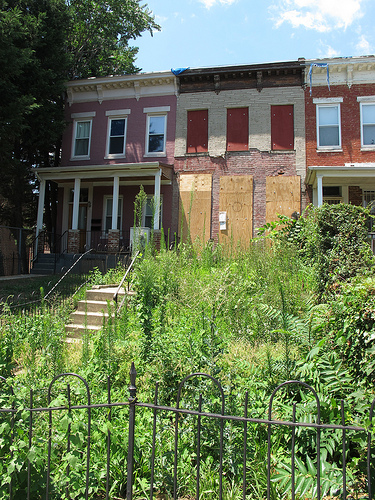
2011
@DCRA tweets this incredible video footage:
“Today’s the 91st anniversary of the roof collapse of the Knickerbocker Theater in Adams Morgan; 98 people were killed.”

I love stumbling upon random bits of history.

And it’s now the embassy of Myanmar.


Photo by Elizabeth McIntire
If anyone has a photo of an area/building/lot that has changed please send me an email at princeofpetworth(at)gmail with ‘Remember When?’ in the subject line. Thanks!
Thanks to Elizabeth for sending the above shot of the future DC USA in 2005. It’s the west side of 14th Street, NW with the former Woolworth’s in the background.

DC USA 2013
Streets of Washington, written by John DeFerrari, covers some of DC’s most interesting buildings and history. John is also the author of Lost Washington DC.
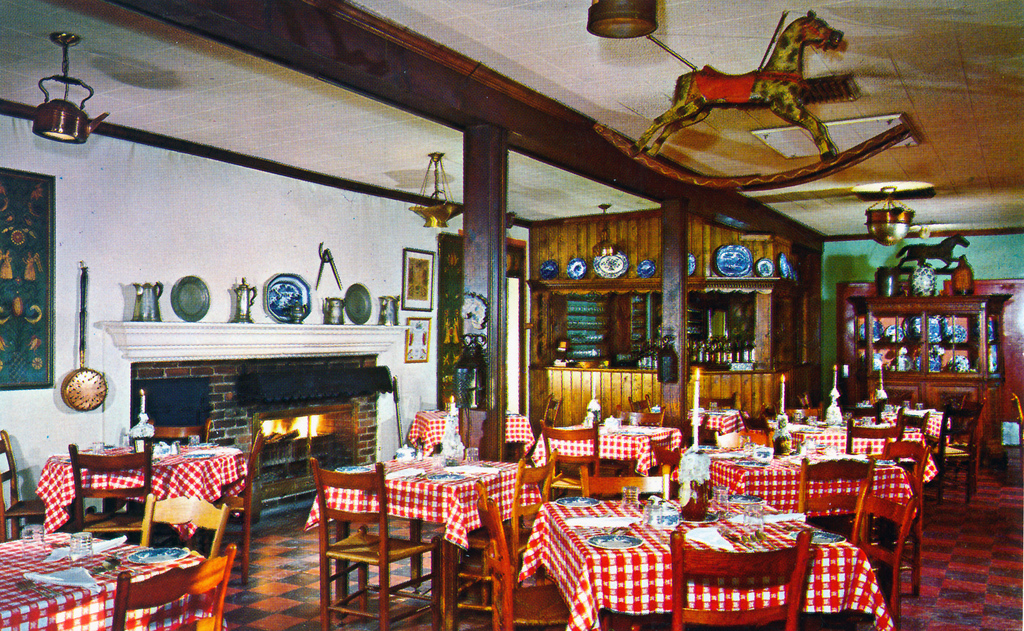
Interior of the Water Gate Inn (author’s collection).
One of the most distinctive restaurateurs of 20th century Washington was Marjory Hendricks (1896-1978), owner of the Water Gate Inn, which she operated from 1942 to 1966 on the current site of the John F. Kennedy Center for the Performing Arts. Like all great restaurateurs, Hendricks knew how to keep her guests charmed and entertained, and her Pennsylvania Dutch-inspired eatery was unique in Washington history.
Born in Seattle, Hendricks came to the D.C. area with her family in 1918. After a brief first marriage and early restaurant experience in Reno, Nevada, Hendricks traveled to France in 1929 to study cooking. On her return in 1931, she acquired a failing country club in Rockville, Maryland, which she turned into the Normandy Farm restaurant, a rustic inn of the type that were very popular in the era. The restaurant remains in business today, its name spelled slightly differently.
Eleanor Roosevelt was among the Washingtonians who discovered Normandy Farm, and she is said to have encouraged Hendricks to open a “branch” restaurant in D.C. In 1941 Hendricks bought the former Riverside Riding Academy at 2700 F Street NW as the site for her new in-town eatery. The location was something of a gamble: the Foggy Bottom neighborhood was a semi-industrial backwater at the time. Some even called it a slum. It was far away from most of the city’s established nightlife, although across the street stood another former riding facility that had been turned into a supper club, The Stables. Nevertheless, with the tremendous influx of newcomers to the city at the beginning of World War II, existing restaurant facilities—particularly for large groups—were inadequate, and a talented restaurateur like Hendricks was in high demand wherever she might choose to set up shop. Wartime materials shortages kept her from opening the new place until August 1942, after which it soon became a hit with local diners.
Continues after the jump. (more…)

Photo of ’14th and U St, NW 1988′ by Michael Horsley
Ed. Note the photographer featured in the article, Michael Horsley, has an incredible archive of DC photos from back in the day.
Thanks to all who sent links for Washington’s Economic Boom, Financed by You:
Washington wasn’t always the place where young professionals plunked down $3,000 a month to announce their arrival. When Abdo founded his business, in 1996, the United States was enjoying around 4 percent economic growth, but in Washington, dysfunction and Mayor Marion Barry Jr. reigned. The city government was locked in a mismanagement-driven fiscal crisis: traffic lights were malfunctioning; garbage trucks stopped picking up trash; District residents were advised to boil their own water; President Clinton and Congress placed the city into federal receivership.
During our drive, Abdo narrated this revival with such intensity that he took a few wrong turns, despite the fact that downtown is just a grid dotted with traffic circles. Near the George Washington University campus, he pointed out a cheap hotel that he plans to turn into a pod hotel. Over by H Street, a neighborhood just a few years ago virtually untouched by gentrification, he pointed out a former convent that he converted into apartments. Abdo announced that he helped develop “thousands” of such tasteful, expensive though not outrageously priced units during the past decade and a half, for “people of substance,” he said, “people who want to participate in this city.”
How Washington managed this transformation, however, is not a story that the rest of the country might want to hear, because we largely financed it.
Read the full story here.