Remembering Officer Sean Collier, 26

Remembering Officer Sean Collier, 26

Click map to enlarge. Source: Library of Congress
Map of the Week is written by David A., a systems librarian and map geek living in Mt. Pleasant. David previously wrote about Development of the area west and east of the Capitol – 1941.
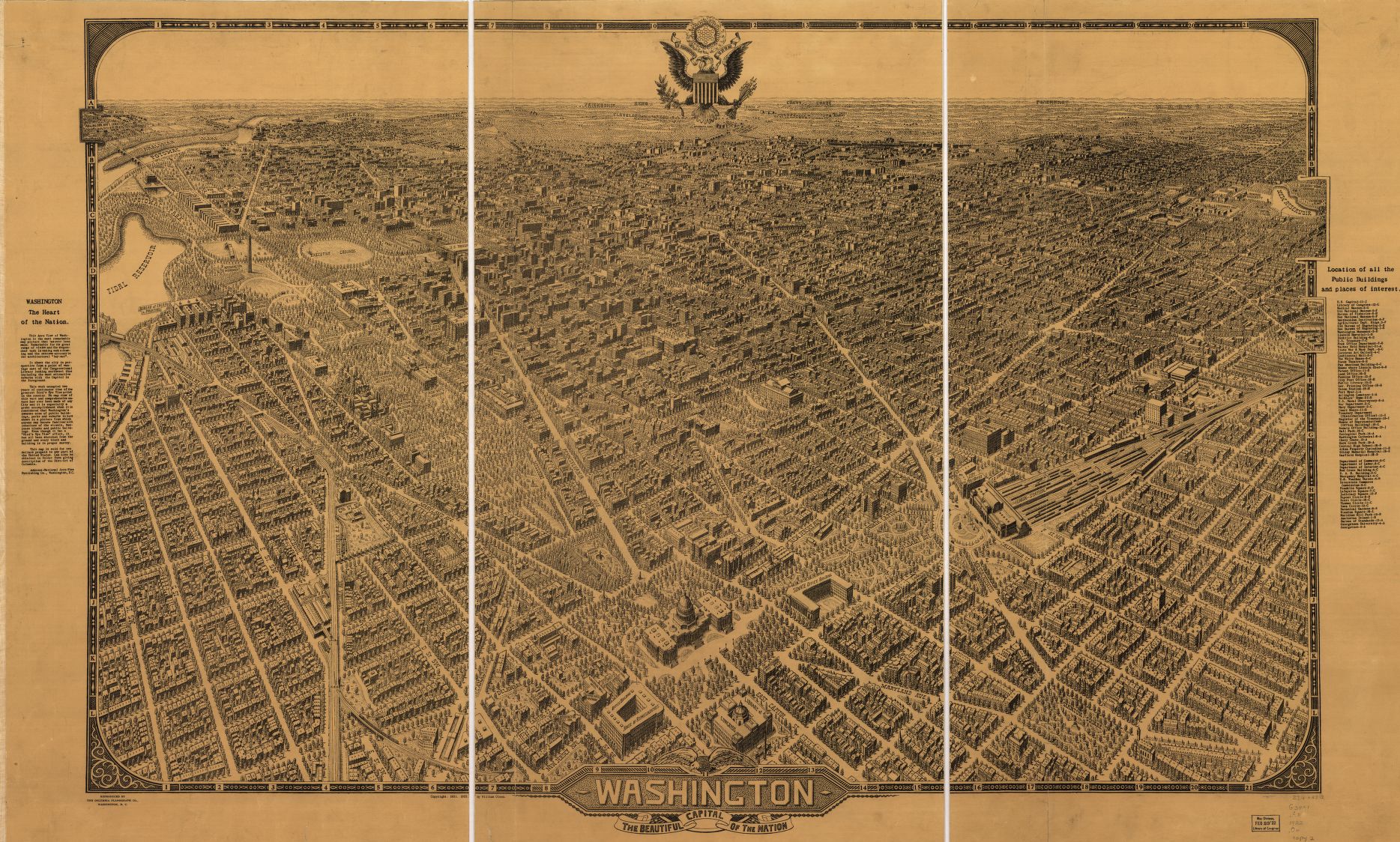
This bird’s eye view drawing of Washington, DC from 1922 was among the most detailed city drawings of its kind when it was created, according to the publisher’s hyperbolic caption:
“This Aero View of Washington is the most remarkable map picture that has ever been made. Remarkable for its great range of vision and the stupendous task in making such a drawing and the extreme accuracy in the architectural ‘lay-out’.”
Zoom in to see some of the really impressive details that took two years for the artist to draw. Many of the buildings have labels describing them. Two monolithic buildings housing the War Department and Navy Department occupied the land south of Constitution Avenue and east of the Lincoln Memorial. Another notable difference between this map and that of the present day is the large number of trees on the Mall and surrounding it. It’s hard to say whether these trees stood exactly where the artist put them or whether they were artistic flourishes to fill space. A few of the buildings around the Mall have also changed hands or disappeared since 1922 (Bureau of Fisheries, Center Market, Medical Museum). See if you can spot the Piggly Wiggly building in present-day NoMa.

Thanks to a reader for sending:
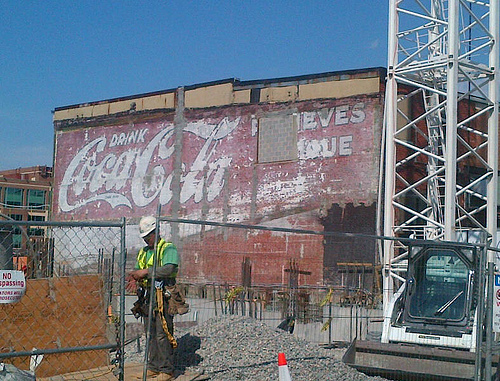
Last week I snapped this picture of a painted wall that had been revealed by demolition on the eastbound side of the unit block of New York Ave NE (the picture was taken from N St.) The sign is billboard sized and painted on the side of a building. The wall must have been covered by the construction of the building that was recently torn down and thus preserved from weather. It was not uncommon for advertisements to be painted on the sides of building, but most have long-ago worn away. After a little research I found that Coca-Cola use the slogan “Relieves Fatigue” between 1906-10. Cool huh? Check it out before the new building covers it up for another century.
Super cool!

2440 18th Street, NW
From the owner:
Before it was Adams Morgan, the 18th St and Columbia Road NW area was home for many well-known clubs including the famous Showboat, where top entertainment performed. Many well known businesses got their start on 18th street : The first Toys R Us, the first Peoples Drug and Dart Drug Stores and Gartenhaus Furs.
Al Shapiro spent much of his time in the neighborhood and was a regular at one of the local 18th restaurants called Ballance’s Columbian Restaurant, nicknamed Bobbies. Once he learned his favorite restaurant was for sale, he jumped on it, and renamed it Millie and Al’s. Millie was Al’s girlfriend who bartended and had a great steady following.
In 60’s patrons could fill the bar from 8:30 am til the wee hours bringing a new meaning to the word, Regulars. Many sat at the bar the same time everyday and the only way they gave up their permanent bar stool was after passing away.
In the early days of Millie and Al’s, a group from the neighborhood car dealership came in everyday after work and sat at the same booth. The manager, who was part of this group died and as a Memorial gesture they brought the horse picture from his office in and placed it above their booth in his honor. Soon after the managers death, a new manager was assigned the position in the same office. He learned of the picture being moved from the office and went to Al to request that the picture be returned. There was no doing by Al, the boys brought it in honor of their friend, who died, and it would remain there . This picture still remains in the same place and has never been damaged or tampered with.
Al existed through so many neighborhood transitions, including some really bad times. Not many would have endured these changes and stayed. This area once had the nickname “Little Harlem”. You could not walk the sidewalks as a pedestrian without fear. Not long after the riots a little Havana was born with crime to match. These were ruff gangsters that could drink until they were blinded. If it was last call and the bar was closing, Al would describe these guys not wanting to leave a drop of beer, so they would chug the remains until it would seem to come out of their ears.
Al was not a very tall or bulky man, but many watched him literally jump up to hit or throw one of these gangster or punks out. They did not resist, whether it was respect or fear, but Al won. He never really boasted in this victory; it was Al defending his turf.
There were riots, gangsters, thugs, and then suddenly there were Yuppies. All the bad` paid off for the good times in Adams Morgan. Soon to explode to an area not duplicated or matched, diversity all the way.
As the neighborhood progressed less violence was occurring and the various cultures were uniting, thus Adams Morgan Day was born. A yearly event that has continued for over 35 years.
2013 marks the 50th year for Millie and Als, a true landmark to Adams Morgan.
The arrival of Yuppie era started a wave of restaurants, bars, and businesses to open so rapid that a Moratorium to new liquor licenses started. Millie and Al’s once a lone bar in a neighborhood with few other businesses was now surrounded by bars, restaurants and clubs. Competition or not, MA maintained its business and it increased its loyal Regulars.
The crowds grew as well as the bathroom lines. More and more couples hooked up and many getting married. There is a large unknown amount of couples that owe their partnership to MA’s: A traveling couple in China bumped into another couple wearing a MA t-shirt and reminisced over meeting at MA.
A young couple on a motorcycle stopped to help a woman with a flat tire on a hot summer day in Minneapolis. Conversation revealed that the couple met at MA and were visiting Minneapolis to announce their engagement to their parents and the misfortunate woman with flat was best friends with the owner of MA.
A couple visiting opening day at a new restaurant were introduced to the owners when they realized they all met at MA’s. Chances are someone you know met their spouse or partner at MA’s, as one of their t-shirts quotes “I met Your Mother at Millie & Al’s”.

Millie and Al’s in the early 70s courtesy of owner Barbara Shapiro
Click map to enlarge. Source: Library of Congress
Map of the Week is written by David A., a systems librarian and map geek living in Mt. Pleasant. David previously wrote about Rand, McNally & Co.’s D.C. in 1903.
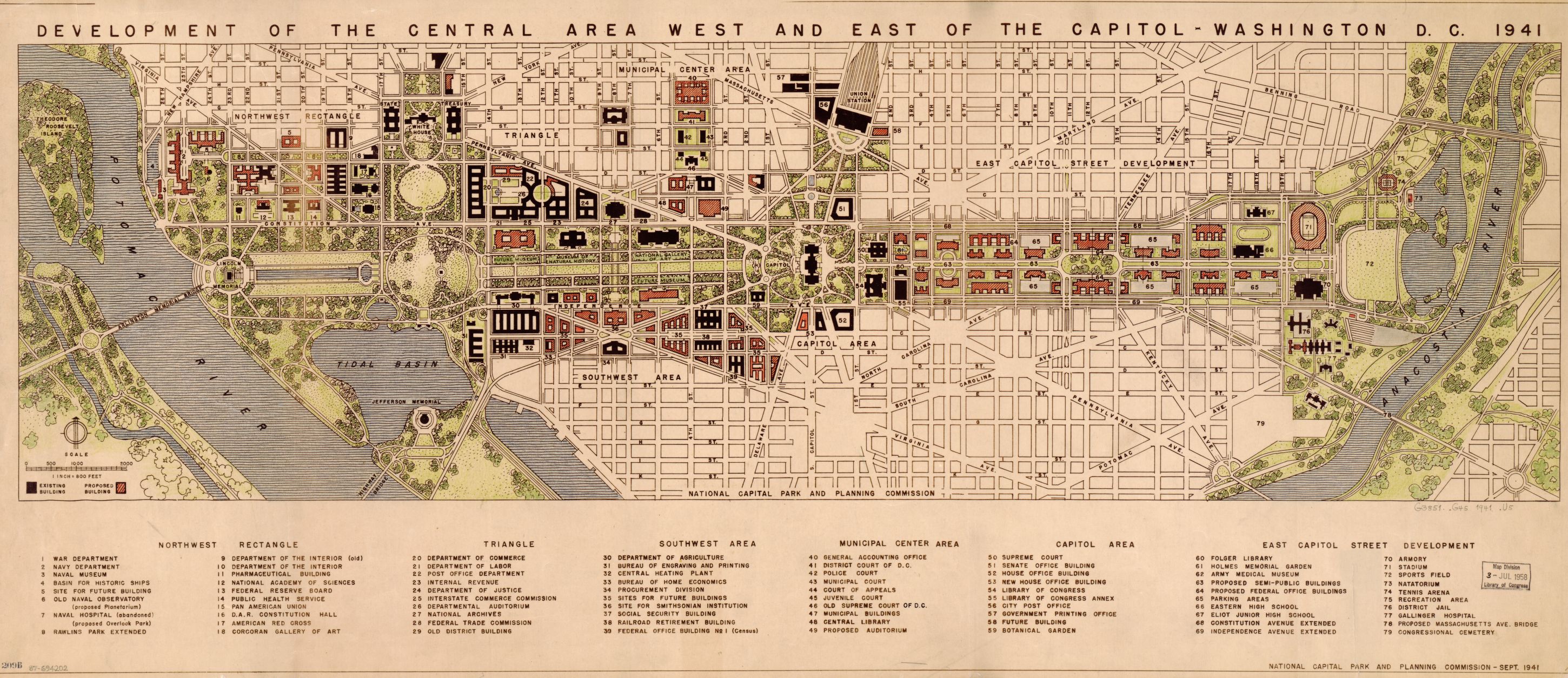
Title: Development of the central area west and east of the Capitol–Washington D.C. 1941
What if the National Mall extended all the way to the Anacostia River? This 1941 plan from the National Capital Park and Planning Commission called for the mall to bisect the city along its east/west axis from the Lincoln Memorial to present-day RFK Stadium. The plan would have involved the razing of a huge swath of residential row houses east of the Capitol in favor of federal office buildings, “semi-public buildings,” parking lots and broad avenues.
Other highlights include a basin for historic ships at the site of the Kennedy Center, a Massachusetts Avenue bridge over the Anacostia, and a sports complex next to Kingman Lake that included a tennis arena, natatorium and baseball fields.
Click map to enlarge. Source: David Rumsey Map Collection
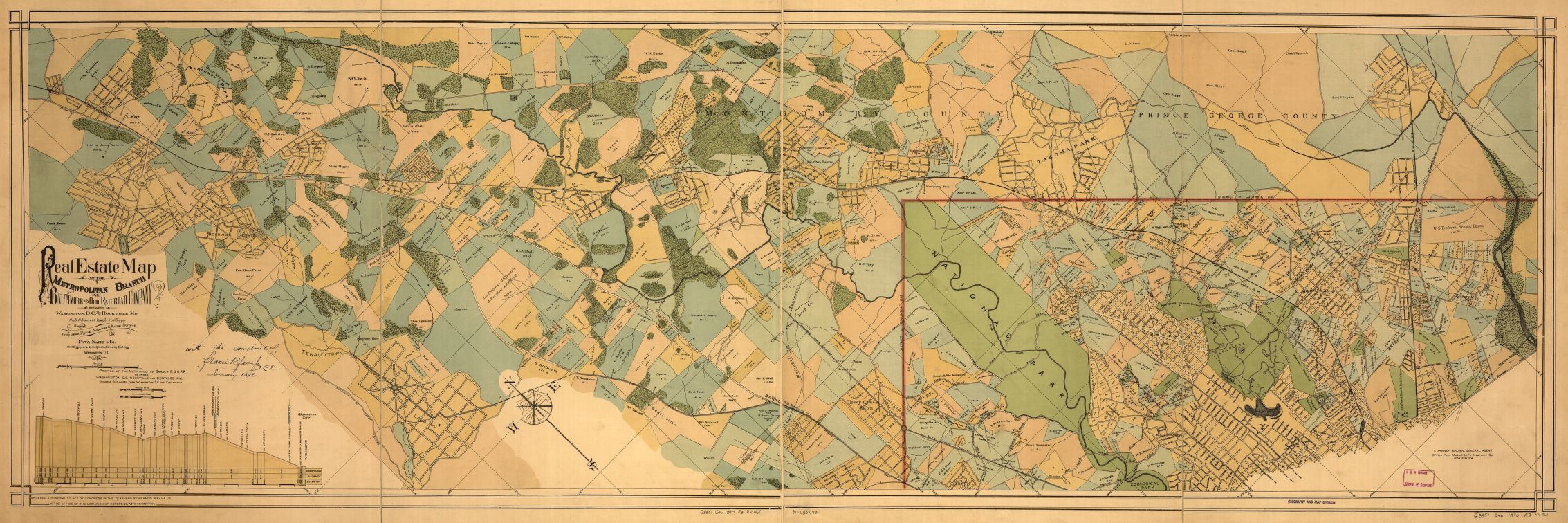
Map of the Week is written by David A., a systems librarian and map geek living in Mt. Pleasant. David previously wrote about the 1890 Real estate map of the B&O Railroad Company between DC and Rockville.
This week’s map comes from a 1903 Rand McNally atlas. By 1903, the city begins to look very familiar, though many of today’s roads do not yet appear. Rhode Island and New York Avenues stop far short of the DC border, though Rhode Island’s proposed extension appears. Notable points of interest include the Ivy City Race Track, Lover’s Lane and Analostan Island. The race track was part of the old National Fair Grounds, and it was one of many tracks built in DC in the 19th century. Lover’s Lane still bisects Dumbarton Oaks and Montrose Park north of Georgetown, and you can find it on Google Maps. Analostan Island would later be renamed for Theodore Roosevelt, the sitting president at the time of this map’s publication.

Click map to enlarge. Source: Library of Congress
Map of the Week is written by David A., a systems librarian and map geek living in Mt. Pleasant. David previously wrote about City of Washington in 1792.
Title: Real estate map of the Metropolitan Branch of the Baltimore and Ohio Railroad Company between Washington, D.C., and Rockville, Md.
This week’s 1890 map of the Metropolitan Branch of the B&O Railroad has some great detail north of the original city limits. The Metropolitan Branch of the B&O Railroad connected DC with the B&O main line in Point of Rocks, MD. Highlights include names of property owners, locations of parks, railroads and the skeletal outlines of several Maryland towns including Takoma Park, Silver Spring, Bethesda and Rockville. The Metropolitan Branch made stops in DC at New York Avenue, University (presumably Catholic University), Terra Cotta (near Ft. Totten), Lamond and Takoma.
You can see a much larger version of the map here.

2007
Kinda like our now and then series, “Only ____ Years Ago” will feature photos from my archives that have changed drastically from a particular year. We will start with a bunch of changes from 2007. Let’s kick it off with 14th and T St, NW. Anyone remember McKey’s Antiques?

2013

Photo by PoPville flickr user lmno.p
2009 Above
2013 Below
If you have any cool ‘now and then’ photos please send an email to princeofpetworth(at)gmail


Streets of Washington, written by John DeFerrari, covers some of DC’s most interesting buildings and history. John is also the author of Lost Washington DC.
Washington has one of the highest concentrations of apartment dwellers among American cities, and fortunately many of its historic apartment houses from the early decades of the 20th century have survived. Among these, the Northumberland, opened in 1910 at 2039 New Hampshire Avenue NW, is one of the best preserved. Thanks in part to its very early conversion (1920) to cooperative ownership, the building has benefited over the years from the meticulous care and attention of farsighted owners and remains a jewel-like oasis of turn-of-the-century urban living.
![]()
The Northumberland (photo by the author).
The Northumberland was one of many projects undertaken by the relentlessly energetic Harry Wardman (1872-1938) in the early years of his career when he was building row after row of houses in Mount Pleasant and Columbia Heights and just starting to construct towering apartment houses. “In apartment building the most expensive structures in the city are the work of Mr. Wardman,” the Washington Times noted in 1911, soon after the Northumberland was completed. Wardman was a developer’s developer, putting up the most desirable buildings possible at the least possible cost and then quickly moving on. “His money is always active and he is always borrowing,” the Times explained. “He always takes profits and goes at something new.”
Continues after the jump (more…)