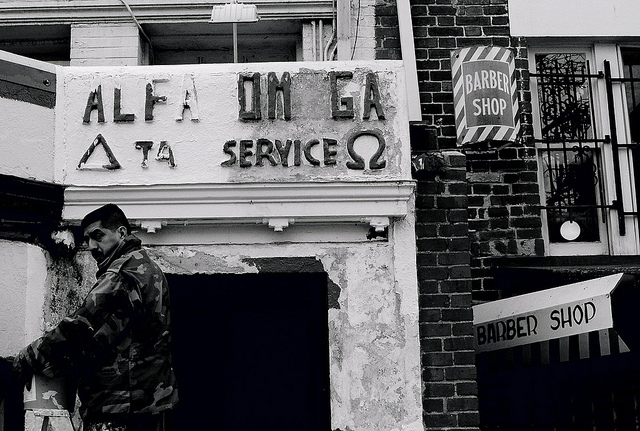
Photo by PoPville flickr user brunofish
From DC Office of Tax and Revenue:
“Property owners who believe their proposed 2015 assessment does not reflect the market value, can appeal by Apr 1:


Photo by PoPville flickr user brunofish
From DC Office of Tax and Revenue:
“Property owners who believe their proposed 2015 assessment does not reflect the market value, can appeal by Apr 1:
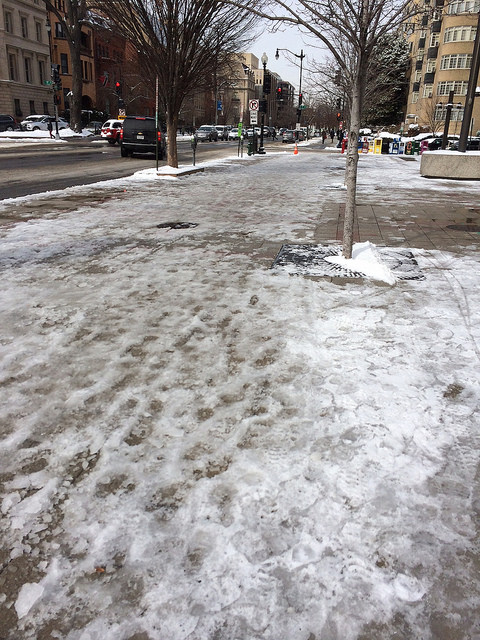
“Dear PoPville,
The sidewalk this morning was terrible outside the Airline Association… And why not wait for the sun to melt it? You won’t get a ticket, as evident by the tweet by 311….More than annoying, this is dangerous.”
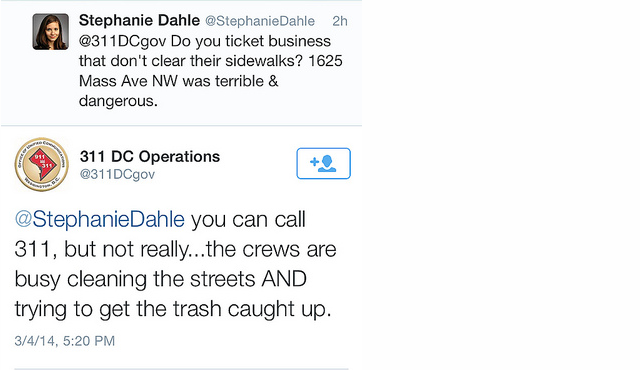
WUSA9 reports:
“The Winter Sidewalk Safety Amendment Act would enable the District to impose a $25 fine on residential property owners and a $125 on commercial property owners.
Under current law, property owners are required to remove snow from sidewalks adjoining their property within 8 daylight hours following a snowstorm, but the enforcement process is impractical, according to a news release from Cheh’s office.”
Ed. Note: I do have to give props to DCFD who cleared a sidewalk in Columbia Heights after a resident tweeted about the danger.
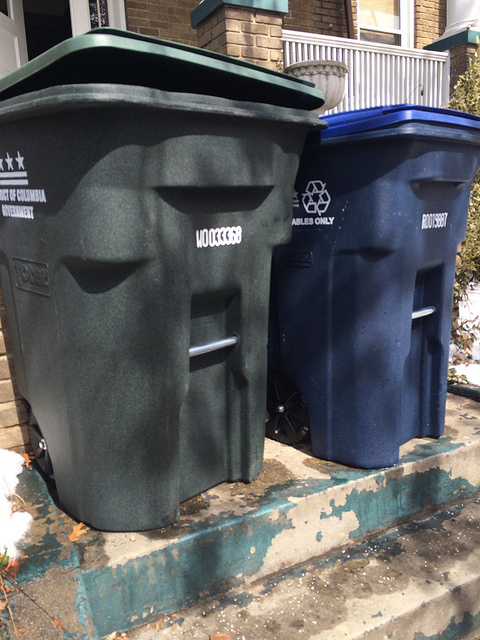
The bigger supercans are starting to arrive. Thanks to a reader for sending this one from Mt. Pleasant. Unfortunately:
“Delivered to the front of the house even though our trash pickup is in the alley and the new super can won’t fit out my back door!”

Photo by PoPville flickr user Joe in DC
From a press release:
“Legislation to decriminalize marijuana, introduced and stewarded by Councilmember Tommy Wells, passed a final vote in the District Council, ten to one.
“This is a victory for social justice and a major step for the nation’s capital,” said Councilmember Wells. “This bill is a tremendous stride to end the disproportionate impact of marijuana arrests that keep our residents from jobs, higher education and housing opportunities. The evidence of racial disparities in arrests and the failures of the war on drugs are undeniable and the negative socioeconomic impacts on African American residents are indisputable.”
According to a 2013 report by the American Civil Liberties Union, the District of Columbia leads the United States in marijuana arrests. DC police made 846 such arrests per 100,000 residents in 2010. Nationally that number was 256 per 100,000.
According to another recent report, written by the Washington Lawyers Committee, 91% of all drug arrests in DC were of African Americans. In 2010 there were 40,353 arrests of African American adults; a number equivalent to 17% of the African American adult population of the District.
A copy of the bill is available here.
What the bill does:
· Drops the possession of an ounce or less of marijuana from a criminal offense, which carries up to six months in jail and a $1,000 fine, down to a civil offense with a fine of $25.
· Establishes a maximum penalty for smoking marijuana in public of 60 days in jail and a $500 fine. Previously the penalty for smoking marijuana in public carried up to six months in jail and a $1,000 fine.
· Protects individuals from being subject to detainment, frisking, searching, and arrest based solely on the possession of one ounce or less of marijuana or based on the smell of marijuana alone.
· The production, sale, and possession of over an ounce remain criminal offenses.
· The bill does not change existing laws related to driving under the influence.”
And from Rep. Norton:
“Congresswoman Eleanor Holmes Norton (D-DC) made the following statement on the District of Columbia Council’s passage today of a marijuana decriminalization bill.
“In a country where many states are permitting medical marijuana, or have decriminalized or legalized marijuana, I do not expect Members of Congress to interfere with D.C.’s local right to pass its own law on marijuana decriminalization. If Members try to interfere, however, I will stoutly defend D.C.’s right to pass such legislation, just as 17 states have already done.”

Photo by PoPville flickr user rfarwell5
From the Mayor’s Office:
“Today, Mayor Vincent C. Gray signed landmark infrastructure legislation into law creating a unique public-private partnership to bury overhead primary power lines to dramatically improve electric service reliability. The new law is the culmination of the work of the Mayor’s Power Line Undergrounding Task Force, established after a series of severe weather events in 2012 caused widespread outages and left extensive wind damage across the region. The D.C. City unanimously passed the legislation last month.
“After the 2012 storms, I promised a game-changer – and today we deliver,” said Mayor Gray. “The new law codifies the recommendations of my Task Force, spells out how this $1 billion infrastructure effort will be financed, and will lead to the improved electric-grid reliability we need. I thank the Council for their quick consideration and vote. I especially want to thank the citizen members of the task force, who made clear that we must act as expeditiously as possible. I’m proud to say that the message was heard loud and clear, and we responded.”
The law authorizes the issuance of revenue bonds for the first phase of the 7-to-10-year project, which focuses on the 60 most vulnerable overhead distribution lines. The law authorizes the District Department of Transportation (DDOT) to construct the necessary underground facilities to be used by Pepco, a subsidiary of Pepco Holdings Inc. (PHI), for the improvements. Through this innovative public-private partnership, every effort will be made to hire District residents and use local businesses.
The Task Force pooled the collective resources available in the District to produce an analysis of the technical feasibility, infrastructure options and reliability implications of undergrounding overhead distribution facilities. The 18-member task force — co-chaired by City Administrator Allen Y. Lew and PHI Chairman, President and Chief Executive Officer Joseph M. Rigby — included representatives from the D.C. Council, the Public Service Commission (PSC), the Office of the People’s Counsel, utilities, community representatives, experts and other stakeholders.
“We are meeting and even exceeding service reliability standards in the District. But this is a critical step beyond that to meet our customers’ expectations for reliable service with severe weather as the new normal,” said PHI’s Rigby. “Everyone in the District will benefit from these system improvements because it will mean better reliability overall.”
In its role on the task force, Pepco prepared a comprehensive evaluation of costs and benefits from undergrounding each overhead line in the District. That information will guide undergrounding priorities. Pepco and DDOT will develop a project plan and submit it to the PSC for review and approval. No work will be performed until the PSC has the opportunity to review the selection criteria and receive public comments on the plan.
For residential customers, the rate impact will start at about $1.50 per month and will increase to a maximum of $3.25 after seven years, or about a 3.23 percent increase in rates. Low-income customers will be exempt from the rate impact. For commercial customers, the rate impact will vary by the class of service and will generally average between 5 and 9.25 percent.
“This historic law is another important commitment by Mayor Gray to improve the District’s infrastructure,” said City Administrator Lew. “From improving the electric grid across the District, to resolving flooding issues in Mid-City neighborhoods, this Mayor has committed billions to improve long-standing infrastructure problems. I look forward to working closely with Pepco and DDOT to get the undergrounding project started as quickly as possible.”
The areas identified will include the high-voltage feeders most affected by overhead-related outages in Wards 3, 4, 5, 7 and 8. About half of the District is already served by underground lines. Secondary and service lines will still run overhead on the existing poles. Typically, these lines are a small factor in outage events. Historically, outages on these circuits are not prolonged. Restoration time for these low-voltage lines normally is much shorter than restoring the high-voltage primary lines, which can require several hours for repair.
To see the full recommendations of the Power Line Undergrounding Task Force and to track future developments for the program, go to the Office of the City Administrator website.”
From a press release:
“Today, the District of Columbia advanced the rights of the city’s transgender community by prohibiting discrimination in health insurance based on gender identity and expression. Mayor Vincent C. Gray announced the Department of Insurance, Securities, and Banking (DISB) is issuing a bulletin to District health insurance companies addressing the application of anti-discrimination provisions in the insurance code, including recognizing gender dysphoria, or gender identity disorder, as a recognized medical condition.
“Last March, the District began the process of removing exclusions in health insurance on the basis of gender identity or expression. Through the hard work of my Office of GLBT Affairs and a multi-agency working group lead by my Chief of Staff, Chris Murphy, we have today taken the necessary steps to completely eliminate these exclusions,” said Mayor Gray. “Today, the District takes a major step towards leveling the playing field for individuals diagnosed with gender dysphoria. These residents should not have to pay exorbitant out-of-pocket expenses for medically necessary treatment when those without gender dysphoria do not. Today’s actions bring us closer to being One City that values and protects the health of all of our residents.”
This action follows DISB’s March 15, 2013 bulletin notifying health insurers to remove language that discriminated on the basis of gender identity and expression from their policies and permit those with gender dysphoria to obtain medically necessary benefits. Today’s action goes one step further in protecting this community’s health insurance rights by affirming that gender dysphoria is a recognized medical condition and thereby treatment, including gender reassignment surgeries, is a covered benefit. To view the full bulletin, click here: http://disb.dc.gov/
“This action places the District at the forefront of advancing the rights of transgender individuals,” Mayor Gray said. “It also fully implements the District’s Human Rights Act by incorporating gender identity and expression as protected classes in the District’s health insurance laws.” (more…)

Thanks to @justinfeldstein for tweeting us:
“an everyday occurrence.”

“a $30 ticket can be issued for violating the restriction.”
From a press release:
“Today, DC Councilmember Tommy Wells, Chairman of the Committee on the Judiciary and Public Safety, issued a letter to Mayor Vincent Gray calling for the resignation of the Deputy Mayor for Public Safety and Chief of the Fire and Emergency Medical Services Department. Councilmember Wells released the following statement in regards to the letter:
Yesterday I chaired an oversight hearing to give the Gray administration a chance to explain what happened in the Cecil Mills case—in which five firefighters failed to respond to a personal plea for help at the firehouse door. Specifically, I wanted to hear the Mayor’s plan to fix the situation so it will never happen again. The administration’s response was deficient and disappointing. Our city deserves better.
In fact, there is no plan—or even apparent capacity—to rectify the failings of the DC Fire and Emergency Medical Services (EMS) Department and restore public confidence in reliable emergency response. Therefore I am calling on Mayor Gray to immediately ask for the resignations of the Deputy Mayor for Public Safety and the Chief of the DC Fire/EMS Department.
I was stunned to learn that the Mayor’s representatives had no plan to respond to the Mills case beyond disciplining the firefighters who failed to assist Mr. Mills, who suffered a heart attack across the street from their firehouse. The only additional corrective action was to issue a memorandum reminding firefighters to “follow the rules.”
But my response is not based on a single incident. There is systemic mismanagement throughout the department that was evident even before I became chair of the council committee with oversight of public safety one year ago. The department has a consistent record of failure. The shortcomings evident in the most visible and horrifying incidents—in which citizens like Mr. Mills have lost their lives—are just the tip of the iceberg.
From burning ambulances, uncertified fire trucks, and no procurement plan to adequately equip our fire and emergency personnel, to a shortage of paramedics, delayed response to emergencies, and poor training and management, this department has enormous and urgent challenges to overcome. Yet the administration has no coherent plan to improve the department’s performance.
Blaming racial divisions, union membership, or other perceived motivations for the department’s dysfunction must end. It is a disgrace to place responsibility on the rank and file employees who put their lives on the line for DC citizens every day. Whatever the divisions in the department, only strong leadership, sound management, and a new culture of excellence can resolve them.
A copy of the letter that Councilmember Wells sent to Mayor Gray is attached.

“Dear PoPville,
I walk to work down 14th street every day. There is a swastika drawn on an electrical meter box at the south end of Thomas Circle. I have called DC government and the relevant Councilman’s office and asked for assistance. Apparently, they don’t remove graffiti when its below 50 degrees. However, my first complaint about this situation was in November and while its been a cold winter, there have been plenty of days above 50. I guess my basic question is why is DC so broken that we have to live with swastikas for months at a time?
The picture attached is of the box with the graffiti but not of the swastika itself (I would not reproduce such a vile symbol).”