panda patrol
Photo: Mehgan Murphy/Smithsonian’s National Zoo

From the National Zoo:

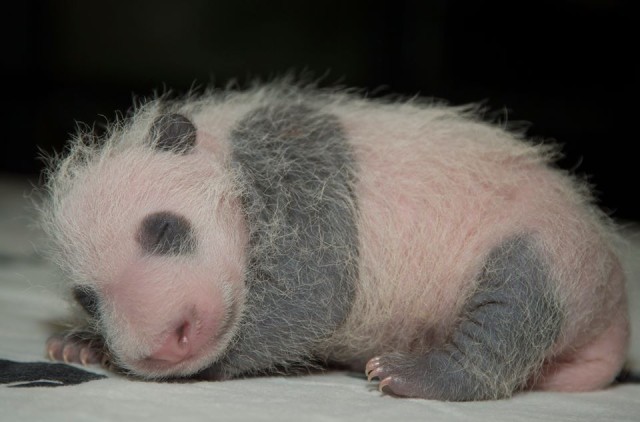
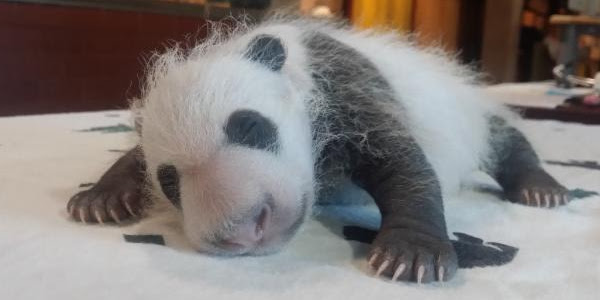
“Our cub is starting to look like a little giant panda! His black markings have come in, and his back saddle looks just like his dad, Tian Tian’s. Keepers have also seen him sleeping with his paw over his eye—which is something both Tian Tian and his big sister Bao Bao do—even though his eyes won’t open until he’s between 6 and 8 weeks old. He’s a whopping 1.9 pounds (881.5 grams) and appears to be doing very well. Mei Xiang has felt comfortable during the last week leaving him on his own in the den several times a day for short periods. She is eating more and even ate one of her favorite food items—a pear—over the weekend.”


baby_panda
Photo via Smithsonian’s National Zoo

From the National Zoo:

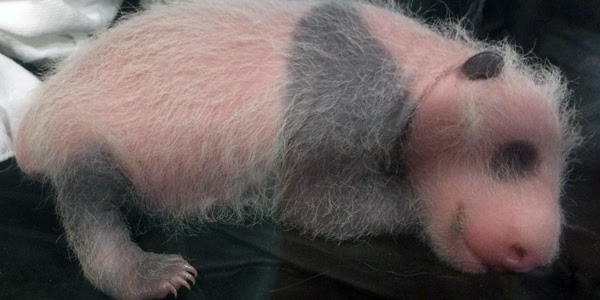
“Our panda cub is growing like a weed! He’s now 1.3 pounds (601.8 grams). That’s a weight gain of 58 grams overnight! In addition to packing on the grams, he is also starting to look like a little panda. His black markings are coming in; his first wisps of white fur are growing in; and every day his tail gets a little shorter. (Panda cubs grow into their tails.) He is squealing much less than he was during the first week and a half of life, and now mostly makes more of a grunting vocalization-all normal for a cub his age. His eyes are not open yet, but the panda team expects that they will start to open between 6 and 8 weeks. At his last two veterinary checkups he appeared to be very healthy and had a full belly each time.

Mei Xiang is becoming more comfortable leaving the den for short periods to eat and drink. It’s normal for a new panda mom to spend almost all of her time in her den with her cub. As her cub grows Mei will leave him in the den for increasingly longer periods of time so she can eat and drink. She left the den twice today.”


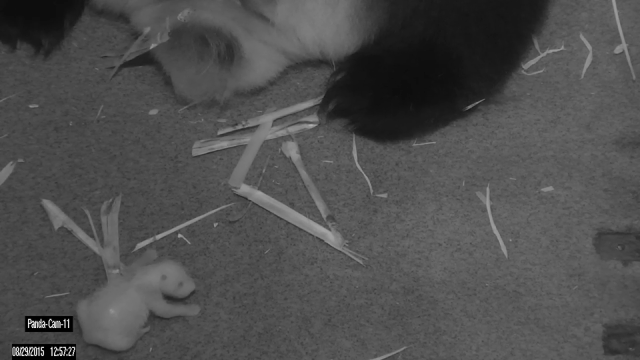
Mei Xiang decided to eat some sugarcane and drink dilute apple juice the keepers left for her yesterday evening around 6 p.m. Two hours later, she left the den to urinate and defecate—only the second time she’s done that since giving birth. She put the cub down when she left the den and he was very quiet for the while she was gone. Over the next few weeks she will get more comfortable leaving him for increasingly longer periods of time to eat and drink. While Mei was away, our behavior watchers captured a fantastic view close-up of the cub! #PandaStory

Posted by Smithsonian’s National Zoo and Conservation Biology Institute on Tuesday, September 1, 2015

From the National Zoo:

“Mei Xiang decided to eat some sugarcane and drink dilute apple juice the keepers left for her yesterday evening around 6 p.m. Two hours later, she left the den to urinate and defecate—only the second time she’s done that since giving birth. She put the cub down when she left the den and he was very quiet for the while she was gone. Over the next few weeks she will get more comfortable leaving him for increasingly longer periods of time to eat and drink. While Mei was away, our behavior watchers captured a fantastic view close-up of the cub!”


From Smithsonian’s National Zoo:

“Our panda cub has been visible on the panda cams several times since yesterday. Keepers left some sugarcane for Mei Xiang in her den yesterday afternoon, and around 1 p.m. she decided to eat some! That is the first time she has eaten since giving birth. She put her cub down for a few minutes while eating, giving panda cam viewers an excellent view of him. He is starting to get black markings around his eyes, ears and back. He also picked up his head and grunted (which is a happy noise) while Mei ate. Mei put him down again early this morning for a few seconds while she sat up. The cub is nursing well and the panda team is very happy with his progress.”


CNf4DtxWgAQp8Ry
Screenshot via Smithsonian’s National Zoo

From the National Zoo:

“Our giant panda cub is a boy, and he was sired by Tian Tian! He is doing well with Mei Xiang, and as of early this morning weighs 139.1 grams. He’s gained about 27.9 grams in the past 72 hours. Mei Xiang starting putting him down last night and trying to leave the den. The first few times she put him down he squealed, so she ran back in and picked him up. She finally left the den to urinate and defecate around 1:40 a.m. and returned to her cub at 1:42 a.m. It is normal for Mei Xiang to start spending short periods of time away from her cub. She will gradually increase her trips outside the den as he grows.

When SCBI scientists artificially inseminated Mei Xiang April 26 and April 27, they used frozen and thawed sperm from Hui Hi (a panda living in China) and fresh sperm from Tian Tian.

Our panda cub who died Wednesday afternoon was also a male and sired by Tian Tian.”


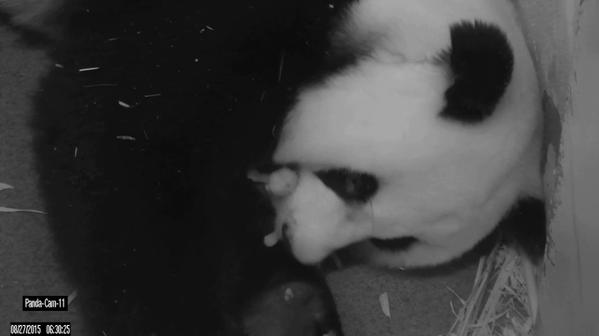
Overnight it was evident to panda keepers and veterinarians that our healthy panda cub was active and nursing appropriately throughout the night. Mei is showing proper maternal care, which includes short sleep cycles, adjusting the tiny cub in her arms for better positioning and grooming. The panda team heard strong vocalizations from the cub and observed it a couple times during the night. The cub is growing more hair, its tail looks plump and the cub overall looks great. #PandaStory

Posted by Smithsonian’s National Zoo and Conservation Biology Institute on Thursday, August 27, 2015

“Overnight it was evident to panda keepers and veterinarians that our healthy panda cub was active and nursing appropriately throughout the night. Mei is showing proper maternal care, which includes short sleep cycles, adjusting the tiny cub in her arms for better positioning and grooming. The panda team heard strong vocalizations from the cub and observed it a couple times during the night. The cub is growing more hair, its tail looks plump and the cub overall looks great.”


11903832_10153529831687902_1215988811770391474_n
Photo via Smithsonian’s National Zoo and Conservation Biology Institute

From the National Zoo:

“Mei Xiang has not been a willing participant in the panda team’s efforts to switch the cubs since 2 p.m. yesterday afternoon. She has the larger cub in her possession. The panda team is caring for the smaller cub and will continue efforts to swap the cubs about every four hours. However, because the smaller cub has been away from Mei, the panda team is now managing it more intensely. The little cub’s behaviors are good. The team is concerned about its fluctuating weight since the cub is now more than 48 hours old. The most important thing for the panda team is to help the cub get enough fluids and nutrients. To accomplish this, they are bottle and tube feeding the cub. The cub has shown some signs of regurgitation which can lead to aspiration in such a tiny creature. To be prudent, the veterinarians are administering antibiotics to prevent possible infection. It’s very important to keep the cub hydrated so they are alternating an infant electrolyte solution with formula and administering fluids under the skin. The cub is urinating and defecating well. The veterinarians have not seen any sign of respiratory distress.

Our observations of the larger cub from yesterday indicate it is doing well and we’re confident Mei Xiang is taking very good care of it. We remain in a high-risk period.

We’ve received a lot of questions about the tiny size of the panda cubs. Bear cubs have the smallest infant-to-mother size ratio of any placental mammal at approx. 1 to 700. Mei Xiang currently weighs about 238 pounds. One of the cubs weighed 86 grams at birth, a 1 to 1,256 ratio of cub to mom. The larger cub weighed 138 grams at birth, a 1 to 783 ratio of cub to mom.”


unnamed

@NationalZoo tweets:

“Our panda team believes Mei Xiang is in labor! We’re hoping for a healthy cub.”

Update:

“Panda team has confirmed that Mei Xiang’s water broke. Hoping for healthy cub. May take a few hours.”

Update:

“Giant panda Mei Xiang (may-SHONG) gave birth to a cub at the Smithsonian’s National Zoo today, Aug. 22. The panda team witnessed the birth at 5:35 pm. Mei Xiang reacted to the cub by picking it up. The panda team began preparing for a birth when they saw Mei Xiang’s water break at 4:32 pm and she was already having contractions. The sex of the cub won’t be determined until a later date.”

CNEDfi6XAAAeNqF

Update:

@NationalZoo with even more good news:

“We can confirm a second cub was born at 10:07. It appears healthy.”

“The Smithsonian’s National Zoo and Conservation Biology Institute confirms one giant panda cub born at 5:35 p.m. and a second giant panda cub was born at 10:07 p.m., Aug, 22. Shortly after the second birth, a panda team of three keepers retrieved one of the cubs per the Zoo’s Giant Panda Twin Hand-Rearing protocol. The cub was placed in an incubator and cared for by veterinarians and panda keepers.

The panda team believes the first cub they retrieved was the second cub born at 10:07 p.m. This cub continues to vocalize very well and appears healthy. It weighed 138 grams last night and this morning weighed 132.4 grams. The cub has urinated and defecated – all good signs. The team fed the cub three times overnight at 2:20 a.m., 3:40 a.m., and 5:00 a.m. The cub received 30 – 40 percent of the serum it was hand-fed. The serum was banked from blood drawn from Mei Xiang last April during the artificial insemination. The nursing bouts were short but the team considers them successful. The goal was to give the cub antibodies (colostrum alternative) as it had not yet nursed on Mei Xiang. This cub has now been marked with a little green food coloring on its left hip.

At approximately 6:30 a.m. this morning, the panda team was able to swap cubs. The cub they had in the incubator this morning is believed to be the first born, and weighs 86.3 grams. It is vocalizing very well and appears strong. The panda team does not plan to feed this cub as it will be switched back to Mei Xiang in a couple of hours. However, they are prepared to feed the cub if it needed.

The Smithsonian’s National Zoo is one of a few zoos with expert nutritionists on staff. They have prepared formula and trained for this scenario. Formula ingredients include: water; human baby formula; and puppy formula. The ingredients are mixed together and strained to omit clumps. Our concern now is whether Mei Xiang will allow the panda team to consistently swap the cubs. The team developed a few different strategies and will continue to try different methods of swapping and hand-rearing. Much of their methods will be dictated by Mei Xiang.

The panda team will alternately swap the cubs, allowing one to nurse and spend time with Mei Xiang while the other is being bottle fed and kept warm in an incubator. The primary goal for the panda team is for both cubs to have the benefit of nursing and spending time with their mother. It is too early to guess about when the cubs will be placed together.

Giant pandas give birth to twins approximately 50 percent of the time. This is only the third time a giant panda living in the United States has given birth to twins. There are only two other female giant pandas around the world who have successfully reared twins and it required a lot of human support.”


View More Stories