
After a false alarm in May – Behold the cicada plague of 2013. Thanks to a reader for sending a photo of the infestation above at 15th and P St, NW.


After a false alarm in May – Behold the cicada plague of 2013. Thanks to a reader for sending a photo of the infestation above at 15th and P St, NW.
From DC Department of Health via MPD:
“Recently, a lactating female raccoon was determined rabid on 34th and R St. NW and ten days later, a second lactating raccoon mother was found about 3 blocks from original sighting 10 days later. Lab results came today July 29. There is the possibility her young may be infected with the virus.
The main message here is prevention and caution on approaching any suspicious animals including loose cats and dogs. For the pet owners, allowing cats and dogs to run at large in the woods is risky due to possible exposure to Rabies and Lyme disease, both of which can be transmitted to humans.”
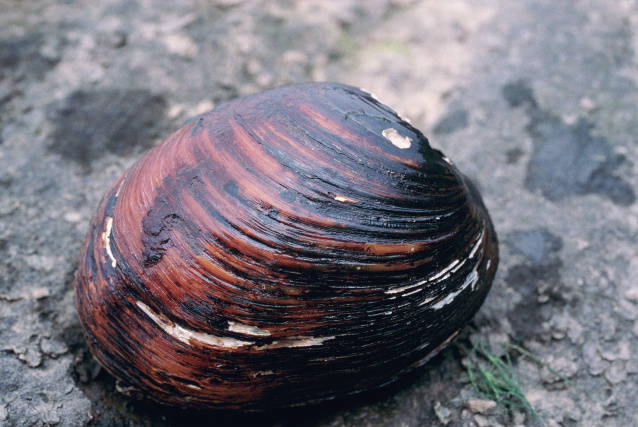
Photo by: Craig Stihler/USFWS via wikipedia.
Urban Wilds is written by Lela S. Lela lives in Petworth. She previously wrote about attracting bats.
Think of mussels and your mind likely turns to the white wine and lemongrass variety. But North America has a rich array of native freshwater mussel species: some 300 of them, a third of the global total. Freshwater mussels look more like clams than their marine cousins, and range from one to ten inches long, in a variety of colors reflected in their wonderful common names: Purple Bankclimber, Shinyrayed Pocketbook, Yellow Lampmussel, Pink Mucket. The endangered Dwarf Wedge Mussel lives in Rock Creek. Some species of mussel can live to over 100 years old.
Like other bivalves, freshwater mussels are filter feeders, and a single animal can filter up to eight gallons of water a day, recycling nutrients and cleaning it of particulate matter. Mussel biomass can be extremely high, making them a largely unseen but vital part of a functioning river system. In many places, however, their numbers have been dramatically reduced through a combination of pollution and sedimentation, invasive species like the exotic zebra mussel, and dams. That last factor might not make sense at first – mussels are basically sedentary, after all. But unlike marine mussels, the freshwater variety has a complicated life cycle involving a larval stint spent hitchhiking on fish. Some mussels are highly selective in their choice of host, meaning they can’t reproduce at all if that particular fish species has been fished out or blocked from their spawning site by a new dam. (more…)

Google and the Google logo are registered trademarks of Google Inc., used with permission
From MPD:
“Another lactating female raccoon was found sick at an alley on 34th and R St. NW on July 10. Lab results came today July 18. There is the possibility her young may be infected with the virus. Please assist in informing your constituents again. See attached Rabies flyer.
On Wednesday July 10, 2013 a sick raccoon that was picked up from the alley on 34th and R St. NW was recently determined rabid by the DC Department of Health. The raccoon was a yr. old lactating mother that left her young ones behind and possibly also rabid.”
Ed. Note: Previously we discussed Rabies alerts in Cleveland Park, most recently on June 10th.

Previous Bee swarm in Ledroit Park from May 2012
Yesterday we talked about the dangers of deer on DC’s roads. And today @HStreetDC_ tweets:
“Watch out for swarming bees at 12th/G NE, just off #HStDC. Neighbors trying to get beekeepers out to round ’em up since city won’t.”

“Dear PoPville,
My girlfriend (driver) and I were coming back from McLean Gardens last Saturday morning around 1:30 AM. Heading Southbound on Mass Ave, we both began to notice a figure by the side of the road up near the bus top at Edmunds and Mass close to the Naval Observatory. Already getting close, we slammed on the brakes as soon as we saw it was a deer and that it was heading into the street. By the time we began to slow, it was too late.
The deer stared into our headlights while slowly beginning to run. All this did, however, was place it directly into the path of our Jetta. We hit it square in the hips going about 15 mph, but its forward momentum continued to carry it into the path of unsuspecting, oncoming traffic.
A Honda Civic coming up Mass Avenue hit the deer at full speed, killing it instantly. By the time the whole thing was over, the Civic was missing a right wheel well and front bumper, and we had a nice dent in the hood. No one (but the deer) was hurt.
I pulled the dead doe out of the road and onto the tree bank, and we called 311. They said they’d take care of the deer, but told us to also call 911. When the cops arrived, they were pretty reverent, saying that: “we invaded the deer’s natural territory, and this thing was bound to happen…”
In any event, be careful out there. If it had been a buck or had we been going faster, it could have been much worse.”

Thanks to @mags_1010 for tweeting us the photo above:
“Ducks getting an escort across K Street at lunchtime today.”

Quite a few weeks for wildlife in the District – snakes falling from trees (twice!), red pandas on the lam, bears on the parkways and now wild turkeys?
@joeddjd tweets us the photo above:
“@PoPville Cool! A wild turkey (I think) in a tree in my backyard. #16thStHeights”
UPDATE: @timreedjr spotted the wild turkey walking down Kennedy Street too:

Update: Another reader emails the wild turkey strutting around Adams Morgan on California St. NW between 18th and 19th:


Two more photos from Adams Morgan – one of the menacing bird peeping in a window on Wyoming Ave. (more…)
And now an update from the The Washington Humane Society:
“Earlier today, the Washington Humane Society (WHS) reported that WHS Animal Care and Control Officers, in partnership with the District of Columbia Department of Health (DC DOH) and the Metropolitan Police Department (MPD), successfully tranquilized and trapped a black bear spotted near the intersection of 49th Street and Glenbrook Road, NW.
WHS received a call early this morning reporting the black bear sighting. WHS Officers immediately responded to the scene where MPD Officers had surrounded the area they believed the bear to be hiding.
The bear appeared frightened and proceeded to run through the backyards of many residential homes in the area. WHS Animal Care and Control Officers followed close behind, and after an approximately two hour chase, WHS Officer Peter Martel was able to get a clear view of the bear and darted him with a tranquilizer. Once hit, the bear ran a short distance and was recovered safe and sound in the backyard of a nearby residence.
The bear was evaluated and determined to be healthy. With the assistance of the Maryland Department of Natural Resources and DC DOH, the black bear was transported to the wilderness in the western part of Montgomery County, MD and released.
In general, black bears pose no threat to the public. If you spot a black bear in the District, do not approach, call DC Animal Care and Control (202-576-6664).”
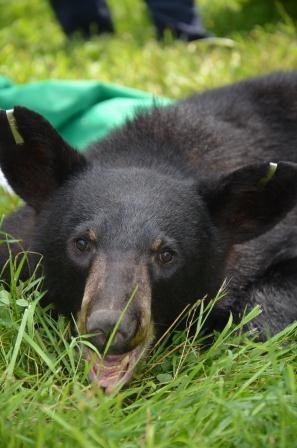
Photo Courtesy of the Washington Humane Society

MPD sends these photos and an update on this morning’s bear sighting:
“This morning MPD received a call from a resident in the 4900 block of Rockwood Parkway. The resident reported that a black bear was in her backyard. Second District officers arrived to the location and in fact observed a black bear (male cub) in the yard. DC Animal Control responded and after an exhausting game of “cat and mouse” they were able to tranquilize the bear. The bear was captured in the rear of a residence in the 4900 block of Indian Lane. DC Animal Control and DC Department of Health are in discussions with the National Zoo to determine a location outside of the District to release the black bear back into the wilderness. There were no injuries to the black bear or citizens regarding this incident. MPD wishes to thank our partner agencies, DC Department of Health and Animal Control, as well as the citizens, who provided assistance with sightings of the bear as it fled from yard to yard.”
