And now an update from the The Washington Humane Society:

“Earlier today, the Washington Humane Society (WHS) reported that WHS Animal Care and Control Officers, in partnership with the District of Columbia Department of Health (DC DOH) and the Metropolitan Police Department (MPD), successfully tranquilized and trapped a black bear spotted near the intersection of 49th Street and Glenbrook Road, NW.

WHS received a call early this morning reporting the black bear sighting. WHS Officers immediately responded to the scene where MPD Officers had surrounded the area they believed the bear to be hiding.

The bear appeared frightened and proceeded to run through the backyards of many residential homes in the area. WHS Animal Care and Control Officers followed close behind, and after an approximately two hour chase, WHS Officer Peter Martel was able to get a clear view of the bear and darted him with a tranquilizer. Once hit, the bear ran a short distance and was recovered safe and sound in the backyard of a nearby residence.

The bear was evaluated and determined to be healthy. With the assistance of the Maryland Department of Natural Resources and DC DOH, the black bear was transported to the wilderness in the western part of Montgomery County, MD and released.

In general, black bears pose no threat to the public. If you spot a black bear in the District, do not approach, call DC Animal Care and Control (202-576-6664).”

WHS Bear Rescue Photos - Courtesy of the Washington Humane Society (1)
Photo Courtesy of the Washington Humane Society


bear_dc

MPD sends these photos and an update on this morning’s bear sighting:

“This morning MPD received a call from a resident in the 4900 block of Rockwood Parkway. The resident reported that a black bear was in her backyard. Second District officers arrived to the location and in fact observed a black bear (male cub) in the yard. DC Animal Control responded and after an exhausting game of “cat and mouse” they were able to tranquilize the bear. The bear was captured in the rear of a residence in the 4900 block of Indian Lane. DC Animal Control and DC Department of Health are in discussions with the National Zoo to determine a location outside of the District to release the black bear back into the wilderness. There were no injuries to the black bear or citizens regarding this incident. MPD wishes to thank our partner agencies, DC Department of Health and Animal Control, as well as the citizens, who provided assistance with sightings of the bear as it fled from yard to yard.”

bear_sighting_dc


Screen Shot 2013-06-26 at 9.40.52 AM

@DCPoliceDept tweets:

“MPD FYI:Avoid area for traffic control at 4900 Rockwood Parkway NW. Bear running in area.//4014″

Update from MPD:

“Traffic Advisory 4900 blk of Rockwood Pkwy is clear & all lanes are open. The bear has been relocated to the Zoo by DC Animal Control.”

Saga continues! Update from Washington Humane Society on our facebook page:

“WHS Field Officers have safely tranquilized and captured the bear in NW DC. The bear is safe and sound. We are working with our DC Department of Health and Washington Metropolitan Police Dept. partners to transport and release the bear back into the wild. More details to come.”


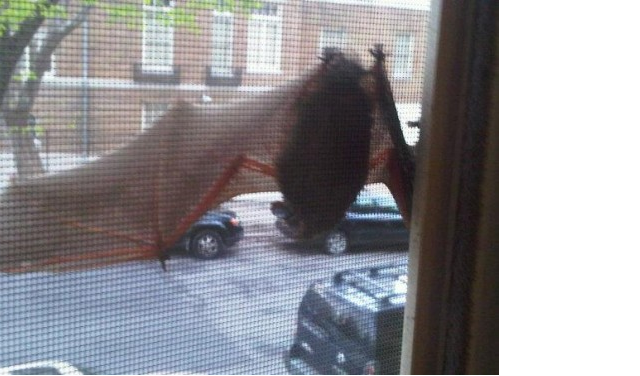
bats_in_dc-e1332855467953
Bat visiting Woodley Park last year

Urban Wilds is written by Lela S. Lela lives in Petworth. She previously wrote about Tulip Trees.

I adore bats and have been thinking about how to coax more of them into our neighborhood. Growing up in the country, bats were a staple of summer evenings, but these days I rarely see them, particularly within city limits. As many as ten species of bats can actually be found in the DC area throughout the year, although several are migratory types, not permanent residents. Several of our species (including tricolored, little brown, and big brown bats) are being decimated nationally by white-nose syndrome, a fungal disease that is estimated to have killed over 6 million bats in North America.

As bat populations decline, we’re left instead with more insects that munch on us and on our crops (including that tomato plant on your porch). Most famous for their taste for mosquitoes – a single bat can eat hundreds of them in a night – they also eat prodigious amounts of other pest insects, including June bugs, Japanese beetles, stink bugs, and cucumber beetles, as well as moths and other pollinating insects. And all that aside, they’re just so freaking cute.

How to bring more bats into your life

In the mid-Atlantic, bats aren’t pollinators themselves, although they do play that role in other parts of the countries. But you can attract them by planting flowers that nocturnal insects enjoy. Try night- or evening-blooming flowering plants, like evening primrose, marsh phlox, moonflowers, four o’clocks, plaintain lily (a kind of hosta), and night gladiolus. Herb gardens with stand-bys like basil and mint are also good.

If you have a pond or stream near your house, bats can use it as a drinking source and will also hunt for insects around to the water.

Finally, if you have the space for it you can install a bat house. I always loved this idea, but we are chronic renters and have yet to find a landlord amenable to adding a bat hotel to the back yard. Bat Conservation International’s guidelines on bat houses suggest the structures be at least two feet tall – much bigger than the ones I’ve seen for sale. Have any readers installed a bat house and had anyone take up residence?

Finally – a quick word on rabies. Your chances of being bitten by a rabid bat are extremely slim, though it does happen. The DC Department of Health has guidelines on dealing with a possible rabies exposure here. Minimize your chances of exposure by never handling a bat directly, even if it appears healthy.


snake_falling_out_of_tree_cleveland_park_dc
Porter and Connecticut Ave, NW

At the end of May we learned the frightening news that snakes were falling out of trees in in Walter Pierce Park in Adams Morgan. Apparently, some snakes have migrated to Cleveland Park. Yesterday afternoon a reader sent the photo above and wrote:

Just saw this guy take the plunge from a tree on Porter Street in Cleveland Park. It was terrifying. Maybe the same kind of snake that was falling from the trees in Walter Pierce Park? It was right below Connecticut, a little after Kim’s Dry Cleaners. It was so bizarre! After it fell it just kind of laid there. I’m not sure if it was dead or if it was freezing like the person in the PoP post said.

Ed. Note: The snakes from Adams Morgan were black rat snakes.


View Larger Map

From the Cleveland Park Listserv:

The Animal Disease Control division of DDC Dept of Health notified the ANC 3C this morning that a rabid raccoon was found in 3100 block of Newark Street last Wednesday, June 5. The appropriate officials have increase their surveillance.

There are few steps that you can take to protect yourself and your animals. Do not approach any animal that is acting strangely, call 311. Do not let your animals wander in the woods off-leash. Wild animals are attracted to food so keep trash cans securely closed, remove food from outside locations, repair any holes or access points to the house or trash.

Ed. Note: There was a previous rabies alert on the 3100 block of Macomb St. NW back in early May.

Office of the Mayor (EOM) adds:

“A lactating female raccoon was found sick at patron’s backyard chewing on itself at the 3100 block of Newark St. NW on June 5.”

MPD passed on the following rabies brochure:

Brochure-Rabies


800px-Liriodendron_tulipifera
Photo via wikipedia by Bruce Marlin

Urban Wilds is written by Lela S. Lela lives in Petworth. She previously wrote about vultures.

For the last few weeks, tulip tree flowers have been falling in the DC area. These gorgeous blossoms – two to three inches long, green and yellow and orange – are the product of one of my favorite plants in this part of the country. Also called tulip poplars, this species is a swift- and straight-growing tree that commonly reaches 100 feet. If left alone, they can become true giants: before they were heavily logged in the 1800s for building materials ranging from ship masts to organ pipes, old-growth tulip trees were recorded at 200 feet tall with diameters of as much as twelve feet. They’ll live up to three centuries under good conditions. Honeybees favor the nectar (which can supposedly be drunk straight from the flower – I intend to try this immediately) and produce a medium-amber honey that’s often used in commercial baking. In Maryland, tulip trees are a primary source of nectar for foraging bees.

Tulip trees can be found in parks and wooded areas around the city, as well as along a number of our streets. Their leaves might be mistaken for a maple’s, but their flowers are unmistakable, especially scattered across a Washington sidewalk. This time of year, the quickest way to find a tulip tree might be to first look down, then up.


Walter-Pierce-Park-adams-morgan-dc-fence
Walter Pierce Park

From MPD:

Walter Pierce Park [2630 Adams Mill Rd, NW]

On Thursday, May 23, 2013 around 11:40am a call came in about a couple of snakes that fell out of the trees. When the snakes fell they scared the children, and everyone fled. This was in the playground area. I responded but found no snakes. I caught one small enough to fit inside an empty water bottle I had. It was probably a black rat snake. They are indigenous to trees and the warm weather is drawing them out.

But fear not the National Zoo says:

Common rat snakes tend to be shy and, if possible, will avoid being confronted. If these snakes are seen and confronted by danger, they tend to freeze and remain motionless. Some adults attempt to protect themselves. They coil their body and vibrate their tails in dead leaves to simulate a rattle. If the snakes continue to be provoked, they will strike.

Though the National Wildlife Federation cautions:

“Although black rat snakes do not usually attack when threatened, there have been extreme cases of black rat snakes charging at predators. Black rat snakes also produce a strong foul odor when scared to deter predators and people.”


dsw_columbia_heights
Irving Street, NW just west of 14th

Dear PoPville,

I was in DSW earlier and witnessed a poor bird trapped in the store. He kept flying into the windows trying to get out. It’s so heartbreaking.

I went to talk to the manager – he acknowledged that they have tried to call Animal Control ‘numerous’ times to capture the bird. In the meantime the have been trying to coax the bird outside, and they have been feeding him.

I tried calling 311 over and over again (apparently Animal Control is available 24 hrs a day). Not once did I speak to anyone in Animal Control. All I kept getting is a recording to not leave a message and to call back when the line was free. Huh?!?!

I did tweet @DOHDC with this earlier today – no response. I am not a DC resident so I am not quite sure what else can be done.

Any help/suggestions??


cicadas_dc

A reader sends word (and the photo above) that the cicadas have arrived in Petworth. I haven’t seen any yet. Have others spotted them too? I guess we’ll be hearing them soon enough…


View More Stories