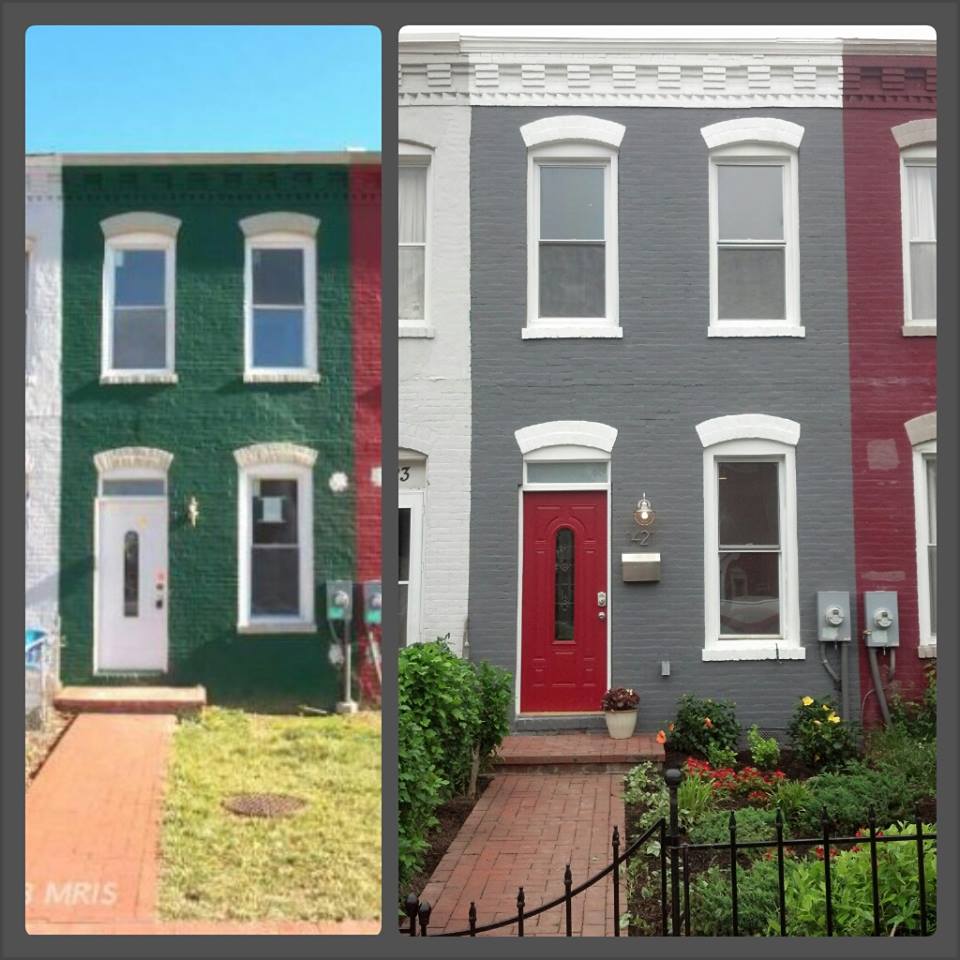
original_row_house_painted_gray
3642 New Hampshire Ave, NW

We’ve occasionally debated painting brick in the past but for today – let’s just talk about this specific house. It’s a row house that is being developed into condos just south of the Petworth metro. It’s a complete renovation and was starting to look really good. I really dig the windows. Now for the record, I’m normally pro-paint but one day I walked passed here and noticed it had been painted gray. Side note: Has “flipper yellow” become “flipper gray”? Anyway, you can see how the original brick looked below. So what do you think – should they have kept the original brick or painted it gray or painted it another color?

original_brick
Color of original brick

original_row_house_brick
Original brick on a neighboring house


kitchen_after_1

The reader writes:

“As you will see in the before photos, the kitchen was very outdated when we purchased the home. Lots of 1970’s appliances in scooby-doo brown and a lot of pink laminate countertop!

We found an awesome contractor that worked with us to take out the wall that separated the old galley kitchen from the dining room to create one large open room. We also closed off the “nook” part of the kitchen and turned it into a half bathroom (access is through the sunroom). We had all electric and plumbing updated throughout the house and lots of extra outlets were added.

Although, there’s actually less kitchen space now, the layout and new energy efficient appliances have made life in our DC home much more enjoyable!

Things I absolutely love about the new kitchen:

– The openness makes it easy to entertain. We can cook in the kitchen while holding a conversation with our guest in the dining room :)
– Subway tile. I love the clean look of the subway tile, especially the tiles that go all the way to the ceiling.
– Vintage style lights. They match the antique light fixtures throughout the rest of the house.
– Our island provides extra storage and is not a permanent fixture.
– Double ovens. I really didn’t think I would need two ovens, but I’m so happy my husband talked me into this. We can cook a pie and a roast at the same time!”

kitchen_after_2

Ed. Note: If you have a renovation you’d be willing to share please send some before and after photos to princeofpetworth(at)gmail(dot)com.

More photos including before shots after the jump. (more…)


9201785698_1ab1025918_z

In March a reader asked for advice about opening up and renovating a kitchen. Here’s a brief update:

My personal favorite additions (aside from this being so much more open than before):
– outlets with USB plugs
– the bookshelf above the new bedroom door
– pocket door solution to the bedroom
– extra storage shelf built in bedroom on back side of the bookshelf

9201787022_00c9def933_z

Ed. Note: If you have a renovation you’d be willing to share please send some before and after photos to princeofpetworth(at)gmail(dot)com. Before photo after the jump. (more…)


IMG_9983
Before

The following renovation – actually completely new structure – was sent by Chris who lives in Petworth. You can read all about the process on his blog here.

If you have a renovation you’d be willing to share please send an email to princeofpetworth(at)gmail(dot)com.

Chris writes:

“A few of the details:

16′ wide x 26′ long x 14′ tall, even though our lot is 20′ wide.

We wanted a 3′-6″ pathway on the side to allow access to the backyard and english basement without needing to go through the garage. We currently don’t rent out the basement, but the future home owner may want that option.

Also, if the garage was on the property line, then the walls would need to be constructed differently to meet fire rating. One wall is 3′-6″ away, and the other is 0′-6” away from the property line.

Accessory structures in our zone cannot be taller than 15′, so I wasn’t able to add a small room above the garage.

The garage matches the style of our house, with a slate gable roof in the front, low sloped roof in the back and parapets on the sides.

Dormer window facing south for natural light.

French doors facing the house for better aesthetics and also to allow easier access to the backyard with equipment, tools, furniture, etc…

Space in the back of the garage for a small workshop.

Hardiplank cement siding which looks like wood siding, but last quite a bit longer.

Rain barrel on the back side for our future herb garden.

50A electrical service from the house to power a few tools, lights, kegerator, TV, and other mancave accessories.

I am contracting out the excavation, foundation, and slab, and plan on doing the framing, doors and windows, and siding myself (with some help from friends of course).

As a responsible resident, I did get permits for all of the work. I only needed a structural engineer to stamp the structural and architectural drawings, and I was able to do the electrical, environmental, and plat layout drawings myself. I’ll need to have a licensed electrician do the electrical, as the city won’t accept my electrical engineering degree as justification for allowing me to do the work. It’s probably safer that way.

Getting the permit was a pain though. I didn’t know the homeowner’s center could handle large projects like garages until a month after I submitted the drawings. I also didn’t know the homeowner’s center was a separate office in the DCRA. I thought it was all the same, and that the home owner went through some special flow in the permitting process. I didn’t know what it actually was. The DCRA failed to mention this to me the several times I was in there asking for advice before I actually submitted for the permit. Because of this, my permit took almost 2 months, instead of 2 weeks. I’ll definitely use them for other future projects, and advise all DC homeowners to try there first. I blame it on naivety on my side, and miscommunication on both sides. Having gone through the process, I’ll know next time, but I don’t like that the only reason I know the correct process is because I had problems with it the first time.

To help address this, it would be nice if the first question the person behind the DCRA service desk should ask is, “Are you the homeowner? If so, please try our homeowner’s center (back there) which will help you through the permitting process. If not, here’s your number. Next!” ;-)

From various DC blogs, I see that a lot of people don’t know about the homeowner’s center, so it doesn’t seem to be advertised as well as it could be. It wasn’t clear to me, and I spent a lot of time on the DCRA website before I even went to their office. Maybe it’s just me, but if more than a few people have the same issue, then it’s most likely a systematic issue. (Yes, I do speak engineer from time to time.) That’s just my two cents…”

image_5
Finished alley view

image_6
Finished backyard view

Progress photos after the jump. (more…)


Before
Before

I love seeing people’s renovations and projects. If you’re doing/have done anything interesting and have before and after photos please send a brief description in an email to princeofpetworth(at)gmail(dot)com

Thanks to HG for sending these shots. He writes:

“I managed the project including hiring an engineer, getting drawing, getting permit, hiring three different contractors, negotiation the best deals from each (window installing company, Marvin, for material and labor; brick demo and structural support installation company; then finally drywall and other finishing company). The project spans enlarging window openings on three floors, not just the top floors (the pic) so I haven’t really calculated the final cost yet, but definitely more than half-off of prices I was given by general contractors when I was shopping around.

Before – As you can see there were two small windows and a door that takes you to a deck.”

During
During

“During – They used drill to loosen the brick, but picked one brick at a time… a very length process.”

after
After

“After – we love the outcome. The sliding window/doors are great.”


IMG_0684

Thanks to a reader for sending word that the massive renovation at 2867 Tilden St, NW was completed.

IMG_0685

You like the way it turned out. Here’s an image from google street view to give an idea of what it used to look like:

Screen Shot 2013-05-09 at 11.56.00 AM

It went under contract with a listing price of $2,195,000. You can see what it looks like on the inside here.

And nearby the reader sends in some awesome house porn from 2604 Tilden Pl, NW. Check out this virtual tour. It’s yours for $2,495,000.

2604_tilden


The House Gut is written by HumaneFoodie. She lives in NoMa. You can read the first installment of The House Gut here, the second installment on finding the right contractor here and the third about Investing in the mechanics of a house here.

Garbage

So, you are gutting a house.

And you scroll through the list of items you will need: 100 square feet of tile for ONE of your bathrooms, cabinets, sinks, doors, windows…the list goes on.

Suddenly, the Story of Stuff video starts playing in your head. If you’re anything like this bleeding-heart environmentalist, the thought of buying all new stuff from Home Depot, Ikea or Lowe’s makes you cringe.

Thankfully, the D.C. area has delicious salvage gems hidden all around. We found quite a few, thanks to tips from our contractor and other fellow salvagers we met along the way. We found more gems post-reno when we started looking for salvaged wood for our garden.

Radiator

Here is a list of the places we went and what we got:

Community Forklift

Located right outside of D.C. in Edmonston, Md., Community Forklift (CF) is a huge warehouse full of your treasures/someone else’s trash.

CF has rows of doors and windows with the specs listed. (We got one interior door here, and this is also where Mark, our contractor, found our front door.)  We salvaged some of our tile here, and bought a short radiator for under our bedroom window. We also got a vanity for our upstairs guest bathroom and a pedestal sink for the powder room.

Continues after the jump. (more…)


View More Stories