Wayan Vota writes:

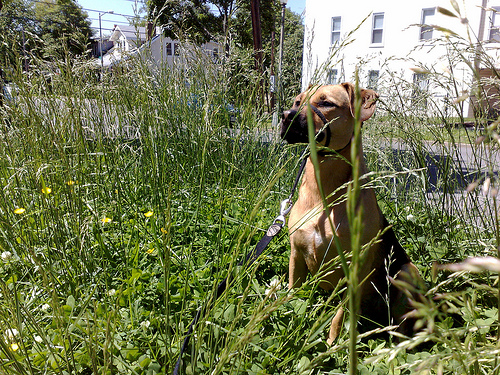
“You know your neighbours grass is too high when a Taxi Dog can get lost in its un-mowed depth. And with such disregard for community standards, when do you break down and mow their yard? Its not like you can get your ANC chair email the Park Service for a quick mow. ”

We tackled this question almost exactly a year ago last April. But I think the real question here might be – why is Wayan walking his dog in his neighbor’s yard…?


photo by M.V. Jantzen

Well it’s been a while. Yesterday there was a post in the great H Street, NE blog, Frozen Tropics where, I feel, the author unfairly maligns Columbia Heights. I can understand her frustration but is it really necessary to make the point of defending one neighborhood by cutting on another? I can’t accept that provincial way of thinking. The author writes:

“But, to be frank, I feel safer living here than in Columbia Heights. Maybe it’s just me, but I feel like I know too many people who have been robbed in Columbia Heights. And when I say robbed, I mean pistol whipped, punched, or hit in the head with a brick. None of these people were resisting. By contrast, I only know (personally) one guy who was ever violently attacked during a robbery in this area.”

I really don’t mean to start a neighborhood war here. I’m a big fan of H Street, NE (in fact I just filmed a PoPtrekker there, stay tuned). I think what makes Washington DC great is that it has many great diverse neighborhoods that each have much to offer. You know, “the whole is greater than the sum of its parts” and all.

Nevertheless, let me make a few points in defense of Columbia Heights. You see Columbia Heights is a huge neighborhood. And lots of people live there. So yes, there is crime. In fact I was hit in the head with a rock not too long ago. But it has in no way diminished my love for it. I mean if we’re going to use the scientific method of how many people we personally know who’ve been mugged then I’d say it’s one of the safest neighborhoods in the city. Yeah, I don’t know anyone personally who’s been mugged there. Ok, obviously I don’t think it’s the safest neighborhood in the city but just making a point.

Here at PoP we’ve often discussed that everyone has their own comfort level. I happen to feel comfortable in Columbia Heights and H Street, NE. That doesn’t mean I walk the streets at 3am with dollars sticking out of my ears and a fresh can of airplane glue. I also happen to feel comfortable on Georgia Ave. And H Street, NE reminds me a lot of Georgia Ave. (except H St. has more new restaurants). But when I was recently filming the PoPtrekker there I couldn’t help but notice how many boarded up storefronts there were. It didn’t bother me. But I can see how some people might feel uncomfortable. It is what I call gritty. Which is far different, in my mind, than unsafe. Crime is a citywide problem. It may occur on some streets more than others but it is a problem we need to battle as a city.

But like I said, I love Columbia Heights. And I love H Street, NE. No need to justify loving one by taking down the other.


On Tuesday I posted an open letter to Chief Lanier from a reader. The reader follows up:

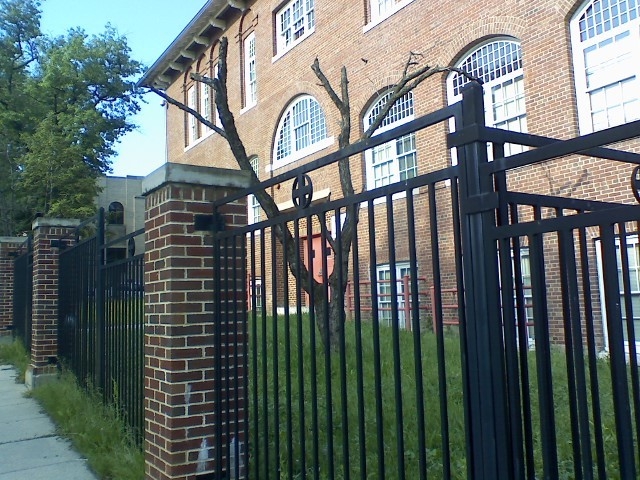
“In an act that shines a bright and gleaming light on the perfunctorily efficient (or efficiently perfunctory) DC Government, the dead tree at the 801 Sheppard Street police facility was removed this morning. Please hold your applause… First I would like to offer my sincere apologies to the woodpeckers and tree creepers who have now lost a potential food source. Second, I would like to thank PoP for creating and allowing this marvelous forum that accomplished in two short days what years of sidewalk conversations with officers and administrative staff could not. And last, I would like to express my appreciation to the blog-reading community at large for the many diverse, constructive, divisive, sardonic, and just plain fun comments and thoughts on the issue. You are all gems – not a word from Chief Cathy though.

PS – Anyone got a mower?”


“Attached is a photo of the 8th Street side of the 810 Sheppard Street, NW Police Facility.

When I moved to Petworth 6 years ago, we were told by the chief of police that this building, which underwent a $10 million renovation, was to be a beacon for the neighborhood which had seen tough times. The tree in the picture was dead six years ago and it is dead now. I don’t think it is coming back. If the neighborhood revitalizes, I am fairly certain the “beacon” will have little to account for it. For 6 years I have walked past the dead tree on the way to Metro to go to work. At the moment the dead tree has knee-high grass around it. My father was a police officer in Nassau County, NY for over 30 years. I know he wouldn’t have walked past a dead tree on his way to the office for 6 years; he probably wouldn’t have walked past a dead tree for 6 weeks. He would have picked up the phone and told someone to do their job and remove it or he would have taken a saw to work and cut it down himself.

I have watched the pot smoking, drug sales and drinking in parked cars on Taylor Street and around the Recreation Center and have wondered about the close proximity to the police building and I realize now that it all makes sense. There is ZERO connection between the persons at work in the building and the neighborhood they work for. All the talk by the police about the neighborhood and importance of community in police work is just that – talk. Forget the ongoing crime issues – this dead tree and the fallen parking space numbers that litter the parking lot and the general decrepitude of the facility’s outside areas are the best evidence of the attitudes of the workers inside this building toward the people living in the surrounding area.

Who do I have to ask for permission to cut down the dead tree and drag it around to the other side of the building and put it in the dumpster?”

I think this letter raises a very important point:

“There is ZERO connection between the persons at work in the building and the neighborhood they work for.”

I have to say I kind of feel the same way. Once on 14th Street a bit south of Red Derby I saw some police talking with residents and I felt like this was a great step in the right direction. I’m sad to say, at least it feels like, that may have been an anomaly. So what is it going to take to get a connection between the officers who serve our communities. I mean I know they have a very important job to do. Preventing crime and capturing criminals should be their number one priority. However, most feel that there is a correlation with that and closeness with the community. What can cops do to actually change this perception/reality. I feel like a neighborhood cookout is just not going to cut it. I really feel like regular foot patrols (with the right officers) are the only way. Am I missing another way?


“Dear PoP,


I would love to see what ideas your readers generate on how these funds could be well-used to help our community.


David Tumblin

Commissioner, Single Member District 4C06″


District Receives $16.4 Million in Community Services Block Grant Funds From Recovery Act

The US Department of Health and Human Services (HHS) announced April 10, 2009 plans to make $1 billion available for the Community Services Block Grant (CSBG) program. Funded by the American Recovery and Reinvestment Act, the new resources will be allocated to states across the country. The District will receive $16,427,550 that will be distributed to community groups that help Americans through tough economic times.

Under the Recovery Act, organizations receiving CSBG funding must use the resources to help get our economy back on track. Funds must be used to reduce poverty, revitalize low-income communities, and assist low-income families to become self-sufficient. Eligible entities use funds to provide services and activities addressing employment, education, housing, nutrition, and emergency services to combat the central causes of poverty.

Services currently provided by community organizations that receive CSBG funds include:

  • Job training and placement assistance.
  • Financial literacy programs such as credit counseling.
  • Housing assistance programs that help keep Americans in their homes.
  • Nutrition programs that provide meals for vulnerable families.
  • Community agencies that bring public and private resources together to assist families in need.

The United Planning Organization, which is the District’s federally-recognized community action agency, is responsible for determining how these funds are distributed. Interested parties should contact Harvey Johnson, III, UPO’s Director of Public Awareness, for more information. He can be reached at (202) 238-4696 or by email at [email protected] or [email protected].


Any ideas?


“Dear PoP,

I live in a new condo building in Petworth. Before that, I’ve lived in group houses in Petworth and Columbia Heights since 2004, so I’m not unfamiliar with the neighborhood. As I was taking my bike from my apartment out the back door, I was surprised to see 2 people smoking crack… right in the doorway. They saw me, looked up then gave me a look of supreme annoyance, because I was obviously inconveniencing them. I didn’t really want to deal with them, so I just went back to my apartment, made sure my windows were locked, and went out the front door instead. Eventually the two wandered off. This surely isn’t the first time I’ve seen someone smoking crack in a semi-public place. I use to have a next door neighbor who would sit on back porch many a night and whip it out. It was pretty depressing to watch that persons life slowly fall apart over a long period and eventually the person ended up in jail. I’ve also watched someone in my own family deal with an addiction to meth over the years and so maybe I’m just desensitized to the whole tragic spiral and have become brainmush neutral to seeing junky behavior up close and personal. I guess this kind of neutrality is why I had no urge to call the cops…. at that time. But later, I thought, (as I’ve had this though before in my life) I don’t want to and refuse to live that close to junkies. Although, I also don’t like the idea of just literally throwing people in jail for an often fatal substance abuse problem.

I am wondering how your readers feel about crack use in the district? Are people less neutral than I am about it? Was crack use really about 10 times worse in the 80’s and 90’s like I always hear? What are some ideas?”

These are good questions. I’ve only seen some of the small baggies on the street but I’ve never seen anyone actually smoking crack. I’m very curious to hear what other folks have experienced. Do you see folks smoking crack in your neighborhoods? Is crack still a huge problem in the District?


photo by Néstor Sánchez Cordero

Are there enough public restrooms in DC? GGW’s Lynda Laughlin (a friend of mine) wrote a great post titled When you gotta go, where do you go? A brilliant question. She writes:

“We’ve all been there. You’re out and about, and then suddenly, you need a restroom. When I leave home to go on a walk or run an errand, I keep a mental map of the closest available restrooms. I usually rely on restrooms in commercial businesses, largely because it is difficult to find public restrooms in the District.”

Since I start my walks in Petworth I’ve always used busboys and poets (pictured above by Nestum 23) as my safe haven. I don’t know if that actually counts as a public restroom but I’ve never had a problem taking a quick pit stop there. So what do you think – are there enough public restrooms? Do you have any go to spots around town? It reminds me of that Seinfeld episode where Costanza can name the best public restroom on any block in Manhattan.

On a side note Laughlin also writes:

“The redeveloped public park at 14th and Girard, NW will include two freestanding restrooms.”

Do you think public restrooms in parks are a good idea or will they attract a “bad” element?


photo by David Farrant

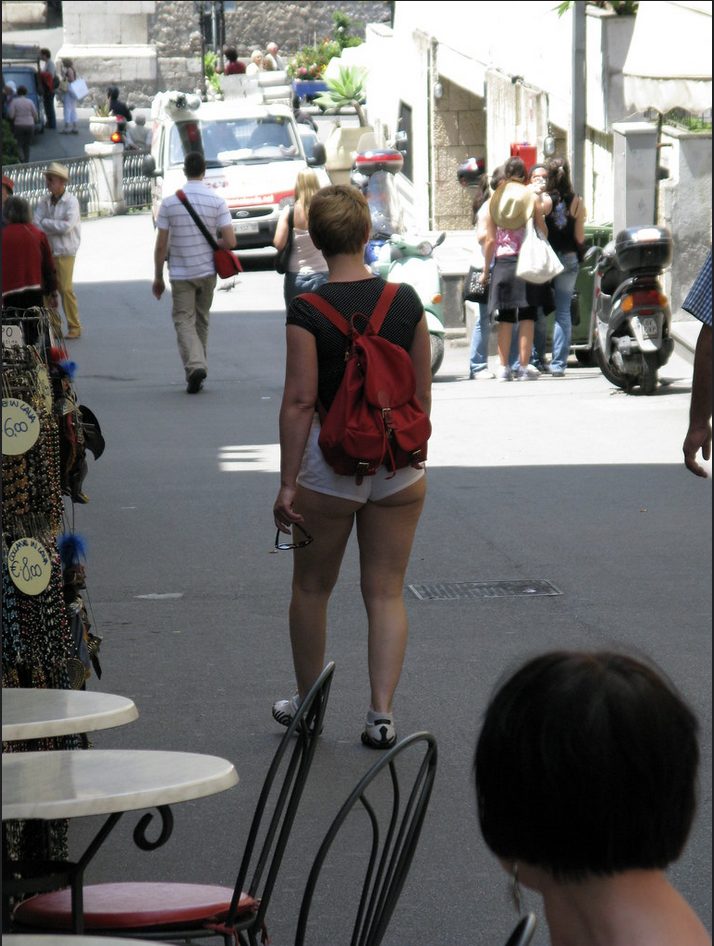
It is clear from a previous discussion that street harassment is a real problem in DC. For obvious reasons, I’m sure it becomes worse in the warmer months. While I definitely advocate self defense classes, I thought for street harassment the best thing to do was to simply walk away, or nod and walk away with your head held high. I guess I’m wondering if folks feel that a self defense class is useful for dealing with catcalls? The class below mentions “prevention”. Sadly, from the stories I’ve heard, it seems impossible to prevent harassment. For those who have dealt with street harassment, would you feel more comfortable dealing with the situation after taking a self defense class?

“Dear PoP,

Thought your reader might be interested.

Get ready for Spring: Dealing with street harassment

With Spring, unfortunately, comes a huge increase in street harassment. Get ready for Spring by expanding your skills for dealing with the “hey babys” that may come your way.

Can you “ignore” street harassment? Of course you can. And you already know how to do that. This class will give you other options, making ignoring it only one in a range of skills to choose from, especially when ignoring it doesn’t seem safe.

The class will cover the range of self defense skills–prevention and awareness, verbal self defense, and physical techniques-that you might need in dealing with street harassment. Most of these skills can also be transferred to other irritating or dangerous situations in the rest of life.

* Saturday, April 18, 1-4 pm
* For women and teen girls ages 16+
* In NW DC near Howard University, Georgia Ave., and the Green Line
* $44.Register with a friend or family member and get $5 off each

www.defendyourself.org


“Dear PoP,

Enjoying today’s gorgeous weather by eating a delicious lunch @ Logan Tavern & watching Logan staff plant their sidewalk flowerboxes. It doesn’t get more springlike than this!”

Every Spring I say it’s my favorite time to live in DC. Then I say the same thing every Autumn…


April 17-19, 2009

Atlas Performing Arts Center

1333 H Street NE

Washington, DC 20002
Tickets: visit http://www.atlasarts.org/ or call (202) 399-7997
Last week, the PoP community discussed and debated at great length the recent increase in youth violence seen and reported on the streets of Columbia Heights, Petworth, and the surrounding DC neighborhoods. Many potential solutions were offered. But with the DC government’s systemic failures to overcome — not to mention the vast socioeconomic gap between DC’s haves and have-nots — the problem of escalating youth violence can feel hopeless at times. And with the news of an unending parade of violent youth offenders overrunning our outmoded juvenile justice system, it’s easy to forget that most teenagers in DC — whether rich or poor, black or white — are inherently decent, non-violent kids worthy of our support.

An inspiring group of these forgotten teenagers participate in DC’s City at Peace, “a nationally recognized nonprofit organization that empowers teenagers to create safe, peaceful, and productive lives and communities.” Each year, City at Peace organizes DC teenagers as they write and star in their own musical play, based on the tenets of non-violent conflict resolution.

City at Peace’s last two spring performances did much to restore my personal faith in our next generation. Teenagers who, at first glance, appeared as menacing as those I’d cross the street to avoid late at night, sang and danced and acted their way into the audience’s hearts. I don’t know the particulars of this year’s play, LIVING [in theory] (taking the stage at the Atlas Performing Arts Center on April 17, 18, and 19), but I can assure you there’ll be plenty of artistic talent on display. More important, I promise you’ll witness dozens of DC teenagers — most of whom are as economically and socially disadvantaged as their violent counterparts — performing on stage out of a genuine sense of hope and pride and confidence in their generation.   
I’m all in favor of organizing communities for safer neighborhoods, and petitioning the DC government to reform the juvenile justice system, before any more youth offenders are hardened into lifelong, violent criminals. I also believe that, as cliché as it sounds, everyone has the potential to make a difference in a young person’s life, no matter how powerless he or she may feel. But it’s ultimately programs like City at Peace that can, with our support, equip a whole legion of peace-loving young men and women with tools for curbing the increasing violence and nihilism of their generation. So check out the show this weekend — you won’t be disappointed!
~ 2 bars + 3 stars


View More Stories