Photo by PoPville flickr user egr5005
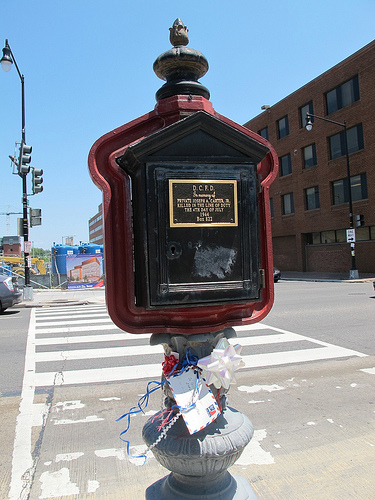
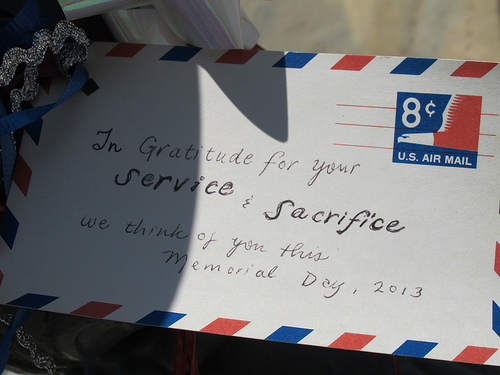
Remembering those who made the ultimate sacrifice.

Photo by PoPville flickr user egr5005
Remembering those who made the ultimate sacrifice.
click map to enlarge. Source: Library of Congress
Map of the Week is written by David A., a systems librarian and map geek living in Mt. Pleasant. David previously wrote about Palisades of the Potomac from 1890.
This week’s 1879 map provides a view of Arlington and Alexandria when they were part of the federal district. If you look close, you can see that this map splits the former Alexandria County into three different smaller “districts”: the Washington District to the west, the Jefferson District to the east and the Arlington District in the middle.
Notable features include the names of many of the area’s landowners, the names of railroad stations, and the C&O Canal segment connecting Alexandria to the aquaduct bridge to Georgetown. The canal, also known as the Alexandria Canal, would be abandoned seven years after this map’s printing.

I sometimes take for granted how incredible these fire box conversions are. I haven’t seen this one in years. It’s especially awesome how they incorporate both sides into the sculpture. It’s also pretty brilliant how they highlight different periods of history.

Description, artist and dedication after the jump. (more…)

click map to enlarge. Source: Library of Congress
Map of the Week is written by David A., a systems librarian and map geek living in Mt. Pleasant. David previously wrote about a James E. Clements’ map of Washington City from 1891.
This eye-catching 1890 poster advertised a brand new neighborhood just north of the Georgetown Reservoir in the Palisades, a section of the district that extends from west of Georgetown to the Maryland border. The Palisades grew along the the Washington and Great Falls Electric Railway, a streetcar line that ran from Georgetown to Cabin John.
The accompanying images are probably more interesting than the map in the center. MacArthur Boulevard runs over the Cabin John Bridge, which still stands today.

Continues after the jump. (more…)

From Vaughn:
Boundary Stone Bike Ride
Capitol Heights Metro
Sunday, May 12th, 2013
9:30am – 5:00pm | FREE!Are you a history buff? Biking enthusiast? Regular old adventure seeker? Join me for a bike ride around the oldest federal monuments, the DC boundary stones.
I walked around the original DC border a few years ago with a friend, and I’d like to do it again – this time on two wheels instead of two feet.
Meet at the Capitol Heights metro at 9:30am – we’ll do the SE, SW, NW, and NE borders in that order. Feel free to join for 1, 2, 3, or all 4 sides. If you do it all, expect a solid day (~60 miles) of riding – it’s an urban ride, stopping for lights (and stopping to check out the stones!), so it’ll take longer than your normal weekend jaunt.
Here is the route. I highly recommend checking out the route in conjunction with this site.
This ride will be unsupported – I will provide directions (route + stone locations, places to stop for food & water, metro stops in case you need/want to stop riding), but you should be prepared with everything else you might need: ID & cash, pump & patch kit, etc. We will be riding on regular roads, so take necessary precautions.
Boundary Stone Public House and DC Brau Brewing Company have agreed to sponsor this excursion: the first 50 riders to show up on Sunday will get Boundary Stone commemorative bike ride tshirts, and there will be DC Brau Corruption IPA on tap for $4 at the post-party! Whether you ride one side or all four, join us at the bar from 5pm til ??

click map to enlarge. Source: Library of Congress
Map of the Week is written by David A., a systems librarian and map geek living in Mt. Pleasant. David previously wrote about a Topographical sketch of the environs of DC from 1867
Title: James E. Clements’ map of Washington City and surrounding country
James E. Clements’ 1891 map is all about selling the capital region to prospective buyers of real estate. The copy boasts of the region:
The people are neighborly, hospitable, cultivated and generous, and political liberty and freedom of opinions are enjoyed untrammeled and to their fullest extent. The taxes are low, and the public roads are good, being rapidly converted into solid stone and gravel highways. In fact, everything here is combined to make homes in this section comfortable, profitable, enlightened, and happy.
The mustachioed Clements is pictured at the top left of the map and sells the region thusly:
There is no safer investment of money than in Real Estate, and there is no surer place to invest that near Washington City, the Capital of the Nation. Real Estate here will never depreciate, but to the contrary will ever continue to enhance in value. Now is the time to purchase.
Yours, very truly,
James E. Clements
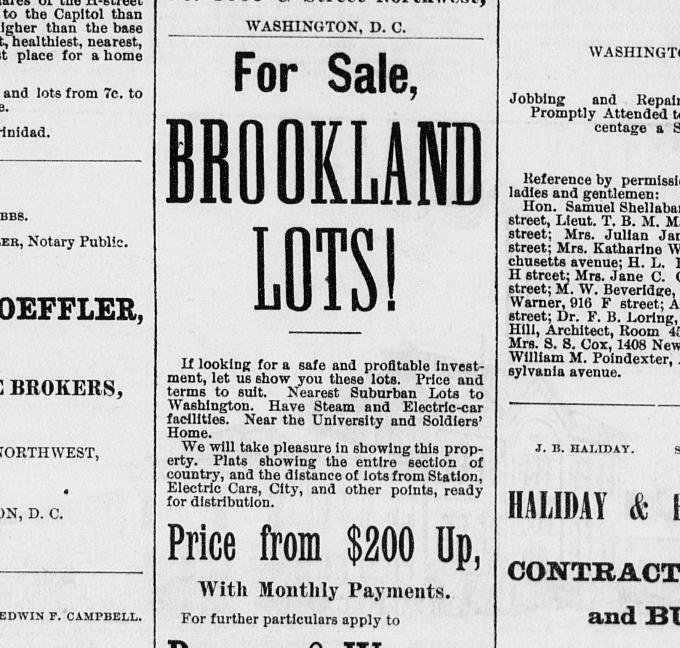
In 1891, lots in Brookland were priced starting at $200. That’s a little over $5,000 in today’s money.
Streets of Washington, written by John DeFerrari, covers some of DC’s most interesting buildings and history. John is the author of Historic Restaurants of Washington, D.C.: Capital Eats, to be published this September by the History Press, Inc. John is also the author of Lost Washington DC.
One of the stateliest private buildings in Washington is the old Masonic Temple at 13th Street and New York Avenue NW, completed in 1908 and now home to the National Museum of Women in the Arts. Like other Masonic temples, the imposing structure was built with unique cross purposes; it was meant to be both a public forum for lectures and performances as well as a private place for the fraternal order’s meetings and rituals. Since the 1980s, this distinctive Renaissance Revival palace has had a remarkably fitting second life as a museum, and now the NMWA is looking to preserve the building for many more years with much-needed roof repairs. As a participant in the Partners in Preservation program, the museum will be hosting a festive open house this Sunday, May 5, from 12 to 5, offering a great, free opportunity to see this extraordinary building up close and appreciate the art it now displays.

Photo by the author.
The sharp-eyed visitor will notice decorative touches denoting the building’s original use as a Masonic Temple. Freemasonry is a centuries-old tradition descended from medieval stone masons’ guilds, although modern masons are a strictly fraternal order dedicated to benevolent acts. Masons organize themselves into lodges, which are chartered by regional Grand Lodges. DC got its own Grand Lodge in the mid 19th century. In 1870 it built a temple, still standing, at 9th and F Streets NW, but by the 1890s, with 49 Masonic lodges chartered throughout the city, the old hall was no longer adequate. The Masons resolved to build a magnificent new temple at a suitably prestigious location.
The site selection committee received some 20 offers for sites all around the city, and in 1899 they chose the distinctive trapezoidal corner lot formed by New York Avenue, 13th Street, and H Street NW, a prominent location that would allow unobstructed vistas of the new temple on three sides. The lot, once a knoll with a clump of trees known as “Seven Oaks,” cost $115,000.
Continues after the jump. (more…)

Click map to enlarge. Source: Library of Congress
Map of the Week is written by David A., a systems librarian and map geek living in Mt. Pleasant. David previously wrote about Washington, the beautiful capital of the nation – 1922.
Title: Topographical sketch of the environs of Washington, D.C. : (survey of locality for public park & site for a presidential mansion), 1867
This shaded relief map of present-day Rock Creek Park and surrounding lands comes from an 1867 survey ordered by the U.S. Senate in 1866. Michler’s map does a great job illustrating the rolling altitude of the northern part of the District. Aside from topographical features, the map includes some cadastral information (land holdings) and some road names.
Rock Creek Park did not come into being until 1890, but this map had a role in its beginnings. The U.S. Senate commissioned it out of dissatisfaction with the White House building and the desire for more park land. Rock Creek Park: An Administrative History, by Barry Mackintosh, tells the story:
On June 25, 1866, the United States Senate directed its Committee on Public Buildings and Grounds “to inquire whether a tract of land of not less than three hundred and fifty acres, adjoining, or very near this city, can be obtained for a park and site for a presidential mansion, which shall combine convenience of access, healthfulness, good water, and capability of adornment.” Sensing that it may have overly limited its options, the Senate passed another resolution five days later lowering the minimum size to 100 acres. Then realizing the need for professional landscape gardener or topographical engineer to examine the different tracts of land offered to the committee” and to report on their suitability for the desired purpose.
Like many of the other maps featured in this series, this map includes a race course. The Piney Branch Race Course sat not far from the present-day Rock Creek Park Tennis Center. T. Rohr’s Piney Branch Hotel served visitors to the track. An 1865 ad in the Daily National Republican newspaper boasted the following event at the race course:

Photo by PoPville flickr user Sanjay Suchak
From an email:
Pleasant Pops will be distributing thousands of their handmade locally sourced ice pops today around DC today in Partnership with American Express and the National Trust for Historic Preservation in order to promote the first day of voting in the Partners in Preservation Contest. Here’s all the sites and details.
Pleasant Pops will be bringing our truck “Big Poppa” today (4/24) to Foggy Bottom [H St NW between 21 and 22nd] to distribute free pops noon to 4PM.
There will be another giveaway on Friday at Farragut Square 11AM to 3PM (4/26).
Additional giveaways are scheduled for May 4 in Dupont Circle (12 noon to 4PM) and May 10 in Chinatown (12 noon to 4PM)
Streets of Washington, written by John DeFerrari, covers some of DC’s most interesting buildings and history. A version of the following article will appear in Historic Restaurants of Washington, D.C.: Capital Eats, to be published this September by the History Press, Inc. John is also the author of Lost Washington DC.
Of all the mid-20th-century icons of everyday life in Washington, Hot Shoppes ranks among the most memorable. The chain of casual drive-in restaurants founded by J. Willard “Bill” Marriott (1900-1985) in 1927 once had a commanding presence at dozens of sites across the metropolitan area, serving up thousands of fast, friendly meals every day. Beginning with a tiny root beer stand in Columbia Heights, the chain rose rapidly to prominence in the 1930s, expanded in the 1940s and 50s, and then almost as dramatically dwindled away in the 1970s and 80s, eventually slipping into history after winning the hearts and stomachs of several generations of Washingtonians.

Matchbook cover from the early 1960s (Author’s collection).
The Marriott rags-to-riches story used to be one of the most oft told in the city. The son of a Utah sheep rancher, Bill Marriott was imbued at an early age with strong Mormon beliefs and an intense work ethic. As a teenager he experienced firsthand how hard it was to make a living raising livestock out west and resolved to get into a line of business less subject to market volatilities. In September 1921, after spending time in New York, Marriott passed through Washington on his way home to Utah. He spent a day sightseeing and noticed how vendors of ice cream, lemonade, and soda would sell out to the sweltering crowds practically as soon as they arrived on the scene with their carts. Six years later, when he was ready to start out on his own, Marriott decided to return to Washington to open a franchise selling A&W root beer.

The original Hot Shoppe on 14th Street (photo courtesy Historic Photographs collection, Marriott International Archives).
With a partner from Utah, Marriott rented out a slim corner storefront at 3128 14th Street NW in the Arcade Market, where the DC-USA shopping center now stands. Inside was a counter with nine stools. Offering frosted mugs of cold root beer for a nickel, Marriott did a booming business. Within a few months, he had gone out to Utah to marry his college sweetheart, Alice “Allie” Sheets (1907-2000), driven her back to D.C. in his rickety Model T, and opened his second root beer stand downtown at 606 9th Street NW, another resounding success. While Allie counted the nickels every evening, separating the ones stuck together with root beer syrup, Bill would wrestle with problems like how to keep expensive frosted mugs from shattering when they were plunged into boiling water to be sanitized. (With the help of well-connected friends, he was able to get D.C. regulations changed to allow cool chlorine-based sanitization.)
Continues after the jump. (more…)