By employment law attorney Tom Spiggle, who is barred and practices in the state of Virginia, with The Spiggle Law Firm.

Arguments in a lawsuit filed by a D.C. neighborhood commissioner in her individual capacity against the D.C. Zoning Commission were heard by the D.C. Court of Appeals.

The suit, filed by Bertha Holliday, alleges that the development proposed by Vision McMillan Partners (VMP) is racially discriminatory because it segregates the housing for Housing and Urban Development (HUD) supported individuals from the non-HUD housing, and therefore should never have been approved.

Ms. Holliday, in making her case, claims that 90 percent of the individuals that receive housing assistance from HUD are African-American. VMP’s proposed plan shows the low-income housing units of its development being in one area, having their own entrance, common areas, elevators, and ventilation units. The effect, she said, was to segregate African Americans from others.

“Race is a protected class under the United States Constitution, meaning that any attempt to discriminate based on an individual’s race may be found unconstitutional and unlawful,” said Tom Spiggle, an employment law attorney with The Spiggle Law Firm. “This lawsuit is against the D.C.  Zoning Commission, alleging that, in approving the proposed development, the Commission is allowing discrimination based on race.”

“Racial discrimination claims are very complex and require a very involved understanding of the Federal laws governing those claims,” said Mr. Spiggle. “Ms. Holliday’s claim, however, seems to satisfy many of the requirements of a prima facie claim, including the individuals being members of a protected class, the discriminatory result, and the fact that there are other alternatives to the layout of the development that do not require separation of low-income housing from non-low-income housing.”

In addition to being complex, each Federal Appeals Court Circuit has different standards for successful claims of discrimination. This means that a plaintiff in one of these actions must know the specific standard they must use to show for a prima facie case of racial discrimination. However, as a general rule, the complainant must show that he or she was the member of a protected class (race in this instance), that the law or rule in question had a discriminatory effect, and that discrimination caused injury to the complainant.

In the meantime, the development of the 25-acre tract being questioned by Ms. Holliday is on hold, and has been on hold since 2016, when the Appeals Court entered an indefinite stay on construction. At the very least, the site will not be developed until a decision regarding its discriminatory nature is reached.


District Floor Depot is a new hardwood flooring retail store located at 1600 Rhode Island Ave. NE.

We sell quality hardwood floors directly to customers at every day low prices. After years of renovating hundreds of houses, we have developed a passion for home renovation and interior design. Flooring choices can build the foundation for a great design and influence the character of the rest of the house.

We started District Floor Depot to help customers make great design choices and to make the best flooring options accessible to them at a great price.

We opened our first store in March of 2017. District Floor Depot has over 300 styles of top quality flooring available including everything from hardwood to bamboo and reclaimed to vinyl. We offer fast-delivery, installation services, a local showroom and can beat the prices of local contractors with mill-direct prices.

The flooring choices we offer are responsibly sourced, giving our customers peace of mind. Our design consultants and associates are professional, knowledgeable and detail oriented to best help you with your next project. We would be happy to personally visit your work site and bring any samples you’re interested in. (more…)


We all know the weather is supposed to be amazing this weekend.

Throw on your shades, maybe have one (or several) too many brunch mimosas and check out some of our suggested open houses going on across the district. To see the entire DC Open House List click here.

  • 1301 20th Street NW #416 — $280,000 — Dupont Circle
    Open Sun. 2-4PM — Gene Sung
    Bright studio in The Lauren, a boutique condo building just a block from the circle.
  • 432 Evarts Street NE #4 — $389,000 — Brookland
    Open Sat. & Sun. 2-4PM — Craig McCullough
    “Beautiful 2-year-old condo located on the edge of Brookland and Eckington.”
  • 5125 3rd Street NW — $735,000 — Petworth
    Open Fri. 5-7PM, Sat. & Sun. 1-3PM — Matthew Similuk
    If you act quick, maybe they’ll throw in that WMATA Metro Map shower curtain.
  • 1311 Delaware Avenue SW #S741 — $235,000 — Southwest Waterfront
    Open Sat. 12-2PM & Sun. 1-3PM — Peter Paglio
    “Unbeatable location in sought after SW DC!”
  • 1907 11th Street NW #1 — $674,500 — U Street
    Open Sun. 1-3PM — Jessica Evans
    It may technically be a condo, but this home feels much more like a townhouse, except with no stairs.

By personal injury lawyer Cade Parian, who represents clients in Georgia, Alabama and America with The Parian Law Firm.

Fighting the opioid crisis in America should be a priority for every health official in this country. Dr. Jerome Adams, the U.S. Surgeon General, hopes to prevent deaths resulting from an opioid overdose by advocating for Americans to carry Naloxone, the “overdose antidote”.

At the National Rx Drug Abuse & Heroin Summit, which took place in Atlanta on April 2-5, Dr. Adams discussed his new health advisory. The annual Summit’s mission is to discuss prevention and treatment for health issues in the United States.

Naloxone, which costs $80 for a single dose and is covered by insurance, is an injectable medication given to someone who is overdosing on an opioid — either a prescription opioid or heroin. It can also be sprayed in the nose. It is referred to as an opioid antagonist and can reverse the effects of the drug and restore normal breathing.

Dr. Adams says that all opioid users and their family and friends should have access to the antidote, which is available over the counter. According to the nation’s head doctor, 77 percent of these overdoses occur outside of any type of medical setting, away from any health professionals, so having greater access to this medication may save lives.

People who do not have insurance, can obtain this medicine from local health programs for free or a reduced cost. Dr. Adams also wants more federal money to go towards enabling this access.

“The opioid crisis in this country is a sad but growing reality in this country, and it affects us here in Georgia,” said Cade Parian, personal injury lawyer at The Parian Law Firm. “Giving those affected by this terrible crisis the option to carry Naloxone and use it if the need arises is a positive step towards preventing fatal overdoses and should be encouraged. Contrary to what many people believe, these deaths do not result only from heroin overdoses; often they are the result of a doctor legally prescribing pain medication for an injury and not properly overseeing a patient’s usage and dosage, resulting in an overuse and addiction. These doctors and drug companies who promote the drugs’ overuse should be held responsible.”

Naloxone, also called Narcan, can be bought in the District of Columbia and in all but the following states at either CVS or Walgreens pharmacies:

  • Alaska
  • Arizona
  • Delaware
  • Hawaii
  • Idaho
  • Massachusetts
  • New Hampshire
  • North Carolina
  • West Virginia
  • Wyoming

In 2016, more than 42,000 Americans died because of an opioid overdose, up from 33,251 in 2015. Hopefully solutions like this will help to bring this number down.


As wedding season approaches, a local company is offering a unique way for engaged couples to meet potential planners, vendors and local sponsors, Chacho USA, Sankofa Beer Company and Capital Aesthetic + Laser Center.

An Artistic Wedding Experience on H Street is taking place at Gallery O on H on April 22 from 2-6 p.m. The interactive wedding-themed day party will feature live music performances, food and cocktails, fashion and art exhibits, and live beauty demonstrations, including a men’s’ grooming lounge, for ample wedding inspiration.

Most importantly, it’s a chance for couples to interact with top wedding planners, culinary experts, jewelers, stylists, designers and other specially-curated professionals. Guests can also sign up for demonstrations, stage a pop-up wedding shoot and rate their favorites to win prizes.

The one-of-a-kind experience is hosted by Bespoken DC, a D.C. based company that specializes in high-end “experience curation” for parties, elopements and travel adventures. General admission tickets are $40 per person and include complimentary cocktails, hors devours, and desserts. Guests who spring for $50 VIP tickets will also get a tailored gift bag, exclusive access to event partners and a guided tour of Gallery O on H’s carriage house.

The chance to meet the perfect professionals for your dream wedding? Priceless.


This column is written by Metro DC Houses, a local real estate team serving DC, MD, VA made up of Colin Johnson, the immediate past President for the D.C. Association of Realtors and Christopher Suranna, the current President for the D.C. Association of Realtors.

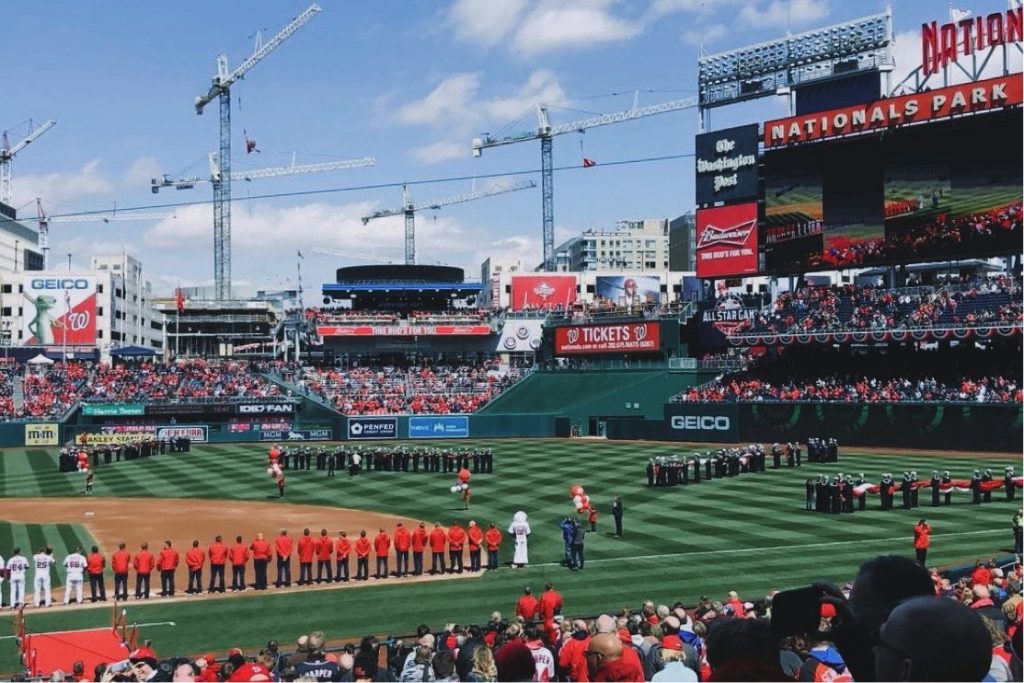
For over 10 years, the Washington Nationals have called Navy Yard (or Capitol Riverfront) their home.

During this time, the neighborhood has seen a resurgence of housing and commerce replacing what was at times considered DC’s industrial backyard.

While Nationals Stadium has been a key cornerstone of this success, such a rapid change could not have happened without a concerted effort by city officials, developers and local residents.

The Capitol Riverfront BID sees the area becoming the, “next-generation neighborhood for business, recreation and city life.” So much so, that Mayor Bowser has even pitched it to Amazon for their future HQ2 site.

With so much development, we thought we’d take a look at the numbers from the perspective of a future homeowner, renter or investor that has been wondering if the Navy Yard is right for them. (more…)


Real Estate Fresh Finds is a weekly selection of newly-listed properties in the District, brought to you by Real Living At Home.

The weather in the district has been just as up and down as the housing inventory the past few weeks. There’s close to 300 new listings to hit the market within the past week, meaning we’re back on the upswing and the 80 degree weekend weather seems to agree. Here’s some of our suggested (and hot) Fresh Finds below:

  • At a soaring $11.2mil, your Most Expensive Home of the Week is this monstrous French Normandy style and 43,000+ sq. ft. land that includes 2 “adjacent, buildable lots,” but that price doesn’t even begin to cover the cost of the proposed mansion renderings.
  • Two bedroom/2 bathroom “Recently renovated and updated, rowhouse-style living with the price and convenience of a condo” just 2 blocks from U Street Metro.
  • Petworth condo with 2 beds and 1 bath for only $230k is your REO/Bank-Owned Property of the Week.
  • The Worst Photos of the Week go to this $2.3mil Ledroit Park listing that only has 4 photos — all of them blurry exterior shots — 1 of which is a black and white that I assume was taken in 1880 when it was first built.
  • A 1 bedroom “tastefully updated condo” less than a block away from Potomac Avenue Metro Station.

By criminal defense attorney Patrick Woolley, who is barred and practices in the state of Virginia, with Price Benowitz LLP.

Non-hallucinogenic medicinal marijuana, or cannabidiol, continues to gain legislative and medical support for its use in combating nausea and pain. Legislators in Virginia are considering a bill that would allow physicians to broadly prescribe cannabidiol (or cannabis oil, as it is commonly known) for any medically-diagnosed condition.

Cannabis oil has gained popularity recently as studies have shown the efficacy of marijuana in pain treatment. As there has been no corresponding increase in support for legalization of marijuana at a federal level, doctors and scientists have attempted to come up with alternative ways of delivering the benefits of marijuana in a form that does not run afoul of current federal laws.

Unfortunately, cannabis oil is considered a “Schedule 1” narcotic by the Drug Enforcement Agency (DEA), meaning that from a federal standpoint, its production and distribution are illegal. However, many producers of cannabis oil claim that their products are derived from the hemp plant, making it legal.

Laws related to the possession, use, production and distribution of marijuana and any of its extracts currently vary from state to state. Several states have completely legalized the use of marijuana. Others still ban it completely, even when only used medicinally. Still others allow medicinal use but not recreational use.

“The state of the law related to marijuana and its derivatives throughout the United States is in an incredible amount of flux,” said Patrick Woolley, a criminal defense attorney in Virginia. “It is incumbent upon individuals who are looking to use cannabis oil or other products to ensure that use and possession of those items will not put them in serious legal jeopardy.”

What does this mean for a Virginia resident seeking to use cannabidiol for medical purposes? Currently, Woolley said, the use of cannabis oil is still illegal, even for medicinal purposes. If the proposed law passes, “the use of cannabis oil with a doctor’s prescription would be legal, but possession without a prescription would still be a crime,” said Woolley. Additionally, possession of any other marijuana derivative, or marijuana itself, would not fall under the protections of this law.

Virginia residents who do avail themselves of any new Virginia law related to cannabis oil should be aware that the legality of something in Virginia does not make it legal everywhere else. If you are traveling to another state or another country, you should make yourself familiar with the possession and use laws of those states and countries, as well as any state or country you may be traveling through. You can still be charged with a crime in another state.


By medical malpractice attorney John Fisher, who practices in New York State with John H. Fisher, P.C.

A bill passed by the House of Representatives proposes to seriously curtail the ability of injured individuals to obtain non-economic damages in medical malpractice lawsuits, among other things.

The bill, proposed by Rep. Steve King (R), Iowa, covers any medical procedure that results in harm to an individual where the Federal government made payment either in the form of Medicare or Medicaid coverage, or through subsidy or tax benefit.

As the Affordable Care Act provides subsidies for all that qualify, the pool of individuals that would be affected by this change is both quite large and generally made up of lower-income, poor, and elderly individuals.

The stated goal is to reduce the amount paid out by the Federal government for unnecessary treatments that are only ordered by doctors to ensure they are not held liable for medical malpractice. King also claims that these changes will reduce doctor malpractice insurance premiums by up to 50 percent.

The bill puts limits on how much an attorney can receive in contingency fees, and reduces the statute of limitations to either three years from the date of the service that caused the injury or one year from the date the patient discovers the injury, whichever occurs first.

“Frivolous lawsuits are an unfortunate fact of life in all areas of the law,” said John Fisher, a medical malpractice attorney with the law firm of John H. Fisher, P.C. “However, judges and juries are normally pretty good at sniffing out the ones that lack good basis, and the attorneys representing the doctors are not slouches either. This law is trying to address the spiraling costs of healthcare by limiting the rights of consumers.”

The primary limitation, however, is the limit on non-economic damages.

Non-economic damages are subjective, non-monetary losses such as pain, suffering, inconvenience, emotional distress, loss of society and companionship, loss of consortium, and loss of enjoyment of life. These damages are capped at $250,000.

“Two hundred fifty thousand dollars sounds like a lot of money,” said Fisher, “but non-economic damages are the funds that are most often used, for example to improve the life of a severely injured child by allowing access to programs and activities that they would otherwise not be able to afford. Why should that child not be able to enjoy life as fully as possible because of the negligence of a doctor?”

Most stakeholders in the medical malpractice realm agree that outrageously large non-economic damage awards are of no benefit to anyone, as they are very rarely upheld, explained Fisher.  “Unfortunately, they become the posters for tort reform, and eventually only harm consumers.”

Currently, the bill has been referred to Committee, meaning that for the time being, no changes have become law.


This is a sponsored column by attorneys John Berry and Kimberly Berry of Berry & Berry, PLLC, a local employment and labor law firm that specializes in federal employee, security clearance, retirement and private sector employee matters.

When an individual with a security clearance is submitted for a security clearance upgrade, any previously existing security concerns are scrutinized again, but at a higher level.

For instance, if an individual has been previously approved for a Secret level clearance and is then submitted for a Top Secret (TS) level clearance by their employer, the individual could be denied based on the same concerns that existed when he or she was approved for a Secret level clearance.

This more often occurs when the individual holds a Top Secret (TS) clearance but is applying for Sensitive Compartmented Information (SCI) access, “TS/SCI.”

Clearance Upgrade Dilemma

One common problem with security clearance upgrades occurs when an employer submits a request to upgrade an individual’s security clearance (e.g., from Secret to Top Secret).

Sometimes the individual is made aware of the requested upgrade by the employer and sometimes he or she is not. It is possible that an individual can be approved for a lower level security clearance with existing security concerns, but that he or she can still be denied when submitting for a security clearance upgrade even if there are no new security concerns. (more…)


View More Stories