Streets of Washington, written by John DeFerrari, covers some of DC’s most interesting buildings and history. John is also the author of Lost Washington DC.
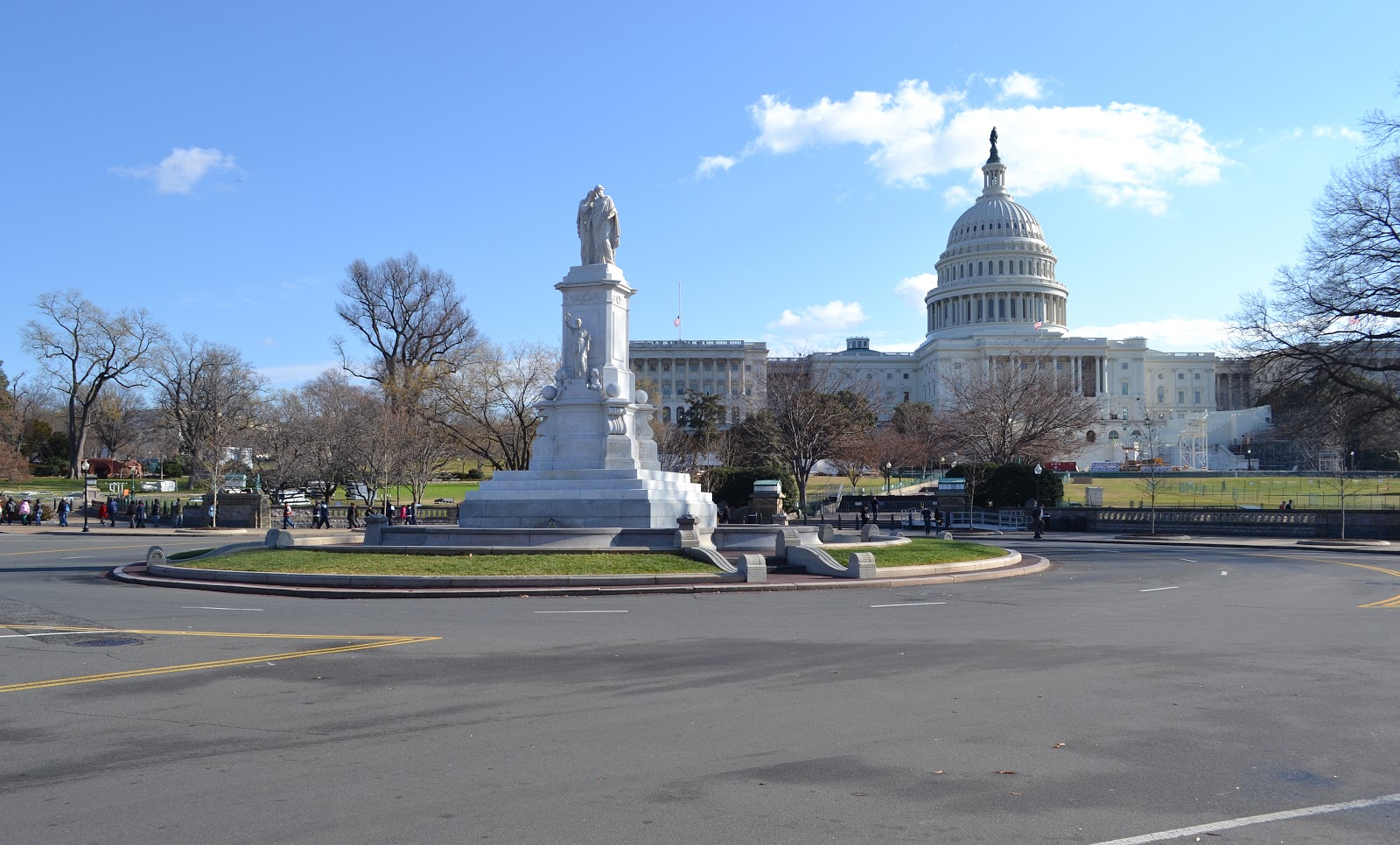
“Why is peace such an untellable tale?” wonders one of the patrons in a Berlin library as he is observed by a kindly angel in Wim Wenders’ classic film, Wings of Desire (1987). Just as peace is hard to write about, so it seems to be hard to erect a memorial to. We have countless monuments to wars and their heroes, but relatively few to celebrate peace. Even our Peace Monument, erected in 1877 at the foot of Capitol Hill where Pennsylvania Avenue ends, is really more about war than peace, and like the city’s many war memorials, people have bickered over it at least as much as they’ve celebrated its theme of tranquility.

The Peace Monument (photo by the author).
The monument was the brainchild of Admiral David D. Porter (1813-1891), one of the top two naval commanders of the Civil War. In 1864 Porter had led the successful naval campaign to take Fort Fisher at Wilmington, North Carolina, in what would be the last major naval campaign of the war. It was after the fall of Fort Fisher that Porter began a campaign to have a memorial erected to all of the brave Navy men who had been killed in the war, just as his famous father, War of 1812 hero David Porter (1780-1843), had commissioned the first naval monument to heroes of the Barbary Wars. That memorial, now known as the Tripoli Monument, had been completed in 1806 and originally stood in the Navy Yard but was moved to the Naval Academy in Annapolis in 1860.
When the Civil War ended, Secretary of the Navy Gideon Welles (1802-1878) made Porter superintendent of the Naval Academy, where he would go on to institute many reforms that enhanced the professionalism of the navy. While at the Academy, Porter worked to get the new naval monument built so that it could join the venerable Tripoli Monument at Annapolis. He collected contributions from Naval officers and seamen totaling $9,000 and sketched out the design of the monument himself. Sculptor Franklin Simmons (1839-1913), who also sculpted the equestrian figure of General John A. Logan at the center of Logan Circle, was hired to carve the figures for the monument in fine white Carrara marble in his studio in Rome. So far so good. A reading of the National Register listing for Civil War monuments in Washington suggests that the ensuing production of the memorial was accomplished with efficiency and purpose: “The sculpture was erected by the government with contributions from Navy personnel under a Congressional Act approved July 31, 1876 (19 Stat. 114). It was sculpted and carved in Rome in 1877 and dedicated in the same year.”

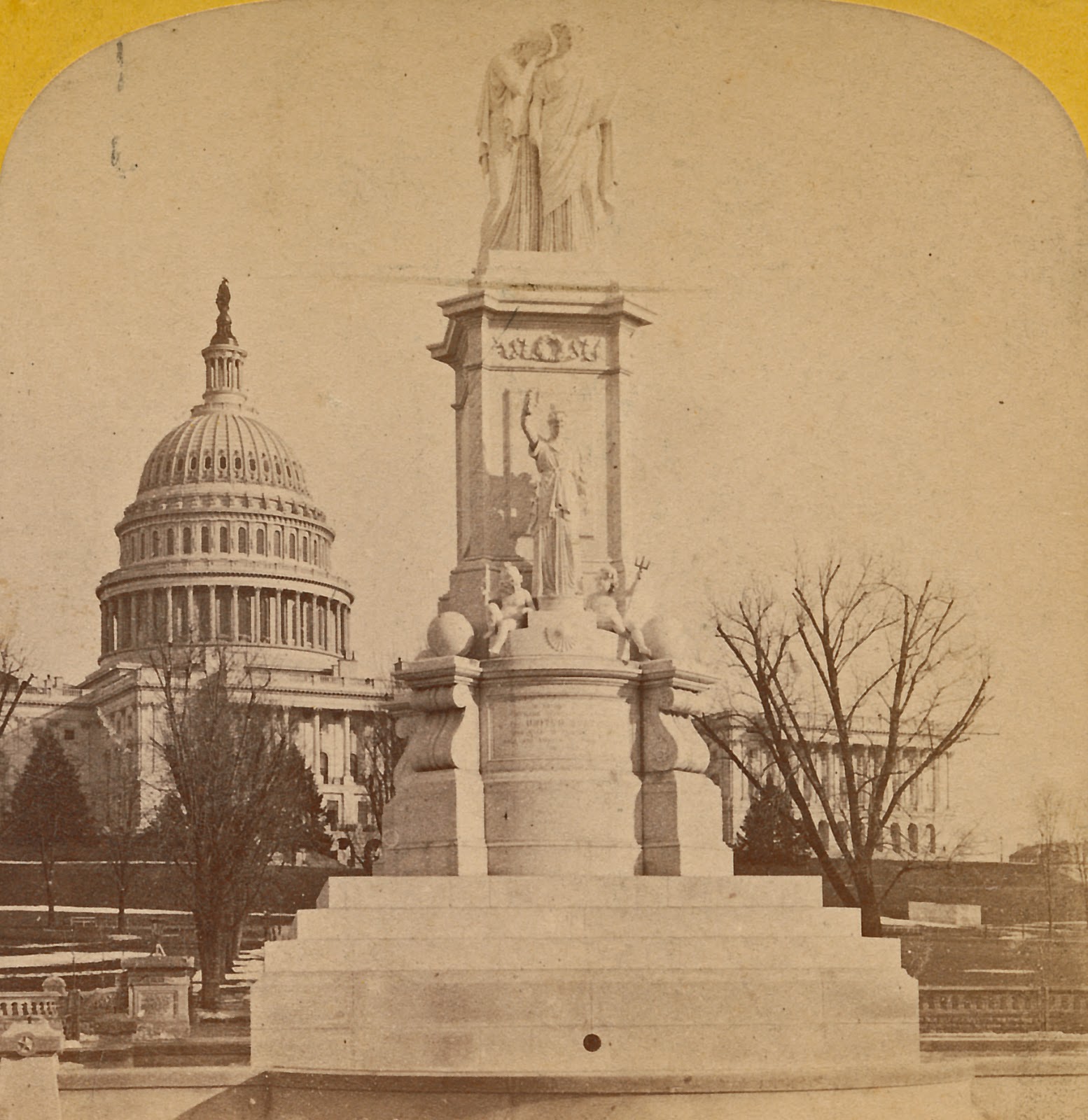
The Peace Monument c. 1880, from a stereoview in the author’s collection.
However, things didn’t really go quite that smoothly. For one thing, it seems that Admiral Porter and Secretary Welles may not have gotten along well together. According to retired Navy officer C.Q. Wright, who wrote about the Peace Monument in the Washington Post in 1923, “the few surviving letters which passed between [Porter and Welles] concerning the location of this monument seem to indicate indifference in the mind of Mr. Wells to the erection of the monument or a quiet disapproval of the affair in which he may have thought he saw sign of the high-handed self-assertion of Admiral Porter.” Wright suggests that friction between Porter and Welles may have led to changes both in where the memorial was to be placed and how it was to be designed.
Continues after the jump. (more…)