Streets of Washington, written by John DeFerrari, covers some of DC’s most interesting buildings and history. John is also the author of Lost Washington DC.

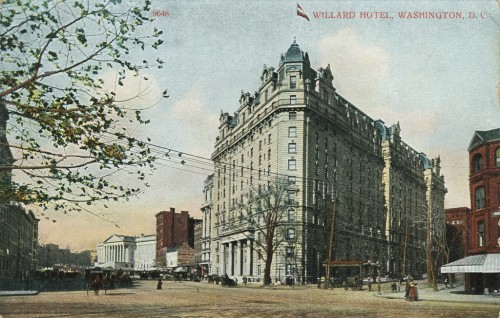
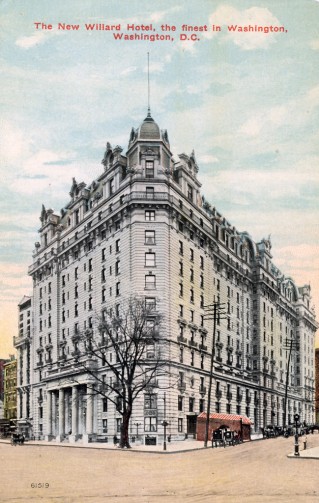
Of Washington’s great hotels, the Willard is one of the most celebrated and easily recognized. Many people know that President Lincoln stayed at Willard’s before he was inaugurated in 1861. Others believe (incorrectly) that the word “lobbyist” was coined to refer to promoters of various causes who hung around the Willard’s lobby, hoping to buttonhole President Ulysses S. Grant for favors. But fewer realize how many incarnations the old hotel has had, that it began life as a rather mediocre hostelry, or that many of the famous events in its history occurred in a very different, earlier building.


Early view of Pennsylvania Avenue with the City Hotel on the right (Source: Library of Congress).

There has been a hotel on the northwest corner of 14th Street and Pennsylvania Avenue, NW, since 1818, almost three decades before the Willard brothers showed up to take over its operations. The prominent early Washington landowner, John Tayloe (1770-1828), whose elegant Octagon House is one of Washington’s great mansions, acquired this property and built a row of six townhouses here as an investment in 1816, renting out the corner building to be used as a hotel two years later.

Continues after the jump. (more…)


Then and Now by the House History Man is a series by Paul K. Williams. Paul has been researching house histories in DC since 1995, having completed more than 1,500 to date. Read Paul’s previous post here.

Many people can’t imagine Cleveland Park without its leafy canopy of trees, but the reality is that it was developed in the early 1900s just a suburban tract is today; trees clear cut for the most part, and the new homes surrounded by young saplings and little else. This 1904 view of Newark Street, NW from the Moore & Hill Real Estate brochure shows what the original residents would have seen when they moved in. The Tudor house on the right at 2941 Newark was built at a cost of $8,000 by the Cleveland Park Company in 1898 and was designed by Robert Head. Behind it is 2945 Newark, which was built by John Sherman in 1902-1903 at a cost of $5,500.

Today one can barely see some houses from the street, and mature trees provide privacy between each house. This photograph from 2002 from the same front yard illustrates the change during the last 100 years, from open yards to a lush treed setting.

(Photographs from Washington Then & Now by Paul K. Williams and T. Luke Young (Arcadia, 2002). Contemporary photograph by T. Luke Young)


I never thought I’d see something cooler than the Glass Forest in the Palisades. Then I met Doug Dupin and the Palisades Museum of Prehistory (PMOP). So freaking cool. At first I was simply admiring the unusual little building and I just thought it was cool looking work shed. Turns out I was way off. Here’s the mission of PMOP:

The Palisades Museum of Prehistory (PMOP), incorporated in Washington DC, is a non-profit regional organization dedicated to promoting the awareness and preservation of prehistoric artifacts in the Palisades of Washington DC.

It is little known by most residents of our area that humans have occupied what is now the Washington, DC metropolitan area for at least 12,000 years. In particular, the Palisades of Washington DC is especially rich in the history of early humans. In light of the area’s rapid rate of development, much evidence of early man’s presence is being lost. (more…)


Click to enlarge

From a press release:

Today, on the third anniversary of the worst rail accident in the District’s history, Mayor Vincent C. Gray fulfilled a promise made last year to the families of the victims of the 2009 Metro crash by unveiling a bronze memorial plaque in honor of their loved ones.

The plaque is located on the New Hampshire Avenue/Charles Langley Bridge, above the approximate location of the accident, which claimed the lives of nine victims and left 80 passengers injured.

“Today we unveil a memorial plaque that will serve as an everlasting testament to these nine members of our community,” said Mayor Gray. “They left us too soon, but we will forever remember what happened here. We will remember the fallen and find joy in their lives and the ways in which they enriched the world around them.”

Many family representatives of victims Jeanice McMillian, the train operator; Mary “Mandy” Doolittle; Veronica Dubose; Ana Fernandez; Dennis Hawkins; Lavonda “Nikki” King; Cameron Williams; Ann Wherley and her husband, Major General David Wherley, met with District officials on the design of the plaque and plans for a proposed memorial park and garden.

In addition to many of the victims’ family members, Mayor Gray was joined at the unveiling by Deborah A.P. Hersman, Chairman of the National Transportation Safety Board; Congresswoman Eleanor Holmes Norton; dozens of first responders from D.C. Fire & Emergency Medical Services and the Metropolitan Police Department; and other public safety officials who rushed to the scene from neighboring jurisdictions.

“Our public safety officials rescued, triaged, treated and transported the injured within the first two hours of the incident. They guided the public, calmed surviving victims and kept their families informed,” Mayor Gray said. “In short, their heroism was on display that day, and I extend my thanks and appreciation for the professionalism and bravery they bring to their jobs every day.”


Photo courtesy of Mayor Gray’s office


The following was written by Janice Kaplan.

Twenty-two massive Corinthian columns that stand in a meadow two miles from the U.S. Capitol represent a little-known piece of inaugural history. One of Washington, D.C.’s most notable and dramatic landmarks, the original National Capitol Columns are on permanent display at the U.S. National Arboretum where they may be viewed leading up to the inauguration, and throughout the year. The columns were the backdrop for two dozen presidential inaugurations from Andrew Jackson to Dwight D. Eisenhower. Abraham Lincoln, for instance, gave his famous second inaugural address in front of the columns.

“Anyone who has visited the U.S. National Arboretum, either during the day or when the Capitol Columns are dramatically illuminated from below at night, understands the power and grace of these historic pillars,” said Dr. Thomas S. Elias, director of the U.S. National Arboretum. “In this inaugural season, it is compelling to imagine the sights and sounds of past inaugurations while standing among the Arboretum’s columns.”

History

The sandstone columns were a source of great pride when they were installed at the U.S. Capitol in 1825. They were considered the splendid finish for a building that had taken 33 years to build. Their elaborate design is based on ancient Roman Corinthian columns used in the grandest public buildings of that empire. These classic architectural references were considered necessary for a young nation that wished to assert itself on the world stage.

The columns were removed from the Capitol in 1958 when they were declared too fragile to support the newly expanded dome and an extended east portico. They were replaced with marble replicas and the originals were put into storage on the banks of the Anacostia River.

Continues after the jump. (more…)


9th and T Streets, NW

Then and Now by the House History Man is a series by Paul K. Williams. Paul has been researching house histories in DC since 1995, having completed more than 1,500 to date. Read Paul’s previous post here.


9th and T Streets, NW in 1934

Located on the southeast corner of 9th and T Streets, NW is the Grand United Order of Odd Fellows (GUOOF) Building, which was draped with electric lights in 1934, just two years after its opening. The occasion was the 26th meeting of the GDOOF convention, held in August of that year. Local noted African American photographer Addison Scurlock took the dramatic image at night. The GUOOF was founded in 1843 as a separate, black organization from the white only Independent Order of Odd Fellows.

The building was designed by African-American architect Albert I. Cassell, and construction began in January of 1932. The building featured an auditorium among its 30,000 square feet of space, and was built at a cost of $150,000 during the height of the Great Depression. In 2001, the then abandoned building was completely renovated and turned into the Maya Angelou Public Charter School. It went on the market in 2011 for an asking price of $9.5 million.

(Vintage Photographs courtesy of Scurlock Studio Records, ca. 1905-1994, Archives Center, National Museum of American History)


Grace Deli, 701 H Street, NE

On Thursday we learned of the horrible murder of Hae Soon “June” Lim which occurred in Grace Deli at the corner of 7th and H St, NE. It is very painful to look at but an extremely moving memorial has sprouted at the corner.

CBS reported:

“Lim was just one year away from retirement according to her son.”

Rest in Peace June Lim.


Streets of Washington, written by John DeFerrari, covers some of DC’s most interesting buildings and history. John is also the author of Lost Washington DC.

When traveling to Washington in the early 1900s—by train, of course—you would have arrived either at the Baltimore & Ohio Station on Capitol Hill or at the Baltimore & Potomac Station on the western end of the Mall, where the National Gallery of Art now stands. Stumbling out of that station, in desperate need of lodgings, you would have to travel a block north to Pennsylvania Avenue to get to the famous National Hotel across the wide street on the right or the nearly-as-famous Metropolitan Hotel down the block to the left. But if you didn’t want to lug your bags that far, you could choose the St. James, immediately to your right, on the southeast corner of Sixth Street and Pennsylvania.

The St. James was never quite as prominent as its rival neighbors, although it strove for its own brand of distinction and capitalized on its strategic location. It was opened as Bunker’s Avenue Hotel by George W. Bunker (1834-1889) shortly after the Civil War. Bunker, a native of New Hampshire, had been a manager at the National Hotel for six years and had also worked at the Seaton House hotel, a block to the west. John Wilkes Booth stayed at the National in April 1865, and during the court inquiry into the assassination of President Lincoln, Bunker testified about Booth’s comings and goings, which he had observed.

Continues after the jump. (more…)


Photo of Row Houses in Petworth in 1920 via Library of Congress by photographer Horydczak, Theodor

“Dear PoPville,

I think it’s cool to see Petworth before the trees got established [1920]. Kinda looks like any other suburb. I’ve been trying to figure out where exactly the picture was taken. Anyone know?”

That is wild! To me, it looks like the view from where the Safeway is now on Georgia Ave looking west? Anyone else have a guess?


View More Stories