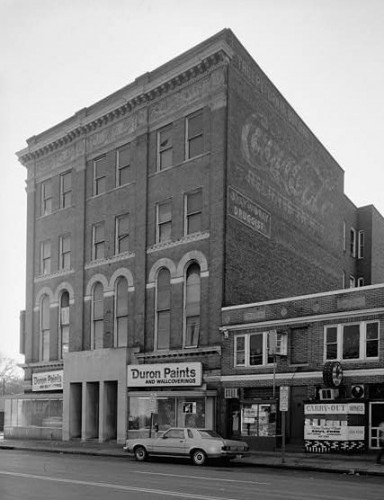
In 2010 it was a dry cleaners (Tony’s One Hour Martinizing Cleaners.) Wikepedia says Martinizing Dry Cleaning was:

a dry cleaning franchise founded in 1949. Martin Franchises, Inc., the parent company, is the largest dry cleaning franchise in the United States, with over 600 franchised stores worldwide. The family-owned company is based in Loveland, Ohio. The concept of One Hour Martinizing was pioneered by a New York chemist named Henry Martin in 1949. At the time, drycleaning was done with flammable solvents, so the plants were located remotely from the storefronts. A customer would drop off their cleaning “in town”, the garments would travel to the production facility to be cleaned and pressed, then they would return to the store several days later for pickup. But, by using a non-flammable solvent, the use of which was discovered by Mr. Martin, drycleaning plants could now be located much more conveniently, and the process could be carried out in a much more timely manner. The use of this non-flammable solvent was adopted throughout the industry and revolutionized the business in that facilities could better serve their customers and provide much faster turn-around on the orders, if need be. Operationally this has been termed “on-site cleaning” (as opposed to the “remote” cleaning of the past).

Cool.


Photo by PoPville flickr user Madame Meow

From a press release:

FREE to the public!
Click here to register.

Historic House Toolbox: Give Your House Some Love

Saturday, June 9, 2012
10:00AM-1:00PM

Hill Center at the Old Naval Hospital
921 Pennsylvania Ave, SE

Metro Station: Eastern Market

Join DC Preservation League along with our partners Capitol Hill Restoration Society and the Hill Center at the Old Naval Hospital for the opportunity to receive FREE individualized attention from contractors and seasoned professionals who will answer your questions on a range of topics.

Two on-site learning sessions will focus on researching the history of your property; and energy audits and greening your house without compromising its historic integrity.

Sessions

10:20am Audits You Don’t Need to Fear: A Path to Efficiency – James Carroll, EcoHouse

11:30am How To Research Your House – Peter Sefton, DC Preservation League


Then and Now by the House History Man is a series by Paul K. Williams. Paul has been researching house histories in DC since 1995, having completed more than 1,500 to date. Read Paul’s previous post here.

The triangular lot at the intersection of Connecticut Avenue, R and 19th Streets, NW was once the home to wealthy lumberman and Wisconsin Congressman Philetus Sawyer (1816-1900), who had a Hummelstown (brown) stone mansion build there in 1888, illustrated here. It was designed by William H. Miller, and built at an impressive cost of $80,000 at a time when the typical brick townhouse coast about $3,000.

Sawyer was elected to the House of Representatives in 1864 and served for ten years from 1865 until 1875. He returned to Congress in 1881 as a US Senator, and served two terms from 1881 to 1893. He became notorious for a bribery charge made against him by Congressman Robert La Follette to fix a court case against several former state officials. His estate sold the house for a record $100,000 in 1900.

As Dupont Circle became more commercial along its major corridors, homes were demolished after the turn of the century, or their ground floors converted into retail shops, and upper floors to apartments or offices. Such was the case with the Sawyer mansion, which was razed in 1921, after an existence of just 33 years. It was replaced by the construction beginning in May of 1923 for the George N. Ray building that now serves as the La Tomate Restaurant at 1701 Connecticut Avenue, NW. It was built at a cost of $120,000.

(Sawyer Mansion Picture via Library of Congress, Sawyer Pic via Wikipedia)


Dear PoPville,

This manhole cover, on the northeast corner of Kansas Ave. and Webster St., dates to 1908. I understand that most of the housing in this part of Petworth came much later. So, do you think the manhole cover comes from elsewhere or is the sewer system really that old? Perhaps someone in PoPville knows the local history?

Good eye!

The DC Water website has a really interesting history section:

The District’s sewerage system, one of the oldest in the United States, began around 1810, when sewers and culverts were constructed to safely drain storm and ground water from the streets. These drains were not all built at the same time, and were not linked together to form a “system” as we know it today.

By 1850, most of the streets along Pennsylvania Avenue, from First to 15th Street, had spring or well water piped in, thus creating the need for our first sanitary sewage process. Sewage was discharged into the nearest body of water. In 1859, the Washington Aqueduct was supplying river water city-wide to the District and this, together with the surge in population during the civil war, quickly created a marked increase in water pollution in the nation’s capital. Before the end of the war, there were epidemics of smallpox, typhoid and malaria, which took many thousands of lives. These epidemics prompted the Federal Government to investigate the problem of sanitary sewage.

From 1871-1874, a general construction program was undertaken by the Board of Public Works, building approximately 80 miles of sewers. Although the amount of construction was impressive, much of the work was poorly planned, structurally unsound and hydraulically inadequate. As a result of the program and up until 1880, the foul conditions in the Washington canal and along B Street (now Constitution Avenue) were eliminated by the construction of the B Street and Tiber Creek Sewers and filling in the canal. However, the problem was transferred to the marshes along the Potomac and Anacostia Rivers.

Up to this time, the sewerage system that served the District was a combined system that carried and discharged both sanitary sewage and stormwater into localways. In the 1890’s, there was considerable difference of opinion among engineers as to the desirability of retaining such a system.

A Board of Engineers appointed by President Benjamin Harrison recommended that the combined system be retained but, in addition, that extensions be built to serve new areas as a separate system, using separate lines to carry stormwater and sanitary flows. The Board also recommended that all the sewage flows be discharged at a point far enough down the Potomac River to prevent their return to the environs of the city. This discharge point is still located at Blue Plains, the southernmost tip of the District. Upon further recommendation from the Board, construction of a system of large interceptor sewers was undertaken to collect and carry sanitary sewage and some stormwater to a pumping station on the bank of the Anacostia River and to the discharge point at Blue Plains. The implementation of those recommendations accounts for the major portion of the current sewage system.


Map of Metropolitan District – Sewerage, 1911 via DC Water


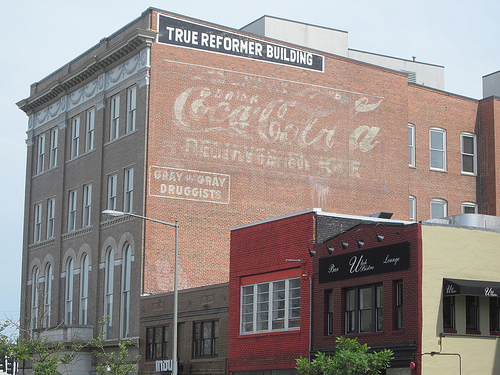
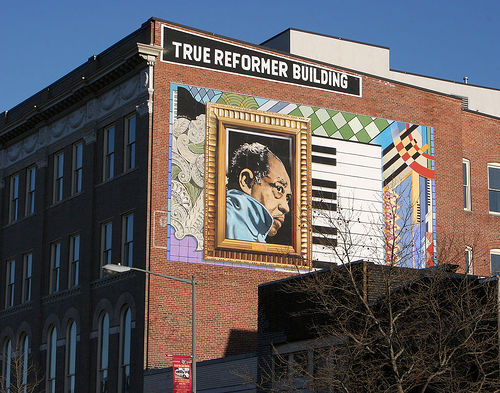
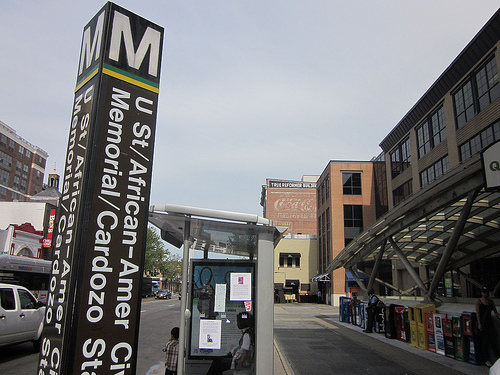
Holy cow, the great Duke Ellington mural on the side of the True Reformer Building at 1200 U Street, NW has been removed. Here’s what it used to look like:


Photo by flickr user @mjb

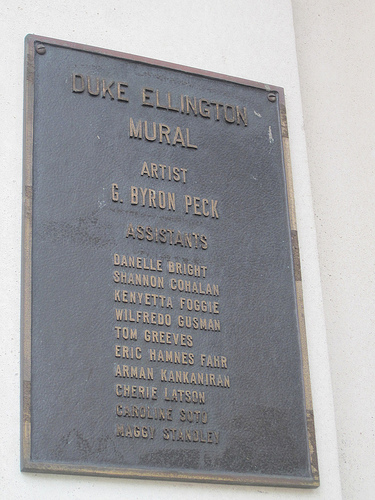
The dedication plaque remains:

Anyone know why?

Here’s what it looked like in 1979:


Photo via Historic American Buildings Survey

UPDATE from DC Commission on the Arts and Humanities:

Two weeks ago, the D.C. Commission on the Arts and Humanities took the first steps in restoring the famous G. Byron Peck mural of Duke Ellington on the True Reformer Building (1200 U Street, NW) to its original condition.

The artwork, which was painted on cement panels, was taken down due to elemental decay over the last eight years.

“The Duke Ellington mural is an iconic artwork in Washington,” said Lionell Thomas, Executive Director at the D.C. Commission on the Arts and Humanities. “Over the years, this mural has become a symbol for the U Street community. We are working diligently to insure that the mural is returned to the community in its original condition.”

The D.C. Commission on the Arts and Humanities hired the fine arts services company, ARTEX, to remove, store and prep the mural for damage assessment. Restoration of the mural may take up to one year.

The mural was originally created and installed in 1997 on the side of Mood Indigo, an antique and vintage clothing shop, at 1214 U St., NW. The mural was relocated in 2004 to the True Reformer Building.


Streets of Washington covers some of DC’s most interesting buildings and history and is written by John DeFerrari. John is also the author of Lost Washington DC.

The reputation of DC’s charmingly-named Swampoodle neighborhood was for its tough Irish street brawlers. Both the Irish toughs and their swampy ground are now gone, but one immense institution has remained there through it all, the Government Printing Office at H and North Capitol Streets, NW. The printing office—nicknamed “The Swamp” in its early days—has been one of Washington’s most contradictory institutions. Once a grimy factory of hard-working laborers culled largely from the surrounding rough-and-tumble neighborhood, for 150 years it’s also been an elite producer of elegant government documents, including extraordinary hand-bound volumes of the nation’s most precious records.
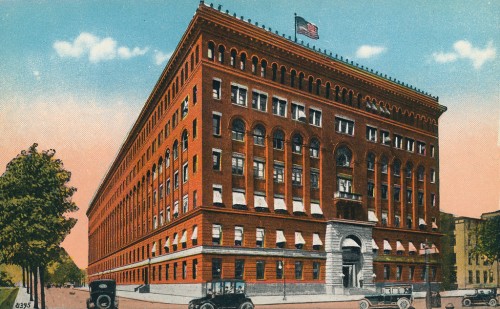

GPO’s 1903 building (postcard from the author’s collection).
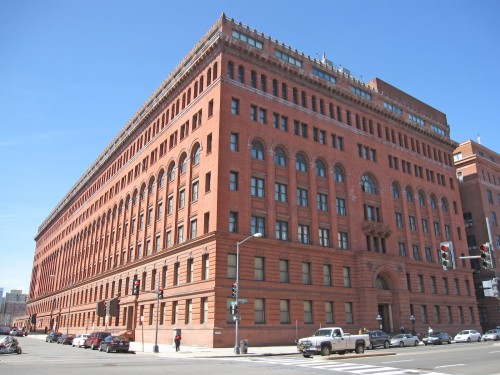

The 1903 GPO building today (photo by the author).

There has always been a recognized need for printing official government documents; the British designated “publick printers” for this purpose in the early colonies. Benjamin Franklin was one, producing official documents for Pennsylvania, Delaware, Maryland, and New Jersey. After independence, the U.S. Congress continued the practice of chartering private companies to do public printing, usually at fixed rates, but as the 19th century progressed and the need for printed documents mushroomed, private companies fortunate enough to be designated as official printers were increasingly accused of fraud and corruption. Congress put an end to all that by passing a law establishing the Government Printing Office in 1861. It would be a completely government-operated facility, and its chief would carry the title of Public Printer.

To outfit the new GPO, the government purchased the printing office that Cornelius Wendell (1811-1870) had built in 1857 at the corner of H and North Capitol. Wendell had been an official printer, and most of the government’s printing work was already taking place at this site, one of the largest and most complete printing plants in the country.

Continues after the jump. (more…)


From DDOT:

Tuesday, May 29

The public viewing is scheduled from 11 am to 10 pm on Tuesday at the Howard Theatre, which is located at 620 T Street, NW. The following streets will be closed for this event:

3:00 am – Midnight
T Street, NW, from 7th Street to Florida Avenue, NW

9:30 am – Midnight

T Street, NW closure will expand to include T Street between 9th Street and Florida Avenue, NW
7th Street, NW between Florida Avenue and S Street, NW
8th Street, NW between Florida Avenue and S Street, NW
Wiltberger Street, NW between T Street and S Street, NW

Thursday, May 31

The public memorial service is scheduled from 12 pm – 3 pm at the Walter E. Washington Convention Center, located at 801 Mount Vernon Place, NW.

6:00 am – 6:00 pm

L Street, NW will be closed in both direction between 7th Street and 9th Street

Please note: all street closures and times are subject to change due to prevailing or unexpected conditions.

The general public is strongly encouraged to use public transportation for both events.


View More Stories