Photo courtesy of Hines, Archstone and the TFI US Real Estate Fund

From a press release:

Hines, Archstone and the TFI US Real Estate Fund, sponsors of CityCenterDC, announced today the commencement of sales of luxury condominium residences at CityCenterDC, the 10-acre parcel in the heart of Downtown D.C. that is currently being transformed into a vibrant blend of residences, offices, shopping, restaurants, hotel and active parks. The new center for urban living is showcased in an expansive and interactive sales gallery – at 901 New York Avenue, NW – with an impressive scale model of the entire development, a fully built-out model residence and a striking view of the new neighborhood under construction and quickly taking shape.

Designed by London-based, globally recognized architecture firm Foster + Partners, the 216 condominiums provide homes with open layouts where natural light and outdoor spaces combine seamlessly to create a unique residential experience. The one- and two-bedroom residences have access to balconies and outdoor spaces of up to 900 square feet, and feature signature hallmarks of Foster + Partners’ design, including light-filled modern interiors and natural-colored materials. Residences are crafted with high-quality, custom details and environmentally responsible materials that offer thoughtful living in a modern environment. There are a variety of options for combining multiple residences. Pricing for the condominiums ranges from $500,000 to $3.5 million.

Construction is well underway with an anticipated delivery in Fall 2013.

The residences will be complimented by more than 60 shops and restaurants, providing one-of-a-kind shopping and dining destinations for the Washington, D.C. metropolitan area.

Continues after the jump. (more…)


Click to enlarge

Thanks to a reader for sending this great old advertisement from 1912. My favorite part:

“Other neighborhoods may be inhabited by more expensive homes but no neighborhood in all Washington is more desirable from the standpoint of refinement.”

The reader writes:

“To add context….
2,750.00 in 1912 is about 64,500 in today’s dollars.
5,000 in 1912 is about $117,000 in today’s dollars.
Based off of data from the Bureau of Labor Statistics

Man…. we are all 100 years too late.”


The following map was made by Sarah Hank. She contributed a crime map of DC here and a sewage and plumbing map of DC here.

Hey Renters! Ever wondered how long it would take for you to pay off a house in the DC metro area? Here’s a rough guide.

I’ll start off by saying I am not a housing market expert, and have never bought a house, but I took some commonly accepted numbers and made this map of average length of mortgage by census tract for the DC metro area. I based my calculations on the following assumptions:

– 20% cash down payment (previously saved) ( Source)

– 30% of income contributed toward mortgage ( Source)

– Average household salary per census tract ( American Community Survey 2010)

– Average house value per census tract (American Community Survey 2010)

Of course these numbers are not going to represent everyone’s reality. For example, I did not take into account interest rates, and I assumed that income will be constant as well as the percentage of income contributed to the mortgage (which in reality would most likely not be true). Also, saving up 20% for a down payment is often out of reach for many people, especially these days.

I also overlaid proportional circles (once you zoom in a few levels) showing the percent of the population that holds a bachelor’s degree or higher. The thought behind displaying that data is that it “should” be correlated with average income if you’re lucky.

You can see that a lot of the map looks to fall in the 10-15 year range (light pink). I assume those people might choose to have a lower monthly payment and extend their mortgage a bit longer, but in terms of analysis, it is good to see that a lot of the metro area appears to be in balance. Meaning, housing prices are on par with the average income. In the NW Maryland suburbs, you’ll see $1,000,000 houses with average incomes of $200,000, and in the SE Maryland suburbs, you’ll see $300,000 houses with $70,000 incomes. (By the way, those tracts that have $1,000,000 homes actually are 1 million or above.)

The more consistently dark area is the one where many of us live.* From Shaw following Georgia Ave straight up to the top of DC, that is where the income and housing prices are a bit more in disparity. Does living in a $600,000 house with an income of $50,000 sound familiar to you? These are areas where many people are renters, and probably can’t easily afford to buy the house they live in on their current income.

What do you see on the map that is interesting to you? Do you have other theories about the dark spots and light spots?

*Looking at DC, there are a few spots that need to be disregarded. Why, you might ask, is the average income of the West End so low at around $11,000? Most of that census tract is devoted to GWU. I’d say the same goes for the UMD area. I’m sure AU and Georgetown have a bit of an effect as well, but those areas have many more wealthy residents than the others I mentioned.


611 Maryland Avenue, NE

The beautiful church at the corner of 6th and Maryland Ave, NE is for sale.

The listing says:

“Rarely available large 1890’s stone Church located in Historic Capitol Hill at Stanton Square just 4 blocks from Union Station. Price includes an attached and connecting 4 story Federal Townhouse. Seating for 450+ iincluding ground level hall (w/commercial kitchen). Beautiful altar, balcony, and stain glass windows only steps from the United States Capitol.”

It’s yours for $5,800,000.


The space above Looking Glass Lounge is for rent at 3634 Georgia Avenue, NW just south of the Petworth metro. The listing says:

“GR8T SPACE for rent IN COLUMBIA HTS,1 BLK from METRO above Looking Glass Lounge. Large (1200+ sf), BRIGHT open space with HRDWD FLRs, Open Floor plan w/granite/stainless, enormous living area. Also listed for Comm. Lease. Vouchers Welcome.”

It’s going for $2,500/Mo. Anyone remember the Yoga House Studio?


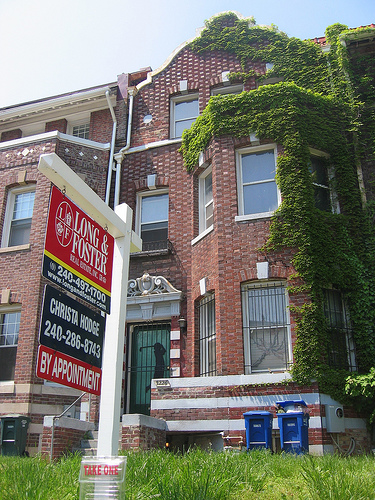
Photo by PoPville flickr user Mr. T in DC

Dear PoPville,

I am looking to find a realtor that works with first time buyers and hoping someone in PoPville has a recommendation. I would have a small budget (around $150,000), but am very flexible on location. Ideally, I would like to buy a one bedroom condo in a early transitional neighborhood (taking recommendations on those, too). I know my budget is small for the DC area, but I am willing to take a risk and hopefully have a great ROI in 5 or so years.


View More Stories