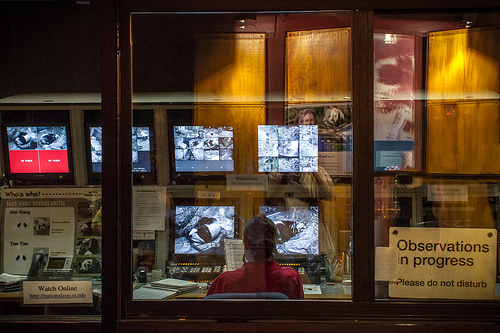
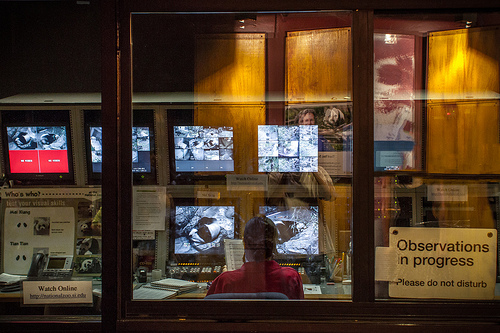
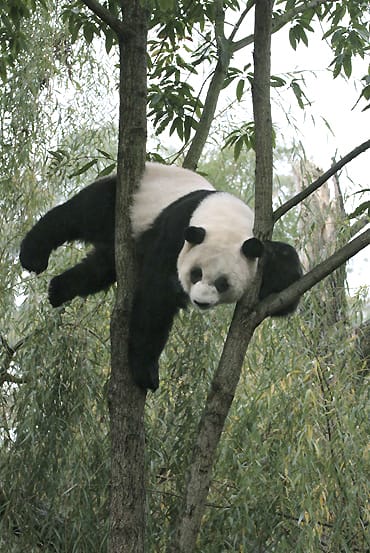
giant_panda_national_zoo_dc
Photo by PoPville flickr user Mr. T in DC

From the National Zoo:

Dr. Pierre Comizzoli is a reproductive cryobiologist at the Smithsonian Conservation Biology Institute. In this giant panda update he explains how the Zoo stores semen for endangered wildlife, which can be used for procedures like artificial inseminations.

The team of people at the Zoo who study and research giant panda reproduction includes keepers, veterinarians and scientists. I am one of the scientists on that team, specifically a reproductive cryobiologist. That means that I am a specialist in the preservation of sperm cells, eggs and gonadal tissues of endangered species at freezing temperatures.

By freezing semen samples of endangered species we preserve them for long periods of time and can suspend the life of sperm for decades. At the Zoo we store frozen semen of giant pandas and other species in the sperm bank. It is critical to create frozen sperm banks because the genes from endangered deceased individuals can be used to produce offspring long after their death. This is really important for the sustainability of small populations and it is integrated with other conservation efforts. When we need the frozen sperm cells, we thaw them and then they can be used for assisted reproduction (like an artificial insemination). The Zoo’s sperm bank contains more than 2,000 semen samples from more than 100 species. Sixty of those samples are giant panda semen from five males.

Our two pandas at the Zoo, Mei Xiang and Tian Tian, have never successfully bred on their own. For a critically endangered species like the giant panda – that presents a challenge for conservation efforts, which is why we perform artificial inseminations on Mei Xiang when natural breeding does not occur.

I have been involved with performing giant panda artificial inseminations at the Zoo every year since 2004 – except in 2006 when Mei Xiang was nursing Tai Shan. For some artificial inseminations we have used frozen sperm, which is stored in the Zoo’s sperm bank.

We only freeze semen from endangered species that is high-quality. The process for freezing samples is very specific to ensure that the samples are the highest quality possible. First, the semen has to be mixed with a solution that prevents pH variations, otherwise those variations would kill the small and fragile cells. Then, an ‘anti-freeze’ agent (glycerol) is added to the diluted semen to protect the cells before being exposed to decreasing temperatures. Ideally the semen is first cooled to 4°C, which is the temperature of a refrigerator, in a couple of hours. The cold semen suspension is then loaded in small plastic straws that hold less than 1/4mL of semen. All of the straws hold the same concentration of semen. Finally, the straws are exposed for several minutes to liquid nitrogen vapors at a temperature of about -100°C, before being plunged in the liquid nitrogen (-196°C).


Photo by PoPville flickr user ashleykalena

From the National Zoo:

Our pathologists have finished the final necropsy on Mei’s cub, and the panda team shared the results this morning. The initial necropsy, which was performed on September 23, showed that the week-old female cub had fluid in her abdomen and her liver was hard in places. There were no signs of internal or external trauma. The final necropsy determined that lung and liver damage ultimately caused the cub’s death. Her lungs were poorly developed and likely caused her to have insufficient oxygen, which would be consistent with the changes in the liver. The mortality rate for pandas in their first year in captivity is estimated to be 26 percent for males and 20 percent for females. Some early mortality rates may be underestimated.

We are working with our colleagues in China to answer questions about giant pandas that will ensure the best care in captivity and that will help bolster the species’ numbers in the wild. The information about how this cub died will add to the scientific body of knowledge about giant pandas. The Zoo will continue to work closely with its Chinese colleagues and share the information it has learned about giant panda reproduction and cub health.

Many of you have been asking about what our plans are for Mei and Tian. No decision has been made about their future. Our current agreement with China lasts through December 5, 2015
and stipulates that the Zoo will conduct research in the areas of breeding and cub behavior. Panda fans can still watch Mei and Tian on the panda cams, which are going to slowly convert to high-definition digital cameras thanks to a donation from the Ford Motor Company Fund, every day.

We are happy to report that Mei is almost completely back to her old self! Her hormones have returned to normal levels, as has her behavior. Mei is choosing to go outside in the mornings. In the afternoons she can usually be found napping on her indoor rockwork. Mei’s appetite has also returned, and she is eating almost all of her bamboo and all of her leaf eater biscuits and produce. The David M. Rubenstein Family Giant Panda Habitat is open, and visitors can see Tian Tian and Mei Xiang outdoors and indoors, though the area directly around Mei’s den is still closed. The panda team expects that the entire David M. Rubenstein Family Giant Panda Habitat will be open soon, as Mei has not shown any sensitivity to noise lately.

Keepers cleaned the bamboo out of Mei’s den on Wednesday since she no longer spends much time there. Months ago, we installed a time-lapse camera in Mei’s den before she started building her nest in hopes that for the first time, we would have a visual record of how she built her nest. We retrieved it from the den this week. Unfortunately, we had some technical difficulties so it did not work out exactly as planned.Even though the progression is not as detailed as we would have liked, the photos still show some of Mei’s nesting. You can watch the time-lapse video made from the photos on our YouTube page.


Photo by PoPville flickr user ep_jhu

From the National Zoo:

Mei Xiang is slowly settling back into her regular routine. She ventured into her outdoor enclosure on Saturday for the first time since we lost the cub, and briefly this morning and yesterday morning. She also made a brief appearance for the keeper talk inside the David M. Rubenstein Panda Habitat on Monday afternoon, though she still chooses to spend most of her afternoons in her den. Her appetite is gradually returning; she has been eating noticeably more bamboo and produce.

The David M. Rubenstein Family Giant Panda Habitat partially reopened over the weekend. Mei could still be sensitive to noise, so visitors may not be able to see her indoors just yet. However, since Mei’s behavior and appetite are returning to normal, the panda keepers expect to fully reopen it soon. Visitors are able to see Tian Tian and Mei Xiang in their yards, and Tian Tian indoors.

We are still waiting for final necropsy results on Mei’s cub. As soon as we have more information we will share it with you.

The entire panda team would like to express their gratitude for the overwhelming amount of support and condolences we have received from the public during this difficult time. We have gotten many questions about how to send messages to the keepers in the past week. The best way to get a message to the panda team is through the Zoo’s Facebook page and the FONZ Facebook page. You can also send them an email. Some supporters have expressed interest in making a memorial donation to help the Zoo’s giant panda conservation efforts. If you are so moved, please donate to the Giant Panda Conservation Fund here.


Photo by Jessie Cohen, NZP photographer

But remember we’ll still have the Red Panda. From the National Zoo Web site:

January 30 (If the Zoo is closed due to inclement weather, the event will be held January 31)
11 a.m-3 p.m.

Come wish Tai Shan a fond farewell!

Tai Shan, the Zoo’s four-and-a-half-year-old giant panda, leaves for China on February 4 to be part of the breeding program that will help sustain giant panda populations in the wild. Giant pandas are endangered—only about 1,600 are left in the wild. Since his birth on July 9, 2005, Tai Shan has delighted millions of people from around the world.

Join us at the Fujifilm Giant Panda Habitat to celebrate Tai Shan and the Zoo’s ongoing commitment to giant panda conservation. It’s your chance to come say goodbye to Tai Shan and learn about how the Zoo worked to conceive, raise, and care for Tai Shan, as well as its other pandas, Mei Xiang, and Tian Tian.

The day will feature a variety of wonderful panda activities and giveaways:

* Panda keepers will be available to answer questions and talk about the Zoo’s giant pandas at 11:30 a.m., 12:30 p.m., 1:30 p.m., and 2:30 p.m. At 1:30 p.m., keepers will present Tai Shan with a special celebratory cake prepared by the Zoo’s Commissary.
* Panda interpreters will answer your questions about giant pandas, conservation, and the Zoo’s role in conserving endangered species.
* Zoo reproductive scientists will talk about panda reproduction, and all the work that went into Tai Shan’s conception and birth.
* Zoo veterinarians will talk about how they care for these rare bears every day.
* Zoo nutritionists will talk about what it takes to feed a bear that eats primarily a few very specific species of bamboo.
* Kids will have an opportunity to make a card for Tai Shan or to celebrate their favorite Tai Shan memory at the FedEx Card Delivery Station. Your card will travel with Tai Shan to China via FedEx.
* The Tai Shan Travel Timeline, sponsored by AAA Mid-Atlantic, will feature a travel TripTik, so you can see what route Tai Shan will take when he travels to China. Zoo conservation biologists will talk about conservation efforts taking place both here and in China. The first 500 people to visit this area will receive a commemorative Tai Shan photo postcard.
* The LAND O LAKES® Butterstick Tribute will showcase photos of Tai Shan since his birth. (When Tai Shan was born, like all giant panda cubs, he was about the size of a stick of butter. This earned him the affectionate nickname “Butterstick.”)”


Rusty the Red Panda photo by Steve W Lee

In early February, the National Zoo welcomed the arrival of Tate, the red panda bear sent in from the Cape May Zoo in New Jersey. And no one cared. I mean, it was reported on by DCist and a few local news channels, and given a blurb in WaPo, but the majority of the public still had stars in their eyes from the Zoo’s glamour days with the red-carpet entrance of Tai Shan the baby panda bear. Poor Tate. Most people don’t even notice the red panda habitat at the zoo, bypassing it entirely while bee-lining for the giant pandas. The giant pandas that, if they ever venture to come out, don’t DO anything but eat and stare at their bellies. One time I was there and a kid who was racing to see Tai Shan stopped momentarily beside the red bears just to point at them and call them “boring pandas,” leaving them feeling dejected and undoubtedly depressed. I’m encouraging all to boycott the gluttonous, overrated, Star Jones’s of the Zoo celebrity creatures and instead consider the adorable, livelier, and severely overlooked red panda bears. Tate and his friend Shama are attention seekers. Unlike the apathetic Mei Xiang and Tian Tian, the more colorful duo WANT to be watched. They’re cute and move around more, and play for the (lack of) camera, and deserve more ‘ooohhhs’ and ‘awwwws.’ If you’re ever feeling underappreciated, pay a visit to Tate and Shama and feel their pain.

Also underappreciated – the mouse with the gigantic teeth. Those guys are terrifying.

What other zoo creature gets unmerited neglect? What’s your goto spot at the zoo?