
Thanks to a reader for sending: “Ducklings recently hatched on 15th and K Street.”


Thanks to a reader for sending: “Ducklings recently hatched on 15th and K Street.”
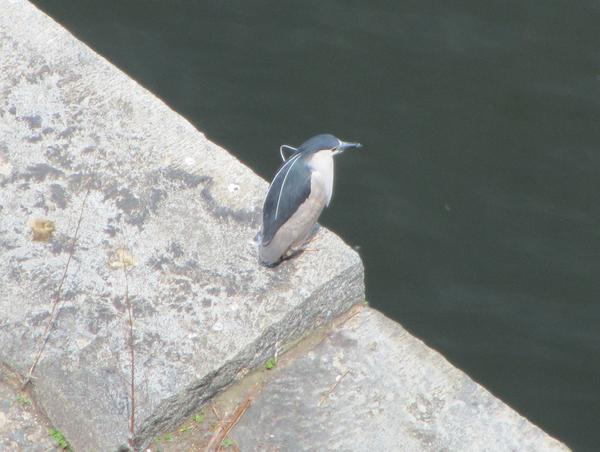
Nice find from @NanksH:
“A penguin under Key Bridge?? What kind of bird is this?”
@JasonWardNY with the score: “Black-crowned Night Heron”.
From Audubon:
“Seen by day, these chunky herons seem dull and lethargic, with groups sitting hunched and motionless in trees near water. They become more active at dusk, flying out to foraging sites, calling “wok” as they pass high overhead in the darkness. Some studies suggest that they feed at night because they are dominated by other herons and egrets by day. A cosmopolitan species, nesting on every continent except Australia and Antarctica.”

Thanks to a reader for sending in:
“The K Street Vultures that roost on the corner of 11th and K NW. They usually perch on the chimney and steeple of the church across the street but often land on our office’s windowsill in the mornings. They’ve become a bit like office mascots. Apparently they were interested in my breakfast today.”

These are fantastic. Thanks to a reader for passing on from The Daily What:
“A Washington DC man noticed his backyard security light flash on in the middle of the night this week, and when he went over to investigate he saw this.”

Thanks to a reader for sending the shot above from Dupont Circle this morning. Falcon?
And quite the description (actually pretty terrifying because it’s happened to me) on the Hill tweeted by @HStreetDC_:
“Aggressive crow dive-bombing people at 14th/SC SE. Animal Control can’t remove for a few days because of baby birds in nest. Be careful.”
It’s pretty funny though if you happen to see it happen to someone. My neighbor still laughs about the time I was chased up and down the street by a momma bird about 5 years ago.
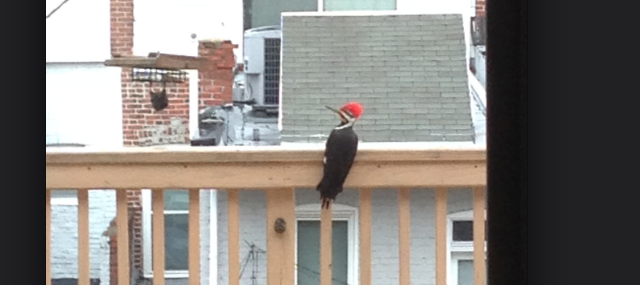
Mount Pleasant repping well this month.
Thanks to a reader for sending in:
“This male pileated woodpecker and his mate demolished my suet feeder a few times this spring. Yes, he’s about 12-15 inches long. Absolutely huge. In Mt Pleasant, near Rock Creek Park.”
If you have any sightings please email [email protected] or tweet to @PoPville

From a tree box on the 600 block of Florida Ave, NW just east of Georgia/7th. Is that a crayfish?


“Dear PoPville,
I live on Kilbourne Place in Mt. Pleasant. Yesterday morning there was a wild turkey on our street… in fact it was on my neighbor’s porch. (At the bottom of the 1800 block right before you hit 19th Street.) Do we know if there is a large population in Rock Creek?”

More shots after the jump. (more…)

Thanks to a reader for passing on from this reminder from the DC Beekeepers:
“If you see a swarm of bees, please call, text or email, and a team of over a dozen DC beekeepers will Spring into action to give those homeless bees the place to live for which they are searching!
It has been another bad Winter and cold Spring, and many of us have lost hives, so we could really use your help.
If you see a swarm of bees, or even think you might, please call (202) 255 4318 or email dcbees at dcbeekeepers.org and we can get an experienced beekeeper over there quick to help you out. Insecticides truly will not take care of your situation, but we can.
Please remember: honeybees are under extreme survival pressure, and those swarms represent the few that have not only figured out how to survive pests, pesticides, and climate change, but THRIVE. We beekeepers can grab those bees, give them safe homes somewhere else, and help ensure a healthier future where honeybees can continue to make our food supply and green spaces grow. It is a kind of compliment to DC that we have a place where honeybees and people can collaborate so well.”

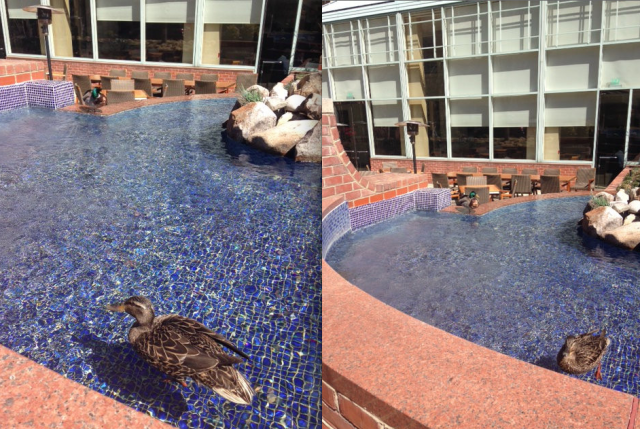
“a couple of ducks have taken up residency in the fountain at Blue Duck Tavern! Two mallards to be exact, according to the hostess they flew in last week and have been enjoying life in the fountain ever since. No sign of a nest yet, but we’re eagerly watching and hoping!”