Streets of Washington, written by John DeFerrari, covers some of DC’s most interesting buildings and history. John is also the author of Lost Washington DC.

The story of S. Kann, Sons & Co., once Washington’s second largest department store behind Woodward & Lothrop, begins just north of us in Baltimore. There a German immigrant named Solomon Kann (1836-1908) opened a clothing store during the Civil War. As time went on, he brought his three sons—Louis Kann (1860-1920), Simon Kann (1861-1932), and Sigmund Kann (1865-1930)—into business with him. In the early 1890s, the family learned that a Washington, D.C., clothing merchant by the name of Dorsey Carter wanted to sell his business, and Solomon Kann sent Louis and Sigmund to investigate. The sons bought the stock of the old business and later two other nearby stores as well, combining their offerings and opening S. Kann, Sons on the northeast corner of 8th Street and Market Space NW in 1893. The location was perfect, right in the heart of Washington’s commercial district, directly across Pennsylvania Avenue from Center Market (where the National Archives now stands). Louis (called “short, quick, and aggressive” by the Washington Post) and Sigmund (“tall, deliberate, and reserved”) soon brought Simon (“short, stocky, and wearing thick-lensed spectacles”) in as well, and the brothers’ store prospered under their energetic management.
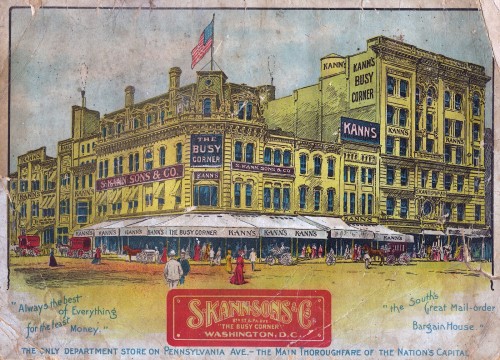

Kann’s Busy Corner in 1907 (author’s collection).

Kann’s, like Woodies which had preceded it by only a few years, was one of the new breed of progressive department stores, imbued with radical business policies: goods were offered at a single, fixed price—no haggling—and customers were welcome to return goods they didn’t want and have their money cheerfully refunded, something previously unheard of. Kann’s and Woodies both vigorously promoted the “customer-is-always-right” philosophy, and it paid off in booming sales, which allowed them to keep prices low. Kann’s in particular was committed to selling goods at the lowest price possible, even resorting to shaving prices to various fractions of a cent—two thirds, three quarters, seven eights—a tactic that had a powerful psychological effect on price-conscious shoppers. “Always the best of everything for the least money,” Kann’s advertised.
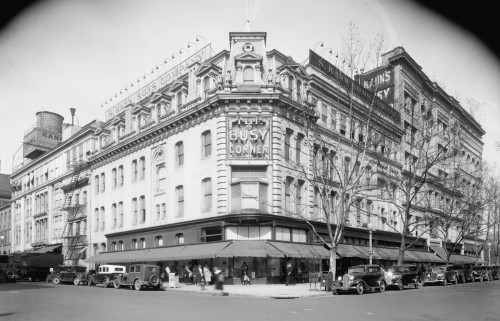

Kann’s circa 1935 (Source: Library of Congress).

Frances Folsom Cleveland (1864-1947), the stunningly attractive first lady who had returned to the White House with her husband in 1893 for his second term, was an early customer of Kann’s. According to the Washington Post, “Washington was eager to see and admire her as she drove about the streets in the highly polished White House landau, drawn by a fine team of horses, attended by a coach and footman, visiting many of the stores along the avenue.” The story goes that as she shopped at Kann’s she attempted to have her purchases charged to her account, just as she did everywhere else, only to be informed by the nervous clerk that Kann’s policy was strictly cash-and-carry. Fortunately, Mrs. Cleveland had sufficient funds to cover her purchases and took no offense. The bargains at Kann’s were worth it.

Continues after the jump. (more…)


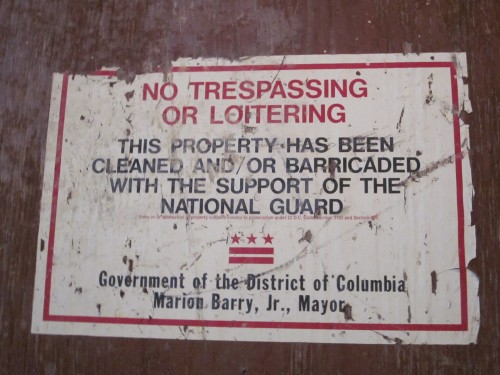
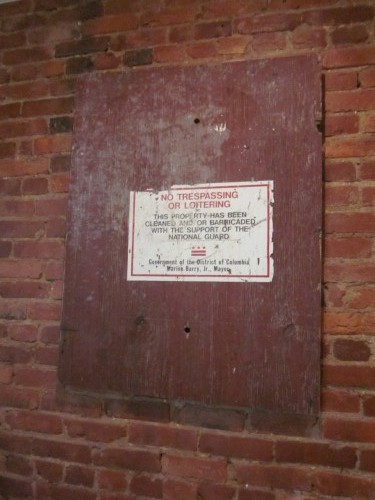
A reader was nice enough to give me a tour of their renovated house in Columbia Heights and I was blown away by this sign.

It’s so easy to forget how things used to be…

I thought it was brilliant how they preserved and displayed this board formerly covering up a front window of the house:


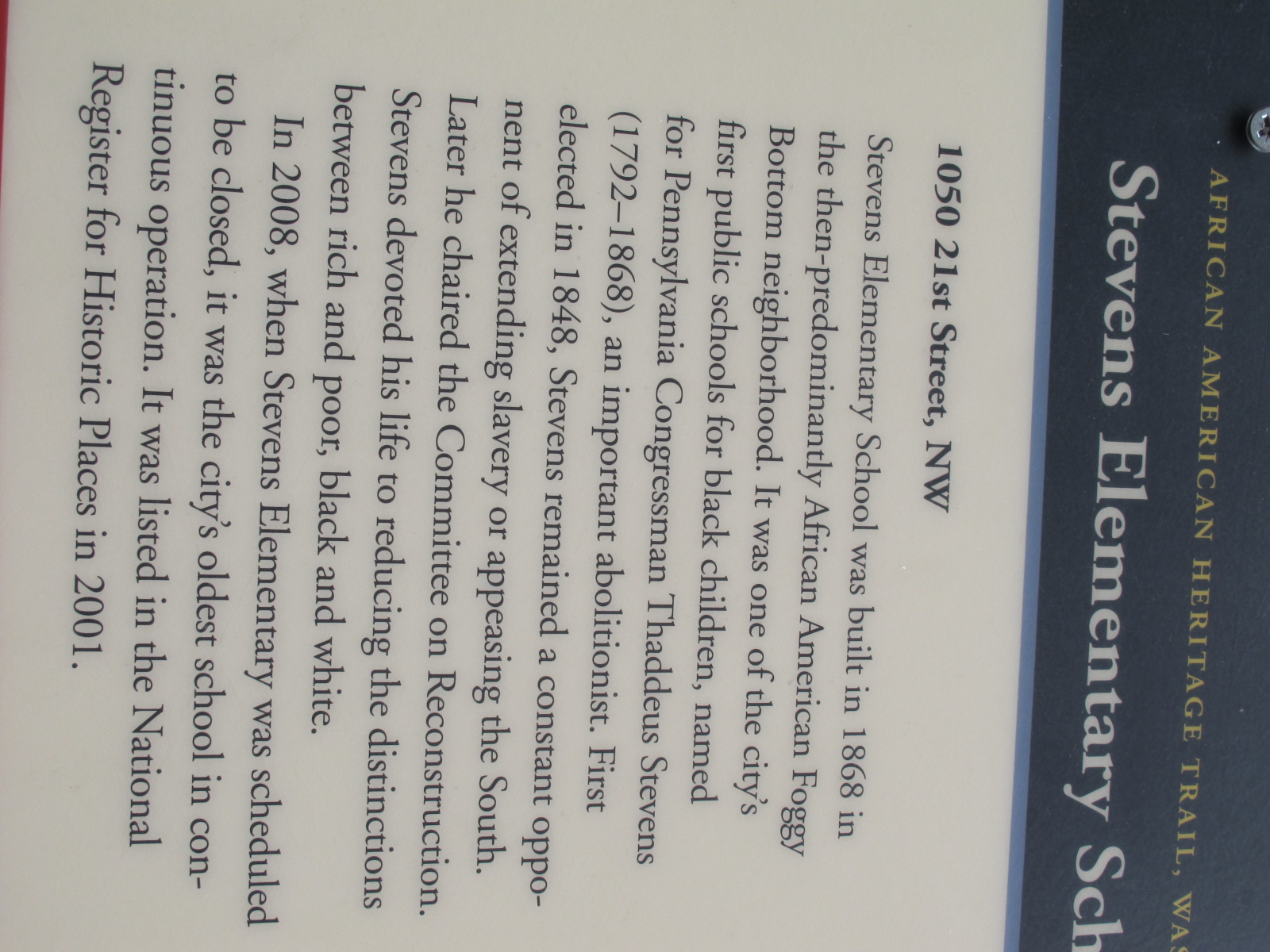
1050 21st Street, NW

From the Mayor’s office:

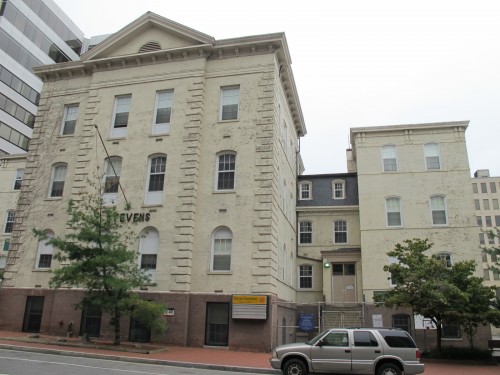
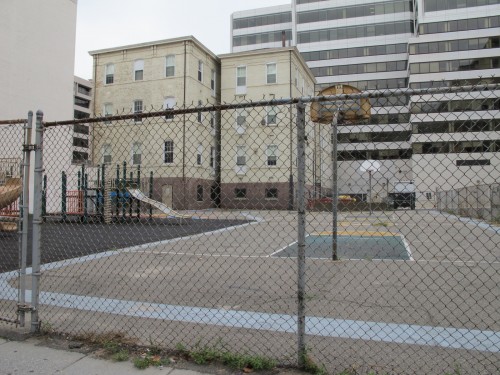
Mayor Vincent C. Gray today announced the selection of the Akridge-Argos development team and Ivymount Schools and Programs to redevelop the historic Stevens School in the West End neighborhood of Ward 2. The two teams bring extensive commercial-development and educational expertise to the project, assuring a productive use for a building that has been vacant since the close of the 2008 school year.

“My administration has worked closely with West End residents and Advisory Neighborhood Commission 2A to ensure that we made positive choices for the future of the Thaddeus Stevens School building,” said Mayor Gray. “We believe that Akridge-Argos and Ivymount are well-respected institutions with proven track records of success that will turn this unique development opportunity into a victory for economic growth and special education here in the District.”

Akridge-Argos’s proposed vision for developing the site includes a 10-story, LEED-certified, Class “A” office building named Thaddeus Stevens Place; ground-floor retail; and underground parking. The Akridge-Argos team brings with it decades of development experience. It also has a strong track record of high-quality historic renovation. The team has demonstrated the skills and experience to lead an outstanding rehabilitation of the Stevens School building, as well as constructing a state-of-the art office building to go alongside it.

“We look forward to our continued work with Akridge-Argos/Ivymount, the Stevens School community and with our Council as we navigate through the surplus, disposition and legislative processes needed to make this project a reality,” said Deputy Mayor for Planning and Economic Development Victor L. Hoskins.

Ivymount Schools and Programs is a high-quality provider of special-education services that has partnered with the D.C. Public Schools (DCPS) for many years. Ivymount’s proposal for the Stevens School parcel consists of approximately 50 seats for special-needs students and a proposed capacity-building program in partnership with DCPS and the Office of the State Superintendent of Education (OSSE). Founded in 1961, Ivymount has served over 8,000 children and young adults with disabilities from throughout the Greater Washington area. The school has been awarded several prestigious honors, including twice being named a Blue Ribbon School of Excellence by the U.S. Department of Education and being named a School of Excellence by the National Association of Special Education Teachers.

“Ivymount Schools and Programs will be an incredible asset to the D.C. community and help us to meet the demand for high-quality educational services for our children and youth with autism,” said Deputy Mayor for Education De’Shawn Wright. “Additionally, the establishment of Ivymount within the District provides a unique opportunity for a robust partnership with DCPS and public charter schools as they seek to improve their capacity to serve a broader spectrum of kids across the special-needs continuum.”

The Thaddeus Stevens Elementary School is located at 1050 21st Street NW. The Stevens building was built in 1868 as one of the District’s first publicly funded schools for African-American children. The school was named for Thaddeus Stevens (1792-1868), a Pennsylvania congressman and prominent abolitionist who championed “free schools” for all. DCPS students in the area now attend the nearby Francis-Stevens Education Campus, located at 2425 N Street NW.


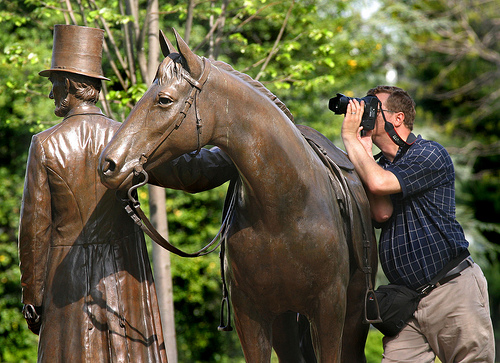
Photo by PoPville flickr user quigley_brown (Jim Hamann)

From a press release:

President Lincoln’s Cottage will be the first public venue to display a rare, signed copy of the Emancipation Proclamation recently purchased by David M. Rubenstein. The historic document will be displayed in the Robert H. Smith Visitor Education Center at President Lincoln’s Cottage from September 22nd, 2012, the date Lincoln issued the Preliminary Emancipation Proclamation, through the end of February 2013.

“Lincoln Cottage was where much of the Emancipation Proclamation was drafted and reflected upon
by President Lincoln, and it thus now seems among the most fitting places for this historic document
to be displayed to the public. I am pleased and honored to help make this possible,” Rubenstein said.
“We are extremely grateful to David M. Rubenstein for lending us the Emancipation Proclamation
for the 150th anniversary of Lincoln first issuing it to the public.” said Erin Carlson Mast, Director
of President Lincoln’s Cottage. “The Emancipation Proclamation is one of the foremost symbols
of freedom in our nation’s history. By viewing this rare copy of the proclamation at the very site
where Lincoln thought through these nation-changing ideas, visitors will be able to gain a deeper
understanding of the global and cultural importance of what took place at President Lincoln’s
Cottage.”

President Lincoln developed the Emancipation Proclamation while living at the Cottage in the summer
of 1862, making it the authentic place for understanding Lincoln’s ideas on slavery and emancipation.
President Lincoln’s Cottage, the “cradle of the Emancipation Proclamation,” is offering programs,
special tours, and events in partnership with national organizations to commemorate the 150th
anniversary of Lincoln’s Emancipation Proclamation.

President Lincoln’s Cottage, located in northwest Washington, D.C., is a site of the National Trust
for Historic Preservation. President Clinton declared the site a National Monument in 2000 and it
opened to the public for the first time in 2008, providing Americans with unparalleled insight into the
Emancipation Proclamation and Abraham Lincoln’s visionary leadership. Through innovative guided
tours, forward-thinking exhibits and quality educational programs, over 100,000 visitors have engaged
in conversations on freedom, experienced a personal transformation in how they view our shared
past, and reconsidered their role in our democracy today. Hours of operation: Tours on the hour,
7 days a week. Visitor Center open 9:30am-4:30pm Mon-Sat, 10:30am-4:30pm Sunday. For more
information on President Lincoln’s Cottage, visit: www.lincolncottage.org


Photo via Shorpy

Dear PoPville,

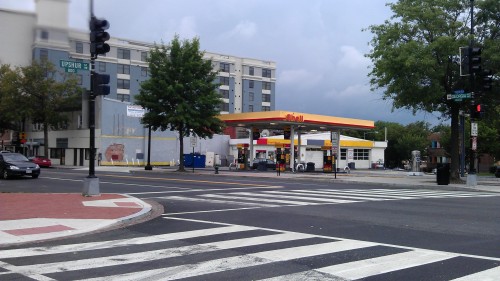
I can’t tell you how many times I get gas in Maryland or Virginia, just to void the negative experience of getting gas near to my home. It’s amazing how long it’s been this way, especially at the corner of Georgia & Upshur, where the same dingy Shell Gas station has been dilapidated and broken for many years, It’s often embarrassingly unsafe that a large company would lower their expectations of service and presentation so far.

This gas station and many others around it suffer from a lack of cleanliness, dated/filthy service bays, broken gas/air pumps, environmental protection issues, abandoned cars, shoddy paving work, missing supplies like oil and windshield cleaning fluid, inconsistent pricing, and lackluster service and selection in terms of their convenience stores.

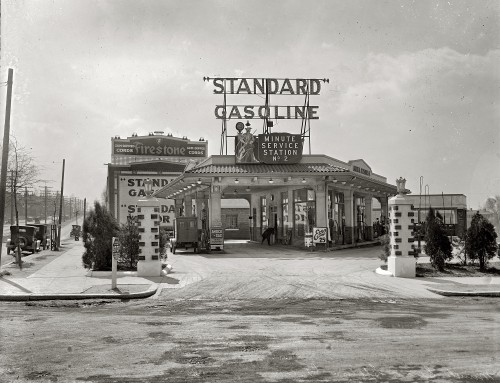
DCRA should hold these stations accountable for cleanliness and compliance. The quality is far away from the quality/convenience of suburban stores that charge less for gasoline. I have included a historical photo (above) of the gas station at Georgia & Upshur as well as one from now (below), that shows how this corner has fallen far from grace, even back when there were only dirt roads in the community.


Georgia, Kansas and Upshur St, NW


Peter Bis

Dear PoPville,

Wanted to let you know that Pete, the homeless guy outside the Exxon on Massachusetts Ave and 2nd St NE, passed away early this morning. Us hill rats remember him telling us how many days until the weekend and then advising us not to go skinny dipping. He’s an everyday staple for some people and wanted to let you know.

Rest in Peace, Pete.


Streets of Washington, written by John DeFerrari, covers some of DC’s most interesting buildings and history. John is also the author of Lost Washington DC.

Last time we re-lived the Willard Hotel’s early era, when it was run by brothers Henry and Joseph Willard and occupied a sprawling complex of low-rise 19th-century buildings on the northwest corner of 14th Street and Pennsylvania Avenue NW. With the death of Joseph in 1897, control of the hotel fell to his son, “Captain” Joseph E. Willard (1865-1924), who had big changes in mind. As the 20th century dawned, a new era and a new building were in store for Washington’s most prominent hotel, and there would be plenty of drama ahead as well. At one point the building was abandoned and left in ruins, but it finally took on a new life as the once-again grand hotel we know today.


The Willard Hotel, circa 1910 (author’s collection).

The younger Joseph, though born in the Willard, immediately began planning to replace it when he gained control of the property. He hired architect Henry Janeway Hardenbergh (1847-1918) to design a thoroughly modern new building. Hardenbergh had designed New York City’s Waldorf-Astoria Hotel and would soon be working on the Plaza Hotel there as well. For the Willard, he created a soaring Beaux-Arts palace that resembled in many ways his other Washington hostelry, the Raleigh. Sometimes called Washington’s first skyscraper, the new Willard used advanced construction techniques, including a steel frame and reinforced concrete base. The stately exterior finishes included rusticated Indiana limestone curtain walls on the first three stories with beige brick and terracotta detailing above. The highly-ornamented top-floor dormers, curved mansard roof, and bullseye windows have become iconic.

Construction took place in two phases so as to allow hotel operations to continue uninterrupted. The first part of the new hotel—the southern section on Pennsylvania Avenue—went up between 1900 and 1901, while guests stayed in the northern part of the old hotel opening on F Street. The hotel’s sumptuous new main lobby on Pennsylvania Avenue opened for business in October 1901. After guests moved into the new structure, the rest of the building went up between 1902 and 1904.

Like the Raleigh, the new Willard included a lavish ballroom and private dining room on the top floor with magnificent views of the city. At street level were the restaurants. The main restaurant on the first floor was “one of the largest and most elegant dining halls to be found anywhere,” according to The Washington Times. “With its richly decorated ceiling and great columns it is a sight worth looking upon.” Across the long main corridor, which in time would be called Peacock Alley, was the so-called Pompeian Room, a “dangerous” place in some people’s minds, because men and women could mingle there, and women were allowed to smoke. Overlooking all this activity was a balcony designed to accommodate the hotel’s in-house orchestra.

Continues after the jump. (more…)

View More Stories