Streets of Washington, written by John DeFerrari, covers some of DC’s most interesting buildings and history. John is the author of Historic Restaurants of Washington, D.C.: Capital Eats, published by the History Press, Inc. and also the author of Lost Washington DC.

Mark Twain is said to have called it the ugliest building in America, a sentiment later echoed by President Harry S Truman, who thought it the country’s “greatest monstrosity.” Now, to tear down this monstrosity would be unthinkable. Declared a national historic landmark in 1971, the massive block-long Eisenhower Executive Office Building, as it is now called, is widely cherished as a stunningly exuberant relic from a bygone era that could never be replicated. Whatever has been thought of it across the years, the building achieves architecture’s highest calling, impressing its unique identity relentlessly upon all who witness it and demanding a response.

State, War and Navy Building 05
(Author’s collection.)

As long as the federal government has been in Washington, cabinet department office buildings have stood on this site and the corresponding space on the other side of the President’s House. George Washington wanted them here, and under his direction, architect George Hadfield (1763-1826), designed the first two distinguished, federal-style buildings, which were ready for early bureaucrats to occupy when the government moved to Washington in 1800. After the British burned the buildings in 1814, they were reconstructed, and two more matching buildings were added, one on either side, to form a neat and symmetrical Executive Branch campus surrounding the President’s House. On the east side, along 15th Street, stood the State Department to the north and the Treasury Department to the south. To the west, along 17th Street, were the Navy and War Departments. (more…)
14740308807_781296aac9_z
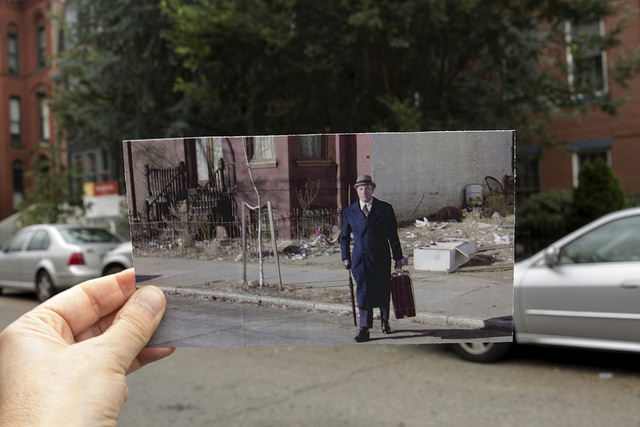
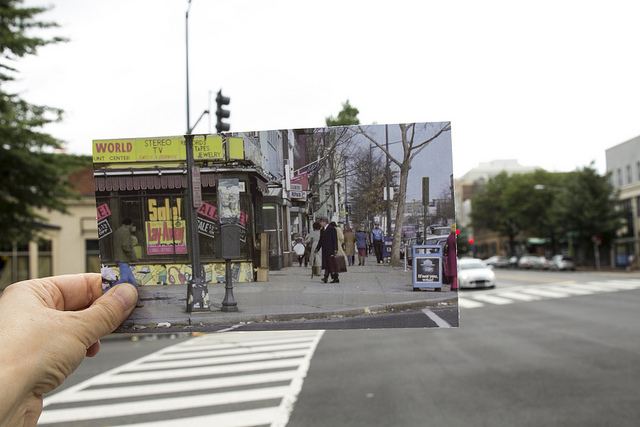
Photo ‘Being There: Then (1979) & Now, 14th St & Rhode Island NW’ by PoPville flickr user number7cloud

“Still shot from the movie “Being There” filmed in 1979. Until fairly recently, Caribou Coffee was on this corner. 14th St, you’ve come a long way!”

14771079137_719b6f84d5_z-1
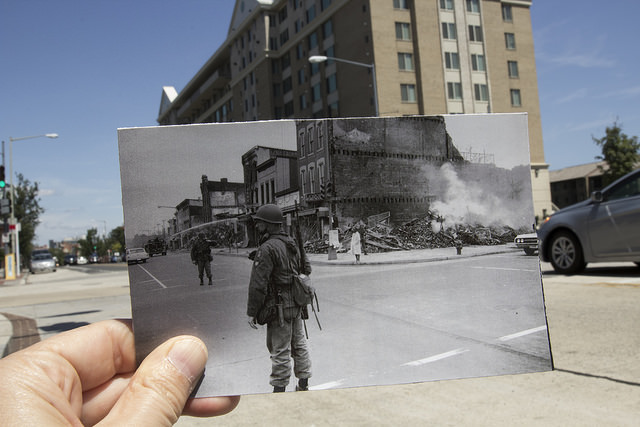
Photo ‘Then & Now: after the 1968 riots 7th St NW’ by PoPville flickr user number7cloud

14782041348_73b2721ef2_z-1
Photo ‘Being There: Then (1979) & Now, M St NW’ by PoPville flickr user number7cloud

“A still shot from the movie “Being There” filmed in 1979″


DC_1984
Photo of ’14th and U St, NW 1988′ by Michael Horsley

“Dear PoPville,

I found these sweet photos of DC from the 1980’s and 1990’s, by a photographer Michael Horsley.

On PoPville, we tend to focus on the here and now and how much things have changed since 2000, but to me it’s amazing how far things have come since the 80’s. The people that were here way back then are really the ones that laid the groundwork for the wonderful city we have today.”

Ed. Note: We’ve been admiring this photo set since 2010. Always amazing/awesome to revisit them year after year.


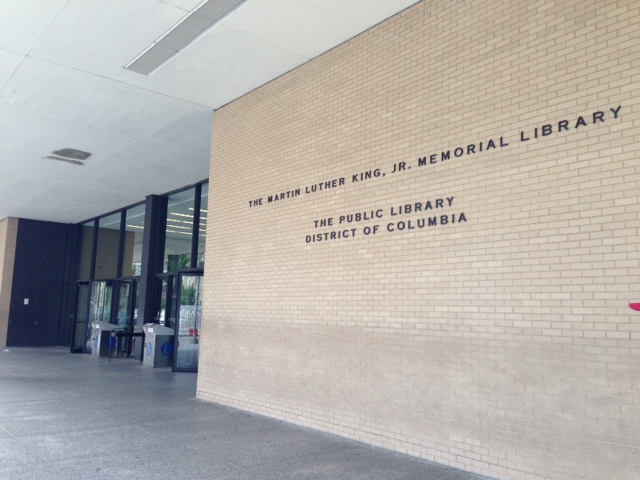
mlk_library_dc
901 G Street, NW

From DCPL:

“The Great Society Subway: A History of the Washington Metro”

Tuesday, August 26, at 7 p.m. in the Great Hall. Martin Luther King Jr. Memorial Library

his talk should be fascinating to anyone interested in Metro, or in the city itself, or more broadly, in how public transit decisions are made. Besides all that, I’m expecting it to be very entertaining, because the book certainly is.

My first thought on looking into Professor Schwag’s book was that it was very densely packed with information (which it is) and might not be a fun read–but it is also that! I’ve found so many wonderful stories in it, that I think it’s safe to say that you will learn a lot, and also are likely to find something that will surprise you, or make you laugh out loud, no matter where you open the book.

An example is this comparison on page 142 of building Metro to the building of the Trans-Alaska Pipeline, through permafrost, mountains, and tundra:

“Metro’s builders faced a challenge equal and opposite to that of their pipeline counterparts….As workers in Alaska built 800 miles of pipeline through wilderness all but uninhabited by humans, workers in Washington took up the challenge of pushing 100 miles of rapid transit through a long-settled region densely populated by lawyers.”

Actually, though I’m still chuckling over that line, other parts of The Great Society Subway have already made me realize we all owe a great debt to those lawyers and other activists, for helping us get Metro instead of a spaghetti bowl of highways in DC, and for pushing needed improvements to Metro, like elevators to serve people with mobility problems. (One Metro official seriously proposed training wheelchair riders to use the escalators, balancing on two wheels!)

The more I read, the more I came to realize that no one who wanted to truly understand Washington DC as it is today could do so without reading this book.

The author, Zachary M. Schrag, has a gift for imparting knowledge packaged in details that make the story come alive; I’m looking forward to his talk!”


woodson_house_repair_dc
1538 9th Street, NW in 2010

From a press release:

“Congresswoman Eleanor Holmes Norton (D-DC) said today she expects the historic Carter G. Woodson Home to be completed by August 2015 with federal funds she requested, and that a National Park Service (NPS) partnership with a non-profit organization (NPO) will complete the two adjoining homes. This is the first-ever National Park Service (NPS) historic site to be completed through a private-public partnership. She expects a local NPO familiar with the Shaw neighborhood, where the house is located and skilled at raising funds, will serve as a vehicle for bringing tax-exempt funds forward. Because Dr. Carter G. Woodson’s work was fundamental to the creation of Black history as a serious academic discipline, work that was responsible for the annual designation of Black History Month, Norton believes that the approximately $9.5 million necessary to complete the entire project is achievable. Once the project is completed, the main home, where Woodson lived, and the adjacent homes, which will be used to facilitate tourism, will together be considered the “Carter G. Woodson National Historic Site.” (more…)


rename_union_station
Photo by PoPville flickr user ianseanlivingston

From an email:

“A. Philip Randolph was a civil rights leaders, labor organizer, and President of the Brotherhood of Sleeping Car Porters – bargaining for better wages and improved working conditions. Honoring Mr. Randolph will continue the trend of renaming major national transportation facilities to recognize great American Leaders. The A. Philip Randolph Union Station will provide an opportunity to educate all youth – especially African-American youth – on his contributions. A. Philip Randolph has several accolades, included being an inductee in the U.S. Department of Labor’s Labor Hall of Honor.

Personally, I am a native Washingtonian who grew up in the 1960’s and 1970’s, attended the 1963 March on Washington, witnessed the 1968 riots, and truly participated and witnessed the “re-building” of Washington, D.C. I believe renaming Union Station to honor A. Philip Randolph is a moral, social, and historical imperative.

If you support this effort, please click on the link and sign our petition. And please pass this along to your friends and family.”


StairMural_140707
Photos courtesy Department of General Services

Thanks to a reader for passing on an article from NBC Washington:

“The frescoes are products of President Franklin D. Roosevelt’s New Deal initiative called PWA – Public Works Administration. The fresco titled “Adolescent America” captures entertainment, movies and fun. The 12-by-40-foot “American Panorama” features scientists, innovation and industry. The plan is to hang both pieces in the school’s new grand entrance.”

And thanks to DGS for sending the photos and these two articles from the 1930s:

1935 12 10_Post_Movies, Comics, Refreshments (PDF)

1934 11 26_Herald_Up Looms the Merry Storm (PDF)

imagejpeg_0


mlk_library_dc_house_history
901 G Street, NW

From a press release:

“The Humanities Council of Washington, D.C. (HCWDC) is pleased to announce the return of its popular House History workshops. They will be held Saturday, August 23, 2014 at the Martin Luther King Jr. Memorial Library, 901 G St. NW in the Washingtoniana Division (3rd Floor). Two workshop sessions will be held: Workshop I: 10:00 am – 1:30 pm and Workshop II: 12:30pm – 4:00 pm. Lunch will be provided for both sessions. These House History Workshops will guide community historians, of any skill or knowledge level, through the DC Public Library Washingtoniana Division’s collections. Participants will learn how to research the history of their own home or any other historical property.

These workshops will feature presentations by professionals who will guide workshop participants on how to navigate the collection of maps, building permits database, photo archives, microfilm records and the council’s DC Digital Museum.

The House history workshops provide residents with an opportunity to explore the history of their homes including the date the home was built, architect, builder, dates of any improvements, former residents, and how the neighborhood evolved over time. House history research is powerful because it provides that personal connection to the past that few other types of historical research can; it allows anyone to forge a strong sense of connection with their neighborhood and their community whether they have called DC home for years, or just moved in last month.

Workshops are free and open to the public. Registration is required, to attend please sign up here.”


Map 1

“Dear PoPville,

Living in Bloomingdale, I always hear of “Truxton Circle” on North Capitol and Florida Ave that was demolished, and longed for its return. Looking at the old pictures of the park and fountain makes one wonder why it was sacrificed instead of saved like Dupont and others. I was unaware of how many other circles were in DC and were demolished over the years. I ran across a circle in Bloomingdale on an 1887 map of DC that I had never heard of. It was at Rhode Island Ave NW, U Street NW, and North Capitol Street It was called Sedgwick Circle and Rhode Island Ave actually ended there and did not continue on into North East.

In the zoomed in image you can see Lincoln Ave (now Lincoln Road), Ledroit Park, Glenwood and Prospect Hill Cemeteries, Boundary Street (now Florida Ave) etc.

I wonder if anyone has any info on Sedgwick Circle?”

Ed. Note: On flickr an image of the same map uploaded by scenicartisan says:

“Sedgwick Circle DC 1887

This is the intersection of Rhode Island Avenue and North Capitol, currently an overpass. the red lines indicate PROPOSED streets. I assume this circle was never realized.”

Map 2


View More Stories