
2630 Adams Mill Rd NW Photo above from Calvert Street entrance
From Washington Parks & People: (more…)


2630 Adams Mill Rd NW Photo above from Calvert Street entrance
From Washington Parks & People: (more…)
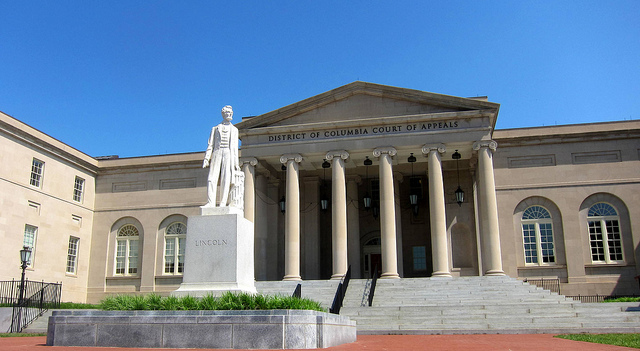
Photo by PoPville flickr user Josh
Deputy Mayor Donahue with the important reminder on why today is a holiday in D.C.:
“April 16, 1862 marks the abolition of slavery in the District of Columbia. Over 3,000 enslaved persons were freed eight months before the Emancipation Proclamation liberated slaves in the South.
For more information.”
Josh writes about his photo above:
“The District of Columbia Court of Appeals, formerly known as City Hall, located on the 400 block of Indiana Avenue NW in the Judiciary Square neighborhood of Washington, D.C. Construction of the neoclassical style building, designed by George Hadfield, began in 1820, but wasn’t completed until 1849. The old City Hall was designated a National Historic Landmark in 1960 and listed on the National Register of Historic Places in 1966. The marble statue (1868, Lot Flannery) honoring Abraham Lincoln is the country’s oldest extant memorial to the assassinated president.”

If you ever spot a cool Archaeological Find in your house, apartment or office – please send an email to [email protected] thanks!
I thought this was super cool. It’s actually built into the back pantry. I spotted it at an open house for 3726 Veazey Street, NW. For the curious you can see a virtual tour of the whole house here.


This rental is located at 2201 Massachusetts Ave, NW. The Craigslist ad says:
“$2650 / 1br – 600ft2 – Furnished house in Dupont/Kalorama for rent with private garden

The house is located in Dupont Circle/Kalorama right on Embassy Row, steps from the metro. It has a private garden, dishwasher, washer and dryer, and lots of storage. Built in 1901 by Paul J. Peltz, who designed the Library of Congress, it was the carriage house for the Argyle/Miller house next door, and was the first automobile house (aka garage) built in DC. Olga Hirshhorn made it her Washington home after her husband, Joseph Hirshhorn (of the Hirshhorn Museum), passed away. She dubbed it the Mouse House due to its tiny size and because a cat carved into the facade of the building above faces the house. There is a replica of the house in Naples, Florida that contains the artworks that Olga (unfortunately) didn’t leave in the house. There is a mural by artist Dana Westring in the bedroom.”

Streets of Washington, written by John DeFerrari, covers some of DC’s most interesting buildings and history. John is the author of Historic Restaurants of Washington, D.C.: Capital Eats, published by the History Press, Inc. and also the author of Lost Washington DC.
It’s now a desolate patch of land–a parking garage over a buried stretch of Interstate 395 waiting to be redeveloped. But the site at the northwest corner of 2nd and I Streets NW has an impressive history. Cresting a gentle hill, the view toward the Capitol from this spot once was commanding. This is where a stately row of three grand townhouses known as “Douglas Row” once stood. They were homes to senators, mayors, businessmen, Civil War generals, and even a U.S. president. They also served as a hospital during the Civil War and as an orphan asylum. But as the neighborhood declined in the 20th century, the prestige vanished. Tourists once stopped and read historical markers on these buildings, but one by one they were demolished. Now, nothing is left to mark this site’s remarkable past.

Late 1860s view of Douglas Row (author’s collection).
The first settler in this area was a Captain Samuel Burch, a prominent early Washingtonian who built a country house nearby in 1812. The area was known as “Burch’s Hill” for much of the 19th century as a result. But little else was here until 1851, when Stephen A. Douglas (1813-1861), the Illinois senator and famous rival of Abraham Lincoln known as the “Little Giant,” purchased two blocks of undeveloped land–the block where Douglas Row would be built as well as the one on the other (south) side of I Street. Other than Burch’s house, few structures had been built in this area; the roads had not even been graded or clearly marked. Though just a few blocks north of Massachusetts Avenue, this was unmistakably “country.” At the time, Douglas was entering his second term as senator from Illinois, and he must have seen this hilltop as a perfect, bucolic location, just outside of the city, to build “a comfortable and convenient temporary residence for himself and his family during his service in the Senate,” as he later explained. (more…)

If you ever spot a cool Archaeologica Find in your house, apartment or office – please send an email to [email protected] thanks!
Thanks to John for sending from his 1889 Townhouse in Eastern Market:
“Found some interesting stuff behind the walls as we are adding some insulation. Apparently Garfinckel’s was the Nordstrom’s of the day at 1401 F Street NW. little 1982 fashion time capsule right there. And one whole page for men! Well, for some robes.
Also found what appears to be a porcelain painted plate for a dollhouse or something like that. Very intricate design!
Maybe some readers know some more Garfinckel’s history? The catalogue is dated Winter 1982.”
Closeups and a look inside the catalogue after the jump. (more…)

“Eugene, right, is pictured with Jeffrey, one of the Midtown Youth Academy’s boxing coaches and a graduate of Dr. Hughes’ program.” Photo by Danny Harris.
“Dear PoPville,
Midtown Youth Academy, the all purpose youth center located at 14th and W street NW lost its beloved curator and father this past weekend, Eugene THUNDER Hughes. Mr. Hughes was an incredible human, and his story is one that needs to be told throughout the district, especially as Midtown Youth Academy is attempting to raise funds to reopen this spring. Attached below, I have a video about the Academy, as I could go on for days about what an impact this man has had on our community for more then 40 years, let alone my personal life.”
Midtown Youth Academy: A Story of Perseverance from Kristen Monae on Vimeo.

2206 14th Street, NW

“Dear PoPville,
The home of one of DC’s most open secrets, widely known only as ‘The Spy House’, has come back under intense focus by a local developer. The house at 2619 Wisconsin Ave NW, which until recently was used for decades to spy on the Russian Embassy, is at risk of being demolished.
For the last three weeks, a surveying team has been assessing the vacant lot and property, including the entire 2600 block of Wisconsin Ave NW.
At the height of the cold war, the home served as the primary observation point for intelligence gathering, including the launching point for a $160 million project to train a cat to spy on the Russians. The historic home still resides in its original condition – an untouched interior that was once home to three shifts of agents working nonstop. As tensions have reignited between Russian and the United States, the DC Council renamed the block where the Russian Embassy sits to “Boris Nemtsov Plaza,” in honor of a slain Russian politician opposed to the Putin government. (more…)

1815 M Street, NW
From Bub and Pop’s:
“The Hebrew Hammer Comes to Bub and Pop’s
Chef Jon had approached me about changing the name of our Jewish Hoagie for sometime. We’ve decided to do it!
We are changing the name of one of our most popular sandwiches, the Jewish Hoagie – to the Hebrew Hammer. This monster pastrami, brisket, roast turkey, kosher salami, spicy mustard, 1,000 Island and Swiss piled with our Cole Slaw was featured by Guy Fieri on Diners, Drive-Ins and Dives.
We are changing the name to honor our son, brother, husband and father, Peter W. Taub, Special Agent, AFOSI, who lost his life on December 21, 2015 in Afghanistan along with his squad of 5 other service members.
Pete was given the name Hebrew Hammer after a sparring session between himself and Jonathan M. Oldhorse. They were training partners in both Karate and MBC (Martial Blade Concepts) when Pete was stationed at Ellsworth AFB in South Dakota. I asked Jonathan to share the story. (more…)
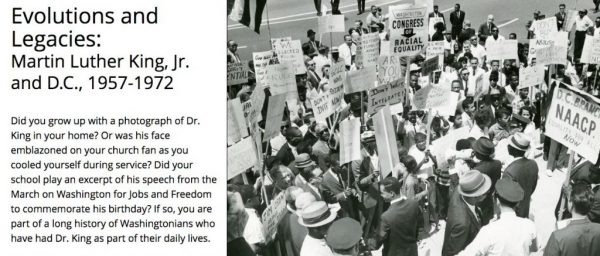
From the D.C. Public Library:
“1968 was a momentous year in US history. The Rev. Dr. Martin Luther King Jr. and Robert F. Kennedy were assassinated. The Poor People’s Campaign, which Dr. King was organizing at the time of his death, brought activists from across the nation to the District.
Locally, 1968 brought the groundbreaking of what would become the Martin Luther King Jr. Memorial Library, the founding of the Duke Ellington School for the Arts and the opening of Federal City College, now part of the University of the District of Columbia.
This year, the Library is hosting a series of programs and events to highlight the experiences that shaped 1968 locally and nationally titled, “The People’s University.” This month, the celebration starts with an online exhibit, “Evolutions and Legacies: Martin Luther King Jr. and D.C., 1957-1972.” (more…)