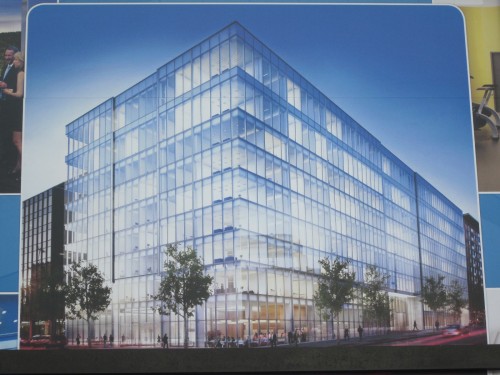
That’ll be quite the transformation – here’s how 2001 M St, NW looks today:
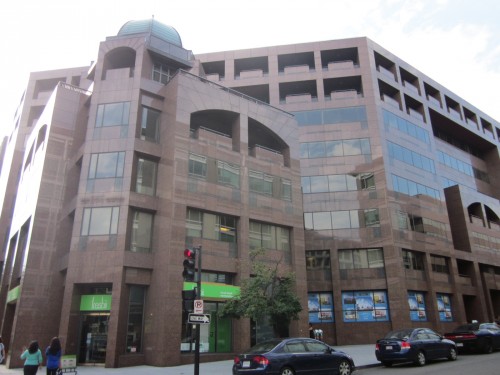


That’ll be quite the transformation – here’s how 2001 M St, NW looks today:
Streets of Washington, written by John DeFerrari, covers some of DC’s most interesting buildings and history. John is also the author of Lost Washington DC.
Last time we re-lived the Willard Hotel’s early era, when it was run by brothers Henry and Joseph Willard and occupied a sprawling complex of low-rise 19th-century buildings on the northwest corner of 14th Street and Pennsylvania Avenue NW. With the death of Joseph in 1897, control of the hotel fell to his son, “Captain” Joseph E. Willard (1865-1924), who had big changes in mind. As the 20th century dawned, a new era and a new building were in store for Washington’s most prominent hotel, and there would be plenty of drama ahead as well. At one point the building was abandoned and left in ruins, but it finally took on a new life as the once-again grand hotel we know today.
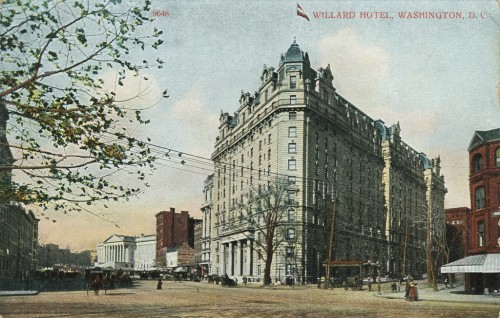
The Willard Hotel, circa 1910 (author’s collection).
The younger Joseph, though born in the Willard, immediately began planning to replace it when he gained control of the property. He hired architect Henry Janeway Hardenbergh (1847-1918) to design a thoroughly modern new building. Hardenbergh had designed New York City’s Waldorf-Astoria Hotel and would soon be working on the Plaza Hotel there as well. For the Willard, he created a soaring Beaux-Arts palace that resembled in many ways his other Washington hostelry, the Raleigh. Sometimes called Washington’s first skyscraper, the new Willard used advanced construction techniques, including a steel frame and reinforced concrete base. The stately exterior finishes included rusticated Indiana limestone curtain walls on the first three stories with beige brick and terracotta detailing above. The highly-ornamented top-floor dormers, curved mansard roof, and bullseye windows have become iconic.
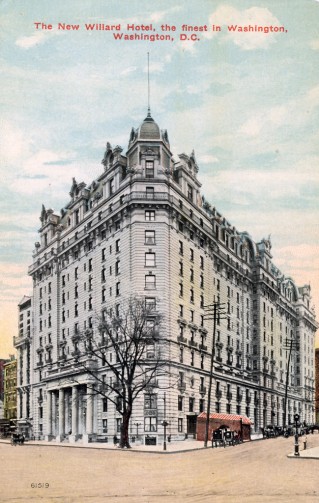
Construction took place in two phases so as to allow hotel operations to continue uninterrupted. The first part of the new hotel—the southern section on Pennsylvania Avenue—went up between 1900 and 1901, while guests stayed in the northern part of the old hotel opening on F Street. The hotel’s sumptuous new main lobby on Pennsylvania Avenue opened for business in October 1901. After guests moved into the new structure, the rest of the building went up between 1902 and 1904.
Like the Raleigh, the new Willard included a lavish ballroom and private dining room on the top floor with magnificent views of the city. At street level were the restaurants. The main restaurant on the first floor was “one of the largest and most elegant dining halls to be found anywhere,” according to The Washington Times. “With its richly decorated ceiling and great columns it is a sight worth looking upon.” Across the long main corridor, which in time would be called Peacock Alley, was the so-called Pompeian Room, a “dangerous” place in some people’s minds, because men and women could mingle there, and women were allowed to smoke. Overlooking all this activity was a balcony designed to accommodate the hotel’s in-house orchestra.
Continues after the jump. (more…)
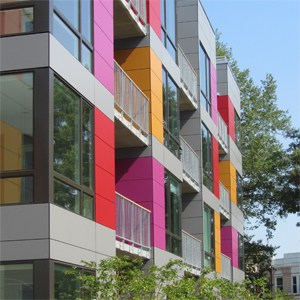
Photo courtesy of Suzane Reatig Architecture
We’ve previously discussed this building back in April 2012.
More details from a press release:
Bailey Park DC [625 Rhode Island Avenue NW]
Synopsis
Designed by award-winning architect, Suzane Reatig Architecture, Bailey Park DC offers oversize rental flats and duplexes in a boutique apartment building. Located across the street from the Shaw Metro and in the center of the Howard Theatre District, Bailey Park DC is walkable to major dining and entertainment nodes, including 14th Street, U Street Corridor, Penn Quarter, Chinatown, and the National Mall. Open floor plans offer up to double the square footage of comparable units currently available in the DC metro area. Bailey Park DC units feature spectacular high ceilings, floor to ceiling windows, and private balconies or terraces. Enjoy the beautiful views of downtown from the rooftop terrace, or relax in the private courtyard.
Details
16 units – 4 already leased
14 market-rate units, 2 units target 60-80% area median income
Floor to ceiling windows
Stainless steel appliances
Granite countertops in kitchens and baths
Washer/dryer in each unit
Private courtyard
Rooftop common area
LEED Certified; green roof
Pet friendly
Located directly across from the Shaw metro
Parking available
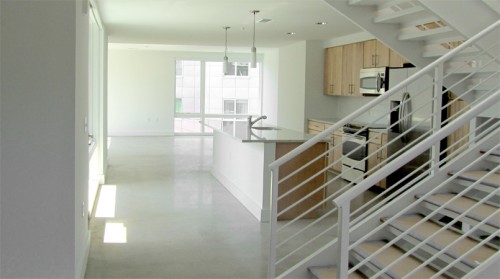
Photo courtesy of Suzane Reatig Architecture

3330 Georgia Ave, NW
Cold war chic?


Looks like they forgot a couple of windows…

Here’s what it looked like in 2011:


Yesterday afternoon we took a look at a rendering and master plan for Union Station development. Here’s more info, renderings a press release from Akridge.

Akridge will join Amtrak, the Union Station Redevelopment Corporation (USRC), and federal, state and local government officials in announcing the Washington Union Station Master Plan. A cornerstone of the Plan is Burnham Place, a 3-million square-foot mixed use development that will create a new urban neighborhood in downtown Washington, D.C. Built atop the rail yards north of the station, Burnham Place will bring a host of benefits to the neighborhood, the region and the entire Northeastern United States.
Ideally located at the convergence of the city’s central business district, Capitol Hill, and the burgeoning NoMa and H St. NE neighborhoods, Burnham Place is envisioned as a major commercial, retail, and residential hub for the entire D.C. Metropolitan area. While still in initial planning stages, early projections for the project suggest 1.5 million square feet of office space, more than 1,300 residential units, 500 hotel rooms, and 100,000 square feet of retail space. Only six blocks from the U.S. Capitol, the project’s potential is vast and could accommodate a global headquarters, cultural or educational institution, or multi-building campus.
Additionally, Burnham Place will feature a linear park or “greenway” along the west side of the station. This half-mile long park will provide a pedestrian walking path and bike lane for commuters, residents and visitors alike, connecting the NoMa neighborhood with Union Station and Metro. The beautifully landscaped greenway will also incorporate and connect to the elevated portion of the popular bikeway, the Metropolitan Branch Trail.
Burnham Place is integrated as part of Amtrak’s overall Union Station Master Plan and will help connect residents, workers, and visitors to the nation’s capital and the region. With regional mobility now severely constrained, the plan offers the ability to accommodate the significant growth in regional transportation projected over the coming decades, with twice the number of trains and triple the number of passengers by 2030. The plan also allows for even further growth, including high-performance, high-speed rail along the Northeast Corridor. Notably, the Master Plan along with Burnham Place is expected to generate $14.3 billion in economic benefit to the D.C. Metropolitan area over the next 15 years.


Rendering via Amtrak Master Plan
From a press release:
Amtrak is releasing a Master Plan today that offers a visionary and practical approach to revitalize the terminal at Washington Union Station. Developed in coordination with other stakeholders including U.S. Department of Transportation, Union Station Redevelopment Corporation (USRC), Virginia Department of Rail and Public Transportation, Virginia Railway Express, Maryland Transit Administration, Washington Metropolitan Area Transit Authority and Akridge, it lays the groundwork for an expanded and greatly improved intermodal station that will increase capacity to accommodate future service expansion, deliver the highest quality passenger experience and provide robust support to local and regional economic growth.
The Master Plan envisions dramatically improved facilities that are modern, safe, and secure which will accommodate three times as many passengers and twice as many trains, all within the same footprint and preserving Union Station’s historic architectural design.
The heart of the plan is the creation of a new train shed that will welcome passengers to the nation’s capital, bring natural light to station spaces and better organize the connections to Amtrak, commuter rail, transit and other transportation services. New passenger concourses, along with a series of new street entrances, will be seamlessly integrated with the existing station, enabling passengers and visitors to easily access the entire station complex and adjoining neighborhoods while experiencing improved amenities and expanded retail opportunities.
The estimated cost for the Master Plan is between $6.5 and $7.5 billion ($2012). In addition to creating a world-class facility with ample capacity for future high-speed, intercity and commuter rail service growth, these investment levels would generate enormous benefits to the city and region through job creation, increased tax revenues, and enhanced economic development. It also will help to create significant public spaces that can be enjoyed for decades and bring together the adjoining neighborhoods that are now cut-off from one another.
Importantly, the plan also makes possible the accommodation of tracks, platforms and concourses to support a new Next Generation High-Speed Rail (NextGen HSR) concourse below the existing station platforms to keep pace with the growth projections and plans outlined in the recently released The Amtrak Vision for the Northeast Corridor: 2012 Update Report. This future lower-level concourse could allow for a potential NextGen HSR extension south of Washington to connect with the proposed Southeast HSR Corridor.
The Master Plan creates a framework for progressive capital investment with a phased construction approach to be accomplished incrementally over 15 to 20 years, providing numerous local, regional and national benefits, and creating an improved station that will benefit millions of rail passengers, transit riders, area workers and residents, tourists and the public. It is estimated to generate a total of $14.3 billion ($2012) in regional economic benefit through direct construction expenditures and other related economic impact.
In addition, the Master Plan includes a public-private partnership to build three million square feet of mixed-use development for Burnham Place, which is envisioned as a major commercial, retail and residential center. Since purchasing the air rights over the Union Station rail yard in 2006, Akridge has worked in close partnership with Amtrak and USRC for nearly four years on planning and design of the project.
See full plan in PDF below:

And it gets even better – check out the painting up top:


Wow, lots of progress at The Avenue coming to Georgia and Newton Pl, NW. Do you like the way it’s turning out? You can see what the 83 unit apartment building looked like in April here.

11th and Harvard St, NW
This is the building that will become the ’11th Street Living Facility’. How do you think the rebuilt section turned out?

June 2011

April 2011