

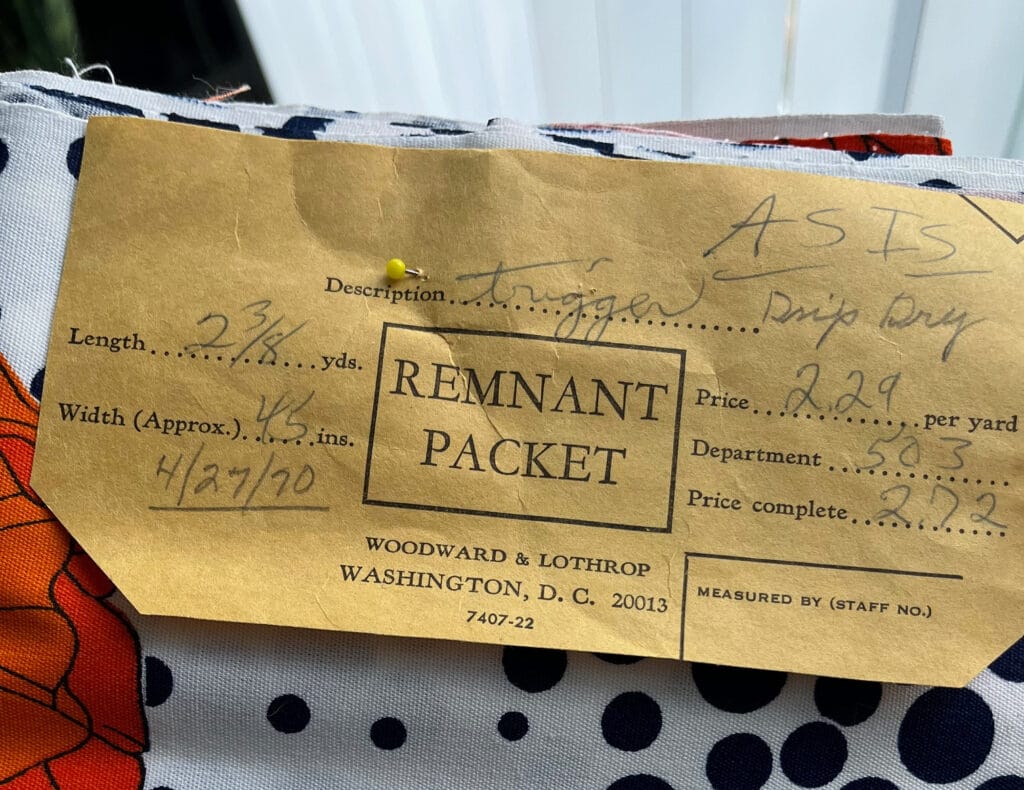
Thanks to Stephanie for sending: “I was surprised to find this fabric remnant amongst my aunt’s belongings. I assume 4/27/70 is a date – was Woodies really selling fabric then?”
Should you come across any old DC photos or ephemera from your or your family’s collection please send to [email protected] or DM us at one of our socials @PoPville thanks!
Some history about Woodward & Lothrop from Wikipedia:
“Woodward & Lothrop was a department store chain headquartered in Washington, D.C. that began as the capital’s first department store in 1887. Woodies, as it was often nicknamed, maintained stores in the Mid-Atlantic United States. Its flagship store was a fixture of Washington, D.C.’s downtown shopping district, competing with Garfinckel’s and acquiring Palais Royal. The chain filed for bankruptcy in January 1994 and completed liquidation in November 1995, with most locations sold to either J. C. Penney or May Department Stores Company. The flagship building is a D.C. historic landmark that became the center of controversy over competing visions for DC’s urban renewal after the chain’s demise, and the former service warehouse in the city’s northeast is also listed as a landmark.
Soon after moving into the historic Carlisle building in 1887, Woodward & Lothrop outgrew its space and began expanding, purchasing the neighboring properties. By 1897 it occupied almost the entire block surrounded by 10th, 11th, F, and G Streets NW. In 1898 and 1902, the buildings were renovated behind a new facade facing G Street designed by Henry Ives Cobb. Two additional floors were added in 1912 and 1913, and yet another building added in 1925.
The building attained its lasting form in 1927. It stands ten stories and once held over 400,000 square feet (37,000 m2) of retail space; the exterior was decorated in cast iron and leaded glass accents with flower designs and the Woodward & Lothrop monogram. It was declared a D.C. Historic Landmark in 1964.
The store hired the architect Michael Graves to redesign its street floor in the 1980s where he incorporated the company’s signature W&L monogram plaques on the columns.
After the chain’s liquidation, the store stood empty while developers and city officials debated its future. The city first lobbied to have the location reopened as a Macy’s, but Macy’s owner, Federated Department Stores (now Macy’s Inc), demurred; the space was too large, in need of renovation, and situated in downtown Washington, where shopping had declined relative to the suburbs. Finally, the Washington National Opera purchased the building in 1996 for $18 million (~$33.1 million in 2024), seeking to have it renovated into its new home.
Unfortunately, the cost of converting the retail space into an opera house proved daunting: $200 million. It remained empty until 1999 when it was sold to developer Douglas Jemal for $28.2 million (~$49.8 million in 2024). Neighborhood activists wanted Jemal to convert the building for mixed use, including arts space, restaurants, and housing as well as retail, but Jemal sought to use it for mixed office and commercial space instead. The District of Columbia Zoning Commission declined Jemal’s proposal, and the building remained empty for two more years.
Finally in 2001, the Commission approved the retail-office plan (on the condition Jemal build housing at another site), and renovation got underway. The building reopened after almost a decade in 2003. Swedish clothing retailer Hennes & Mauritz (H&M) was the first major tenant.
On January 29, 2004, a fire struck the building. Just before 10pm, firefighters responded to visible heavy fire on the 10th Street side. After twenty minutes, most of the fire was knocked down; the cause of the fire was found to be accidental, probably caused by a baseboard space heater.
On August 21, 2007, furniture and housewares retailer West Elm opened in the building. Also in 2007, a three-floor Zara opened while the D.C. branch of Madame Tussauds wax museum opened in the adjacent Rich’s Shoes building, which had been a holdout as Woodward & Lothrop expanded its old flagship store to cover the entire block (see photo at right).
Besides the downtown Washington store, the former Woodward & Lothrop Service Warehouse at 131 M Street, Northeast was declared a D.C. Historic Landmark in 1993. An example of Streamline Moderne architecture, it was added to the National Register of Historic Places in 2005.”