

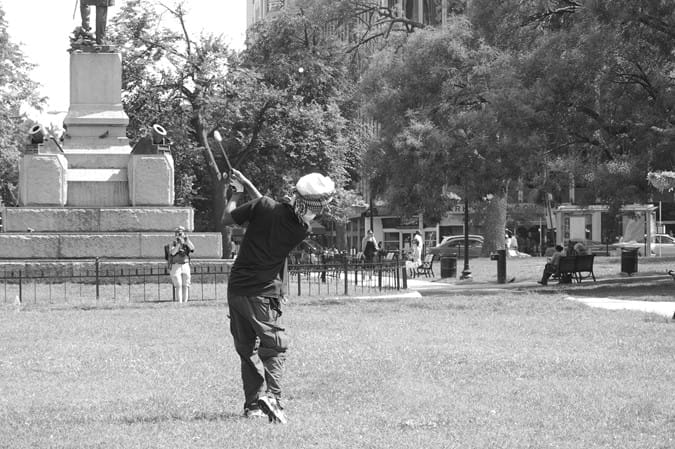
photo by Phil
“Dear PoPville,
**Mr. President: Public Golf Should Remain Public**
When East Potomac Golf Links opened in 1921 as Washington’s first public course, it was designed to be “the model public playground”—a place where working people, not just country club members, could play the game. President Warren Harding loved it so much he’d skip his private club at Chevy Chase to play there instead. That’s the tradition President Trump now threatens to dismantle.
On December 31st, the Trump administration terminated the National Links Trust’s 50-year lease to operate Washington’s three historic public golf courses—East Potomac, Langston, and Rock Creek. The administration claims the nonprofit defaulted on capital improvements, yet NLT invested over $8.5 million in upgrades, doubled both rounds played and revenue, and kept greens fees affordable while elite courses nearby charge triple the price. The real default isn’t financial—it’s a failure to recognize that federal land should serve the public, not presidential ambitions.
These aren’t ordinary golf courses.
Langston, designed in 1939, was one of only twenty courses in America where Black golfers could play. Legends like Charlie Sifford, Lee Elder, and Calvin Peete honed their games there. East Potomac’s layout, created by Golden Age architect Walter Travis, was inspired by St. Andrews and designed to be reversible—a democratic innovation that spread wear and allowed more people to play. Rock Creek was designed by William Flynn, who went on to create Shinnecock Hills. These courses represent not just architectural history, but the history of who gets to play golf in America.
President Trump knows golf. By his own account, it’s a passion that runs deeper than money. He owns courses around the world and understands what makes them great. That’s precisely why this moment matters. A president with genuine knowledge of the game should be its greatest champion—not its gatekeeper.
The administration’s vision, by all accounts, is to transform East Potomac into a championship facility capable of hosting professional tournaments. That’s an admirable goal in isolation. But on federal land purchased and maintained with taxpayer dollars? It’s a betrayal of the public trust. If we allow public courses on national parkland to become exclusive venues, we’re establishing a dangerous precedent: that shared spaces exist only until someone powerful enough decides they’d work better as private playgrounds.
The analogy is straightforward. Imagine if Yellowstone required membership fees. Imagine if the National Mall became gated. Federal land exists to serve everyone, not to enhance presidential legacies or generate revenue for private operators. Golf courses on public land should operate under the same principle.
National Links Trust’s model was working. They brought in Tom Doak, Gil Hanse, and Beau Welling—three of the world’s most respected golf architects—to design renovations pro bono. They launched the Jack Vardaman Workforce Development Program, which has employed nearly 200 DC high school students and taught them both golf industry skills and broader life competencies. They removed invasive species, released freshwater mussels into the Anacostia River, and hosted free community events. This is what public golf can be: not just accessible, but actively engaged in strengthening communities.
President Trump has spoken frequently about fighting for working Americans. Here’s a chance to prove it. If the administration truly wants to elevate these courses to championship caliber, there’s a proven model: Bethpage Black.
Bethpage State Park in New York hosts major championships—including the U.S. Open, PGA Championship, and Ryder Cup—while remaining genuinely public. New York residents pay $70 for a weekday round on one of the world’s most revered courses, while out-of-state visitors pay $140. Compare that to private championship venues charging $500 or requiring six-figure memberships. Bethpage proves you can have both excellence and accessibility.
If East Potomac is to be transformed into a championship facility, it should follow the Bethpage model: dramatic upgrades in quality, with DC residents paying substantially discounted rates and visitors paying market prices. This approach would generate revenue while honoring the public mission. DC golfers could play a world-class course for $50-75. Visitors would pay $150-200. The course could host professional tournaments. Everyone wins.
But this only works if affordability for locals is guaranteed, not aspirational. The administration should commit, in writing, to resident rates that reflect the public nature of the land. Keep the community programs running. Keep them open to the locals who say East Potomac is “basically the only place I can afford to play.”
Public golf in Washington has survived over a century by staying true to a simple idea: that the game shouldn’t be reserved for those who can afford exclusivity. President Harding understood that in 1921. President Trump, who loves golf perhaps more than any modern president, should understand it now.
Federal land belongs to all of us. Let’s keep it that way.
David A. – Washington, DC Golfer”