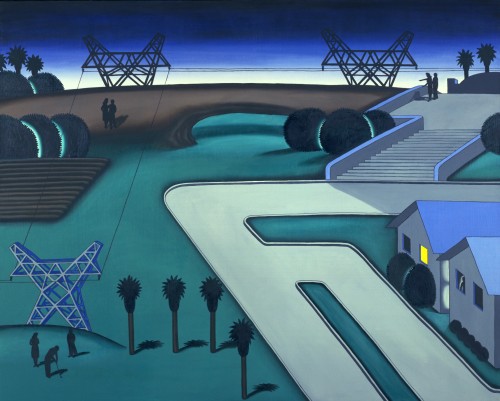
Roger Brown, Natural Bridge, 1971, oil, Smithsonian American Art Museum, Gift of the S.W. and B.M. Koffler Foundation.
As I toured the new exhibition of Chicago art at the Smithsonian American Art Museum, our own city’s modern art legacy was what first came to mind. That legacy tends to revolve around the Washington Color School of the 1960s. Whether you love them or hate them, the color field painters that populate local museums succeeded in engaging with the postwar behemoth of Abstract Expressionism. They didn’t so much pioneer a Washington movement as they did push the boundaries of one born in New York. What is most satisfying about Made in Chicago: The Koffler Collection is the extent to which its artists flout such linearity.
The exhibition is inconspicuous, taking up three small galleries at the south end of the museum’s second floor. Its namesakes are Samuel and Blanche Koffler, Chicago collectors whose foundation donated a portion of their contemporary holdings to the Smithsonian in 1979, back when SAAM was known as the National Collection of Fine Arts. While the majority of the 26 works are paintings from 1960 to 1980, they are wildly different — both from one another and from the kind of abstraction being churned out elsewhere in the United States at the time.
This is in part thanks to Chicago artists’ affinity for experimental art brut that simultaneously draws on art history and snubs it. Half a century ago, such artists formed informal groups with awesomely ’60s-tinged names like “The Hairy Who” and “The Non-Plussed Some” and championed various brands of representational art that were unrestrained by the heavy theory of painterly abstraction. Several of the artists on view shared an interest in popular culture and graphic arts. Others were influenced by the abundance of Surrealist works in Chicago collections.
Continues after the jump. (more…)