
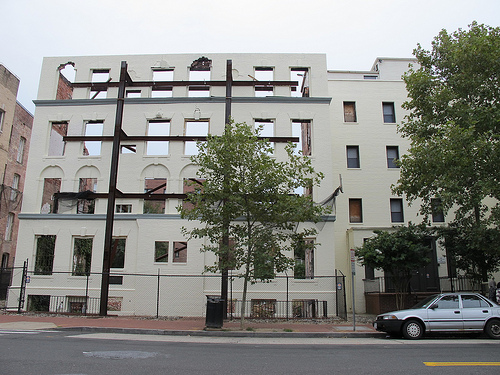
Council Member Jim Graham updates the community on the future Monsignor Romero building in Mt. Pleasant:
Excellent news. The DC gov has approved the tax credit application for the Monsignor Romero building at 3145 Mt Pleasant Street. It has been a very long haul, but this tenant owned building is soon on its way to rehabilitation in service to very low income people. A victory for the tenants, the National Housing Trust and everyone who had faith that this could and would work.
A reader asked him when construction was slated to begin and he replied:
The city gets to allocate Federal resources (Low Income Housing Tax Credits or LIHTC) to help build or redevelop affordable housing. Those federal tax credits allow organizations (in this case, the National Housing Trust) to attract private investors to invest money so that they can rebuild the Monsignor Romero building. For about every dollar in tax credits, a project such as this is able to generate about $10 in private funding.
Almost equally important, without these credits, this project would not have been feasible.
To answer your question as to when the work will start, NHT has to work through the Department of Housing and Community Development’s normal processes, but expect construction to begin in March 2013.
Category: Buildings, Mt. Pleasant
COMMENTS
14 May 2013 12:00 PM
COMMENTS
14 May 2013 10:08 AM
COMMENTS
COMMENTS
13 May 2013 12:57 PM
COMMENTS
15 May 2013 9:29 AM
Why have I never thought of this before? Booze truck!
Question to residents - thank you in advance. I am considering purchasing a 1st level...
Thank you for this, I had no idea about this type of thing. It also makes me think that...
Disgusting.
It'll take a while. After I moved a block down the road, a friend called me a week before...
Excellent news for MtP residents–removing that blight from our mainstreet will be a huge improvement. When they say it’s “tenant-owned,” what does that mean? Affordable co-ops? Low income rentals, supported by the tenant association? anyone know?
It means it was a standard rental. It burned down. DC then spent millions of dollars started subsidizing each residents monthly rent for the next 4 years, to the tune of 22K per unit so they could continue to rent in expensive upscale locations rather than doing what normal folks do when they can’t afford the rent in their desired neighborhood, look elsewhere. Half of the former residents weren’t legal US citizens to begin with and took that money home with them when they left the District.
Then the remaining former residents decided they wanted to buy the property, rather than letting the actual owner sell it on the open market to someone years ago who would have had it renovated they, using what have to be the most ridiculous laws on the books (hey, DC is over the top renter friendly), they forced the owner to sell to them at a substantial discount, using free money they got from “shocker” the District of Columbia.
So after demanding millions more from the District government to get Construction started, here we are.
So the answer is, the former renters now own the building. It will be turned into co ops where you will have to meet some threshold on income to buy.
+100
I think DC got this way cause it’s population for several decades was largely poor, and their reps crafted a bunch of laws to make the government subsidize them. Where that money was supposed to come from is beyond me and probably them. Everyone simply lived off the fat of DC’s few taxpayers. It reminds me of that city law put into affect by the city that says that DC must pay for shelter in hotels for the homeless when the temperature drops below a certain degree. Each year, it costs the city millions of dollars and likely draws the homeless from VA and MD, which should be shouldering some of the costs for social services.
“Half of the former residents weren’t legal US citizens to begin with and took that money home with them when they left the District.”
And you know this how?
Cause I was one of them.
Wash Post did an article on this building back in Jan/Feb of this year. Pretty shocking stuff really.
By saying the residents “weren’t legal US citizens,” you seem to be conflating several different statuses: citizen, legal permanent resident, and illegal/undocumented. I re-read the Post article, and nowhere does it state or even imply that the most of the building’s residents were not “legal.” It simply mentions that some former tenants returned to Mexico, El Salvador, etc. Those individuals who returned to other countries could have been foreign-born US citizens who returned to a home country, or legal permanent residents who did so. It’s one thing to disagree rationally and on a policy level with affordable housing development and subsidies; it’s another thing to use judgmental and un-necessarily disparaging conjecture to make a point.
If so much as a single brick is layed by 3/31/13, I’ll be shocked and amazed.
I’ll be surprised too. Especially because all the brick was layed like 100 years ago.
I have to admit, after many years of nothing, my reaction is: “I’ll believe it when I see it.” That said, this sounds like wonderful news and I am cautiously optimistic.
Jim Graham is a blowhard, so I wouldn’t be surprised if we’re here in April and June and July 2013 wondering again what’s up with the blight.
I wish I could sell this promise short
This is very far from excellent news. Mt. Pleasant would have been a lot better off if what remained of the “building” had been sold off to developers years ago. Why should the former renters get to move back after years of having ridiculous rents paid for with our tax dollars? The city could and should have just bought them apartments somewhere else and saved us all a lot of money. A total waste of my taxes.
I think Mt. P is better off by retaining some affordable housing, and not sending slumlords the message that demolition by neglect and letting your building burn down makes it easy to turn over.
Cool. then feel free to go give these poor people some of your money if it’s so important to you. But please leave the rest of us (or at least me) out of it.
I moved to Mount Pleasant because it is economically diverse and am pleased this will return to affordable housing. It was heartbreaking to see the famlies there flee the morning of the fire.
Wow. Between this, the library reopening, and the new Thai restaurant, I can’t help but feel optimistic about our little neighborhood.
Very nice.
But I do echo the sentiments of believe it when I see it on 3/2013 construction.
And to those who are disappointed that tax dollars are being used to subsidize housing for poor people, I’m sure the IRS will gladly accept a check from you for the amount that they subsidize your house through the mortgage interest tax deduction.
You make a good point, but it’s not completely accurate. It would be a fair comparison if the gov’t paid for my mortgage, not gave me a tax break. Personally, I’d be fine with the DC gov’t giving the Romero renters a tax break to find another place to live, but it sounds like this goes well above and beyond that. Also, at some point, the interests of the community should be taken into consideration, and leaving a major parcel to sit abandoned in its heart screws everyone else, including other poor people.
The principle is the same. On the one hand, the government is using (or foregoing, if you prefer) tax revenues in order to make your house more affordable, and in the other, it is using tax revenues to make these folks’ rents more affordable. We can argue about whether the amount of ths assistance is too high, but it sounds like a lot of folks on here object on principle to the idea of helping folks “live in neighborhoods they cannot afford.”
But isn’t the key difference the volume of the aid or its percentage of the total homeowner’s bill? I’m not sure that the interest tax deduction allows people to live in neighborhoods they can’t afford. I’ve purchased several homes in various places and the tax deduction never factored into my decision. It was simply too small in comparison to the total mortgage to be much of a factor. That’s why I think the more appropriate comparison is the gov’t paying my mortgage so that I can live in a place I can’t afford. Maybe that’s the difference between helping the working poor, like teachers and firefighters, versus people who don’t work or who have extremely low-paying jobs and perhaps a lot of dependents.
+1000. I am on my third home in the district and the deduction has never once even been a consideration in determining where I could afford to live. It is absolutely not the same as what is happening here other than both involve the government ending up with less money.
Well, lots of studies don’t agree with you. They almost always find that MID increases housing prices, doesn’t do much to increase homeownership rates, and mostly benefits the upper middle class and wealthy. Also, FYI, teachers and firefighters in our area really don’t fit the traditional definition of “working poor”. They are pretty solidly middle class.
JCM,
I would love to see one of these studies. Every time I ask someone to provide one, they come up short.
Mortgage tax deductions most definitely make homeownership more affordable. Why else would the government offer them? But very well. Another example. The DC First Time Homebuyer tax credit. $5000 in my pocket to allow me to lower the cost of buying my first home. I can tell you that this DEFNITIELY allowed me to buy a house in a neighborhood I could not otherwise afford. And yet, no one seems throwing hate in my direction. For that matter, the government also gave me a Pell grant, which allowed me to go to a school I could not have otherwise been able to afford, which in turn allowed me to get a great job that I would not have otherwise qulified for. I also have an FHA loan, which guarantees that the government will step in if I ever default on my mortgage. I’m a regular welfare queen. But all you “rugged individualists” out there, keep telling yourselves that you did it on all on your own. We all need a good fairy tale to help us sleep better at night.
Here’s a pdf of the best MID study I know of:
Abstract:
This paper examines the impact of the combined U.S. state and federal mortgage interest deduction (MID) on homeownership attainment, using data from 1984 to 2007 and exploiting variation in the subsidy arising from changes in the MID within and across states over time. We test whether capitalization of the MID into house prices offsets the positive effect on homeownership. We find that the MID only boosts homeownership attainment of higher income households in less tightly regulated housing markets. In more restrictive places an adverse effect exists. The MID is an ineffective policy to promote homeownership and improve social welfare.
This pdf discusses reforming the MID, and has a good survey of the literature.
The deduction is only available to itemizing taxpayers and its value rises with an individual’s tax rate. The result is that most benefits from the deduction are concentrated at the high end of the income distribution, where homeownership rates are likely to be high with or without the deduction.
…
Glaeser and Shapiro (2003) note that the value of the deduction has risen and fallen by tenfold in the past 50 years while homeownership rates have remained nearly unchanged between 63 and 68 percent. Their formal analysis of time-series data finds no effect of the MID on homeownership rates. Cross- national comparisons in Gale, Gruber, and Stephens-Davidowitz (2007) also conclude that the mortgage interest deduction is not correlated with higher homeownership rates
…
The MID also has the potential to affect homeownership through its impact on home prices. The subsidy makes individuals willing to pay a higher price for the same home, but the resulting effect on home prices depends on the elasticity of the housing supply. The effect of the deduction on house prices is likely to vary across and within regions due to differences in tax rates and the availability of undeveloped land. The deduction will raise prices more in densely populated areas with low housing- supply elasticities and high tax rates. At the extreme, Capozza, Green, and Hendershott (1996) estimate an upper-bound estimate of the effect on prices at 10 percent, assuming that the housing stock is totally inelastic.
Ugh. Sorry about the unclosed hyperlink on the second study. POP needs a preview button.
The mortgage interest deduction doesn’t allow someone who lives in Centreville VA to all of a sudden afford a house in Georgetown. This example is simply flawed and off base. To recoup $500 a month or $6000 per year through the mortgage interest deduction, you would have to be paying $54,000 a year in total mortgage interest. That’s $4500 a month, and we haven’t added in the principal you are paying. Basically, at today’s rates, getting $500 a month in mortgage interest deduction means you are paying on a ~1.3 million dollar mortgage and the mortgage interest deductions limitations fall below that., So yea…not the same at all.
I don’t mind a “safety net”. I think it was great that the District stepped in the day after the place burned and help people find shelter for a couple of months. But paying them on average $500 dollars a month for 6 years to subsidize their rent is beyond ridiculous. The fact that it went to known illegal aliens who moved back home in the aftermath is simply infuriating
I had to live in some pretty shady places in my 20′s and 30′s. Why? Because desire as I may to live in Chevy Chase, I couldn’t afford it. So, I lived in places I could afford. Why exactly wasn’t someone giving me $500 a month for 4 years? Or if they had, what possible benefit to the community of Chevy Chase could be had by subsidizing my rent there? What exactly would Chevy Chase had gained by me living there when I couldn’t afford it on my own?
Then to give them millions more to buy the place they couldn’t otherwise afford…then to give them even more to get construction started. Insane. The district has given this “now” tenant owned association nearly $300K per unit in grants, rent subsidies and outright interest free loans and the building is still a hole in the ground. We should have just written them all a $300K check years ago and let someone buy this place and do something with it.
This post is in dire need of some citations.
“What exactly would Chevy Chase had gained by me living there when I couldn’t afford it on my own?”
This is what I mean. Your argument isn’t a question of scale. It’s a fundamental objection to the very idea of of helping poor people live in places they could not otherwise afford. Most people figured out a long time ago that there is a societal benefit to not warehousing poor people in ghettos. It’s not a question of economics, but rather of values. We see moral value in helping people out of poverty. You see it as an assault on your pocketbook.
jcm,
I point you to the Wash Post article I mentioned earlier.
DCdude,
You haven’t answered the question, and there is an ENORMOUS difference between not subsidizing someones rent and letting them choose anywhere else to live, and “warehousing” someone in a ghetto. No one here, least of all me has indicated thats the course of action. There are tons of choices in the DC metro area for someone to live that isn’t a “ghetto”, so stop trying to make this a one or the other comparison.
They, like all of us can make simple adult decisions. Can I afford to live here or not? My inability to live in Chevy Chase was not your problem, nor was it a moral imperative for the taxpayer to help me live there when I couldn’t afford it. Same applies here. The money wasted on this burned out turkey of a building by sending rental subsidy checks to 100% illegal aliens for all those years just makes this worse, and makes it far more difficult the next time when the government wants to spend money funding a legitimate safety net.
I’m for both scrapping the mortgage interest deduction and also stopping the subsidies to the poor. Don’t see a compelling reason for government to be subsidizing the housing sector whatever the method and no matter who benefits.
joker,
If your question is whether there is a societal benefit to subsidizing your rent in Chevy Chase, the answer is, of course, no. The problem of course, is in your trying to project moral equivalence between helping the poor and helping you live in Chevy Chase. If you honestly don’t see the distinction, then we really have nothing more to argue about.
And you are missing the point by equivocating “destitute” with lower income people.
I am all for building all the shelters and soup kitchens one wants to build. But these people weren’t jobless and homeless, they just made less money than you. All of us make less money than our peers at various points in our lives. That doesn’t mean the gov steps in and subsidizes your rent. It means you move to a cheaper neighborhood, tighten your finances or get another job. it means you shop at Costco rather than whole foods.
I can virtually guarantee you make less money than I do. That doesn’t make you poor, nor does it make it valid that I subsidize your rent for 4 years because you want toive in Georgetown and you can only afford Petworth.
I can also promise you that if I was living in El Salvador illegally and my apt burned down, the Salvadorean gov wouldn’t be cutting me monthly checks for 500 dollars to subsidize my rent.
You forgot to suggest that they borrow money from their parents. You honestly appear to have no clue about how the working poor live in this country. What kind of life do you think an immigrant washing dishes for minimum wage can expect to have in this city? After paying FICA and sending money back home, I would be amazed if they lived above the poverty guidelines. But hey, at least they’re not living in cardboard boxes. They’re living the dream!
And BTW, it’s “equate,” not “equivocate.” Take all of that money you make and go buy a dictionary.
You know all these great new restaurants we have now? They all require dishwashers. Dishwashers are never going to make enough money to rent a modest apartment within an hour’s travel time of their work – unless, (as is common,) they share with 6-8 people in some basement or dilapidated old house.
I think even Joker would agree that there is a need for the govt. (i.e. us, with our tax dollars) to play a role in assuring there is decent housing available in an expensive market for those doing essential, but low-paying work. But everyone should be outraged over the way this particular situation with this building was handled.
I agree with you Victoria. Economic diversity is a plus and is one of the characteristics of Mount Pleasant.