Photo by PoPville flickr user D©Bloom

Griffin & Murphy, LLP, is a boutique law firm in Washington, D.C. concentrating its practice in real estate law (including development, finance, leasing, zoning and condominium conversions), as well as estate planning and probate, civil litigation, and business law. The attorneys of Griffin & Murphy, LLP are licensed to practice law in the District of Columbia, Maryland and Virginia. Griffin and Murphy, LLP was founded in 1981.

Please send any legal questions relating to real estate, rentals, buildings, renovations or other legal items to princeofpetworth (at) gmail (dot) com, each week one question will be featured. You can find previous questions featured here.

QUESTION:

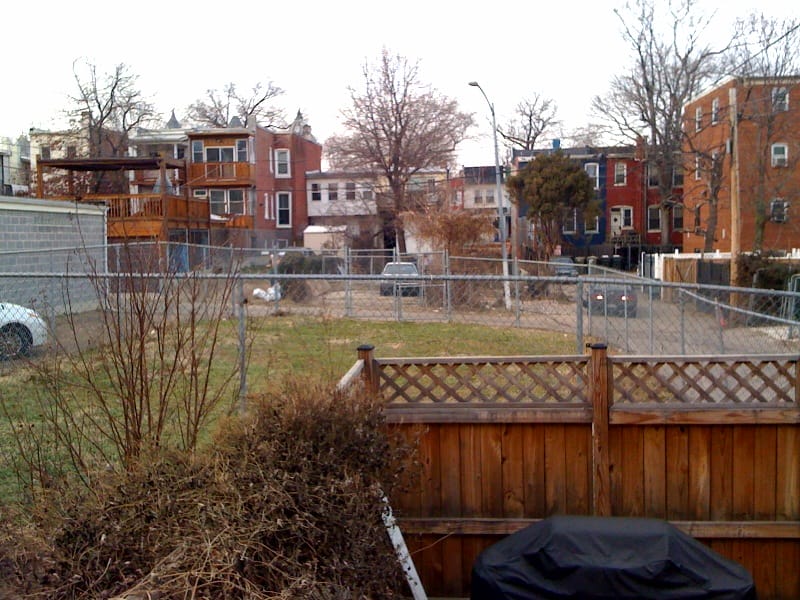
We have a nuisance home that is right next door to our home. The owner bought this home at a city tax auction and has let it sit vacant for over 10 years and has not renovated it or even attempted to fix problems that are affecting the connecting homes. The owner has been charged the vacant tax rate by the city for the home, but that doesn’t seem to affect him at all. This house sits in between my house and the house on the corner. We have both tried to contact the owner to see what he plans to do with the home or at least find out when he will address his house’s problems that are affecting our homes. We have received no response from him. We tried to get the city involved, but if he pays the taxes the city doesn’t care. Other than suing the owner, which I am sure will cost time and money on my part, do we have any other recourse? (Note: The property’s address has been removed from the question by PoP.)

ANSWER:

Not all problems have easy or speedy solutions, especially if you have to rely solely on governmental authorities to use scarce resources to come to your rescue. Nevertheless, you have taken the right approach by first contacting the property owner and then going to the city when you received no response. If you were informed by someone in the DC government that they cannot do anything as long as the property owner continues to pay his taxes, then I would call back and try to speak to someone else because that is incorrect. This property appears on the vacant property list maintained by DCRA, so they are aware of the property. I would contact them to let them know that you believe this property is insanitary, outline the specific problems you and your neighbors are experiencing, and copy your councilmember on any correspondence. Your local ANC may also be able to help you.

We checked the tax records and this property was formerly taxed at the Class 3 rate because it is vacant. Unfortunately, because the Class 3 rate will only apply to “blighted” properties in Tax Year 2010, it may be even more difficult to get this owner motivated to clean up the property if it is not deemed to be blighted and is taxed at a lower rate going forward. Continues after the jump. (more…)


Griffin & Murphy, LLP, is a boutique law firm in Washington, D.C. concentrating its practice in real estate law (including development, finance, leasing, zoning and condominium conversions), as well as estate planning and probate, civil litigation, and business law. The attorneys of Griffin & Murphy, LLP are licensed to practice law in the District of Columbia, Maryland and Virginia. Griffin and Murphy, LLP was founded in 1981.

Please send any legal questions relating to real estate, rentals, buildings, renovations or other legal items to princeofpetworth (at) gmail (dot) com, each week one question will be featured. You can find previous questions featured here.

A reader, Vicky, writes:

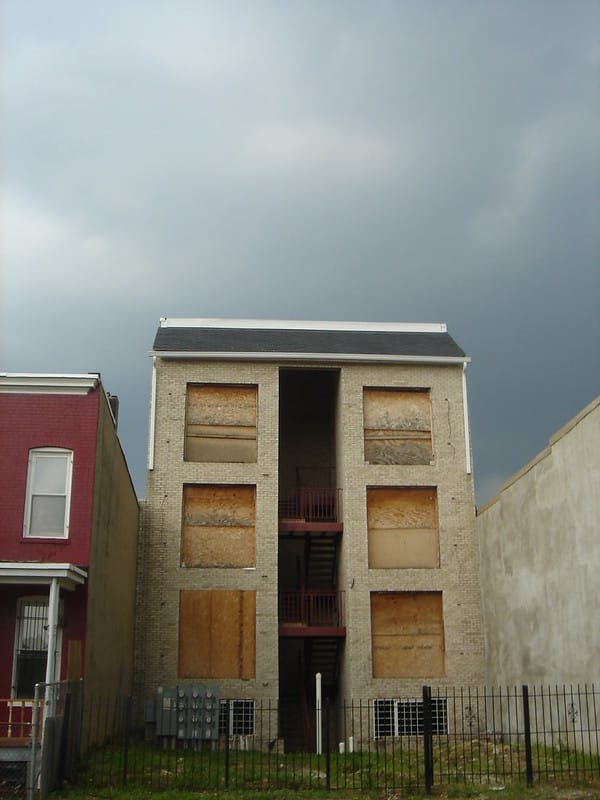
“I am wondering what the laws are for using vacant lots for gardening purposes. I am a renter on the 700 block of Morton Street NW and I hate to see the space at 725 Morton Street (picture attached) wasted and covered with trash (the picture does not reflect the current trash levels, which are much worse). While there is nothing I can do about the building (a neighbor told me that it is owned by the city after they discovered that the guy building it didn’t have the proper permits), I would love for the front yard to be used as some sort of garden. Veggies, flowers, or just a few trees – anything would be better than the condition it’s in now. I’m sure there are safety concerns about people being in the front yard of a building that’s only half-finished, but is there any sort of precedent for a community group using space like this for a similar purpose? And leads on who to contact to get that ball rolling? Or if it’s illegal – what is the likelihood of adverse consequences to going ahead and planting things there anyway (not the easiest thing in the world, the dirt would need a lot of work)? Any thoughts from the legal experts and the readers on ways to improve this lot, and consequently the whole block, would be appreciated!”

Griffin & Murphy, LLP respond:

This property, which is actually located at 723 Morton Street N.W., received some publicity a couple of years ago because the owner was cited by the city for illegal construction. Although the city cited the owner for building the existing structure without the proper permits, it has not condemned the building, and therefore, it is still privately owned property. Strictly speaking, you are not allowed to legally enter upon private property without the owner’s permission, and to do so would constitute a trespass. If a “No Trespassing” sign has been posted by the owner, you could be liable for criminal trespass, which might result in your arrest if the police were called; otherwise, you would only be guilty of civil trespass, which exposes you to liability for actual damages only. It would be hard to argue that you damaged this property if you planted a garden in the front yard.

Because the structure on this property was illegally constructed, the DC government has the authority to raze the building and charge the property owners for the cost of the demolition. If the city has not condemned the property up until now, we think it unlikely that it will do so in the near future barring some major change in the conditions on the property. We suggest that you contact DCRA to see what their intentions are with regard to this property and its owner. Answer continues after the jump. (more…)


Griffin & Murphy, LLP, is a boutique law firm in Washington, D.C. concentrating its practice in real estate law (including development, finance, leasing, zoning and condominium conversions), as well as estate planning and probate, civil litigation, and business law. The attorneys of Griffin & Murphy, LLP are licensed to practice law in the District of Columbia, Maryland and Virginia. Griffin and Murphy, LLP was founded in 1981.

Please send any legal questions relating to real estate, rentals, buildings, renovations or other legal items to princeofpetworth (at) gmail (dot) com, each week one question will be featured. You can find previous questions featured here.

A reader, Amy, writes:

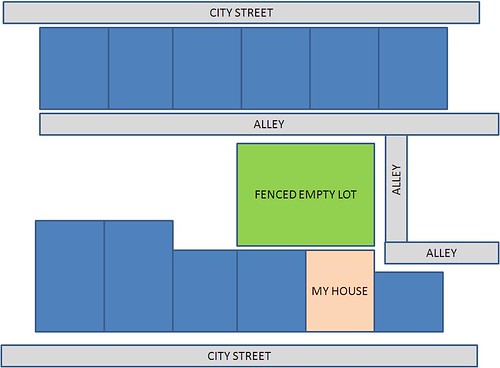
There is a fenced-in empty lot the width of my house and my next door neighbor’s house. I only bought my house 2 years ago, and the title search at the time shows we have all the land we are meant to. But regarding the empty lot, we believe they have adversely possessed the city alleyway between our lot and theirs. That would be about 10 feet in back of our two houses. If their fence were moved back, we could park in the alley like those across the block do in their alleyway. It would significantly add to the value of the house, even though it wouldn’t technically be our land.

Adverse Possession JPEG Version

How can we prove if they have adversely possessed this city alleyway? If they have, what recourse do we have, given that it is the city that has been harmed, not us, technically? Do we have any standing in this matter? I tried contacting the owners of the lot when we first moved in, but incorrect/out of date information on the tax records led nowhere, as did googling the name of the owner…not really sure how else to track the owner down. Of course what I would really like to do is buy the whole lot from the mystery owner, and sell half of it to my neighbor…but that is a different question.

Thanks,
Amy

Griffin & Murphy, LLP Respond:

Good news for Amy! Amy’s lot is part of a legal subdivision covering the square where her lot is located. The alley in question was created at the time the original Subdivision Plat for Amy’s square was recorded at the DC Surveyor’s office. The drawing which Amy supplied (see attached) and which she titled “adverse possession scenario” was not completely accurate because it did not show the alley located behind Amy’s property. According to the City records, there is a record alley that runs directly behind Amy’s property which has been illegally fenced in. Throughout the City we have what are commonly known as “paper alleys.” Paper alleys exist only on paper and are not paved, may not have curb cut access, or appear to be an alley to the passer-by, but do have all the same legal protections of a government designated alley. Amy should be able to get the City to stop the owner of the interior lot from encroaching upon the portion of the alley behind her lot so that she can gain access to the rear of her property from the alley. Answer continues after the jump. (more…)

Griffin & Murphy, LLP, is a boutique law firm in Washington, D.C. concentrating its practice in real estate law (including development, finance, leasing, zoning and condominium conversions), as well as estate planning and probate, civil litigation, and business law. The attorneys of Griffin & Murphy, LLP are licensed to practice law in the District of Columbia, Maryland and Virginia. Griffin and Murphy, LLP was founded in 1981.

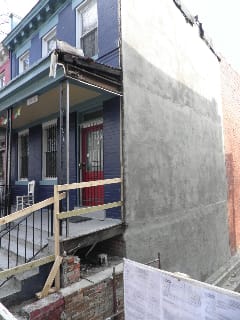
Yesterday a reader wrote in asking advice about the above situation.  I am happy to announce a new partnership with Griffin & Murphy, LLP who will answer your questions.  I will make this a weekly feature.  Please send any legal questions relating to real estate, buildings, renovations or rentals to princeofpetworth (at) gmail (dot) com Following is this week’s advice:

This case involves a D.C. row house which, until recently, shared a common wall with its neighbor. The neighbor tore down a portion of the common wall.

COMMON WALLS MAY OR MAY NOT BE PARTY WALLS

The common wall may or may not have been a “Party Wall.”  A Party Wall is one which straddles two adjoining lots.  Most common walls are Party Walls.  Sometimes common walls are not Party Walls because they have been located improperly on only one lot when built.  If a common wall is not a Party Wall, certain rules apply.  If the common wall is a true Party Wall, then a different set of rules apply.  Party Walls have to be maintained and supported equally by the adjoining property owners.  If a portion of a Party Wall is demolished, it must be replaced at the cost of the property owner that took it down.  If the replacement is to occur at a later date in connection with the construction of a new structure on the adjoining lot, then the portion of the Party Wall still standing must be protected as soon as practicable from the elements and, if needed, it must be adequately secured so as to prevent any structural damage to the house still standing.  Common walls that are not Party Walls must also be properly maintained by adjoining property owners, but the rules for enforcing this requirement differ from the rules that apply to Party Walls.  Continues after the jump. (more…)