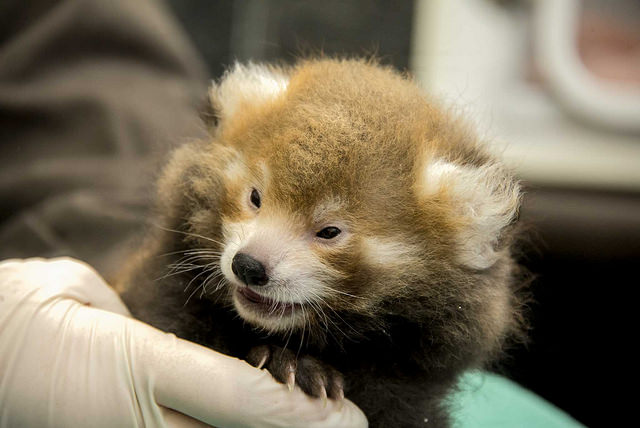
Photo Credit: Mehgan Murphy, Smithsonian’s National Zoo
From the National Zoo:
“We are very sad to share that red panda Shama has died at SCBI Front Royal.
Shama lived at the National Zoo on Asia Trail for years, and recently moved out to SCBI Front Royal with her mate Rusty to breed. She gave birth to three cubs earlier this summer, and she was under close observation because it is rare for a red panda to successfully raise three cubs. On Wednesday, August 13, keepers noticed that Shama had developed a neurologic disorder that progressed quickly. Shama was euthanized Saturday, August 16 due to her worsening clinical condition and poor neurological function, which was likely attributed to accumulation of fluid in the brain
Shama’s three cubs are now being hand-reared by experienced staff. Keepers are also hand-rearing a cub born to female Regan. Shama’s three cubs are active and appear to be doing well, but one is considerably smaller than its siblings, and receiving treatment for pneumonia. As a precaution, all three cubs are receiving anti-protozoal treatment. Rusty, who was housed with Shama and the cubs until recently, is also receiving anti-protozoal treatment as a preventative measure. He appears to be doing well.”