Streets of Washington, written by John DeFerrari, covers some of DC’s most interesting buildings and history. John is also the author of Lost Washington DC.
The retail enterprise founded by Julius Garfinckle (1874-1936) in 1905 was a relative latecomer to the city’s department store field. Woodies, Lansburgh’s, the Palais Royal, Kann’s, Goldenberg’s, and Hecht’s all were established by the 1890s, making for a saturated and highly competitive market by the turn of the new century. But Garfinckle’s store (he later changed his and the store’s name to Garfinckel) carved out a unique, high-end niche and held on to it for 85 years, cultivating generations of dedicated shoppers who depended on the store for the trendiest and classiest apparel. When Garfinckel’s finally declared bankruptcy and closed in 1990, it was a heart-wrenching experience for employees and customers alike.

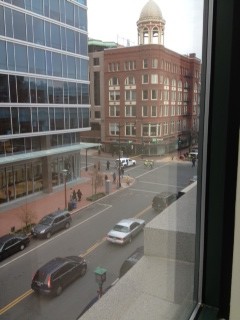
The former Garfinckel’s building as it appears today (photo by the author).
Born in Syracuse, New York, Garfinckle went to Colorado as a young man, hoping to strike a fortune in silver mining. Instead he became a clerk in a dry goods store. He moved to Washington in 1899, where he found employment with Parker, Bridget & Company, a prominent fashion-oriented dry goods store at 9th Street and Pennsylvania Avenue NW. As a buyer for that store’s women’s clothing department, Garfinckle traveled frequently to New York and learned all the ins and outs of the retail fashion industry.
In 1905 Garfinckle set out on his own with the founding of his namesake store, which occupied the bottom floor of a seven-floor building at 1226 F Street NW. With his Parker Bridget experience and contacts, Garfinckle was able to fill his new store with “a carefully selected stock of women’s suits, cloaks, furs, &c, together with imported novelties and specialties,” according to the Washington Post, which observed that the new store’s “popularity is already assured.” In keeping with the expectations of his high-end customers, Garfinckle made sure that each received exceptional personal attention.

Garfinckle’s original store (Source: DC Public Library, Star Collection, © Washington Post).
The Post’s early prediction of success soon came true. Garfinckle’s gradually filled all seven floors of its host building, an odd-looking structure that was originally half-built to allow for future expansion. Within a few years Garfinckle’s booming business led him to take over the two-story space on the corner previously occupied by Brentano’s bookstore and then to build out the missing floors above it.
But even that complete building wasn’t big enough, and by the 1920s, after Garfinckel changed the spelling of his name, he had his sights set on constructing a grand new building better fitting his prestigious business. He began assembling as much property as he could at the northwest corner of 14th and F Streets NW, and in 1928 announced plans for an imposing new 8-story building.
Like many a modern-day developer, Garfinckel immediately ran afoul of the city’s zoning regulations. He had planned for the full 130-foot elevation of his building to extend out to the property line, but new zoning rules adopted in 1927 required a setback for the floors above 110 feet. Protesting the requirement, Garfinckel’s attorneys pointed out that the newly-completed National Press Building, located cater-corner to the site, had no setback. However, that building had been completed in 1927, just before the new rule took effect. When finally constructed, the Garfinckel building dutifully included the required setback.
Continues after the jump. (more…)