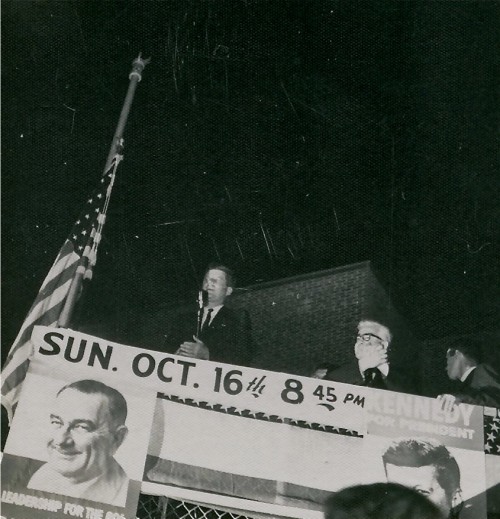
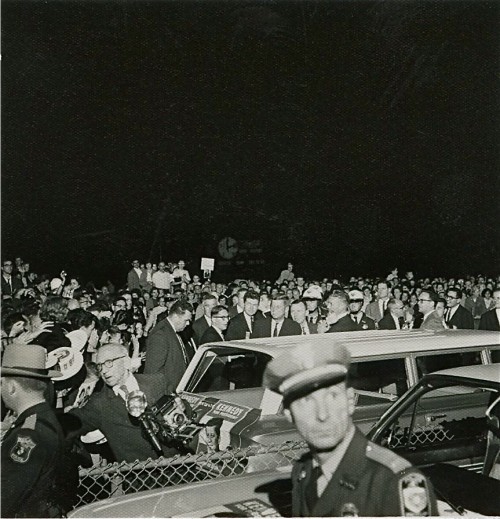
I’m super psyched to be able to share some old photos from Tony T. Most folks know Tony T as owner of The Pug located at 1234 H St, NE. Turns out Tony’s dad took lots of photos around DC back in the day. Tony was kind enough to share some of them with me, so I’m gonna post the best ones this week. These are two of my favorites. President John F. Kennedy from (Tony thinks) 1962. I believe the bottom one is after JFK threw out the first pitch at a Senators baseball game. Awesome.


Streets of Washington is the brilliant blog covering some of DC’s most interesting buildings and history written by John DeFerrari. John is also the author of the equally brilliant Lost Washington DC. Following is a new occasional series called ‘Streets of Washington Presents…’ featuring some fascinating buildings around town. The Evening Star Building has always been one of my favorites. I was blown away to learn about the history. As a result it is a long post, not all contributions will be this extensive. Hope you enjoy it as much as I did.
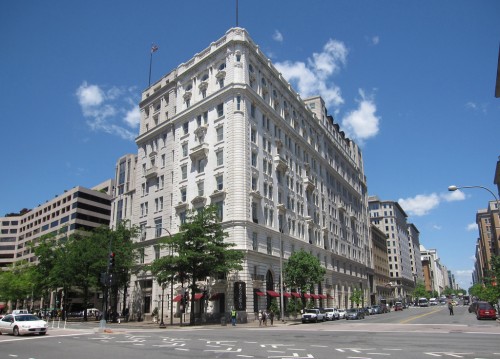
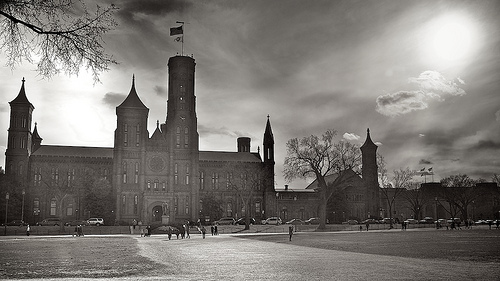
It was a sad day in Washington in August 1981 when The Washington Star ceased publication after more than 128 years of service. The Star’s tenure had stretched back before the Civil War, an amazing run that witnessed the historic sweep of the city’s development from small town to sophisticated metropolis. “The Rock of Gibraltar in Washington journalism is The Washington Star, one of the world’s really great newspapers,” historian Fred A. Emery wrote in 1935. The rise and fall of this bygone institution has its own grand sweep, with its greatest achievements occurring when it was quartered in the majestic marble building at 11th Street and Pennsylvania Avenue, NW, that still bears its name today.

The Star began inauspiciously enough in December 1852, one of dozens of newspapers that sprang up for limited runs in 19th century Washington City. In fact, two other D.C. newspapers had already used the Star name, the Columbian Star from 1822 to 1827, and the first Washington Star in 1841. The third Star, the one that would matter, began as a four-page broadsheet with a run of 250 copies, printed on a hand press in a small office at 8th and D Streets, NW. The paper’s first owner, Captain Joseph Borrows Tate, sought to distinguish the Star from all the other rags published throughout the city by striking a tone of impartiality: “The Star is to be free from party trammels or sectarian influences…devoted in an especial manner to the local interests of the beautiful city which bears the honored name of Washington.” The paper’s neutral stance and focus on local news became its trademark and, in time, gave it broad appeal and commercial success. It also led at times to overly innocuous reportage, as in this oft-quoted remark by reporter William Tucker that appeared in the paper’s first edition: “Our courts are sitting, but the business with which they are engaged is not of a very interesting character.”

Tate sold the paper within a year to William Wallach (1812-1871), an aggressive Texan who worked hard to build up the business, moving its office to the southwest corner of 11th and Pennsylvania in 1854. Wallach hired a promising young reporter, Crosby S. Noyes (1825-1908), in 1853, and Noyes quickly became the Star‘s star. One of his many assignments was to report on the hanging of John Brown at Harper’s Ferry, WV, in 1859, which he did in flowery, dramatic prose. The Star maintained an anti-slavery stance in those days and, once the Civil War began, was decidedly pro-Union, despite the strong Southern sentiments then common in Washington.
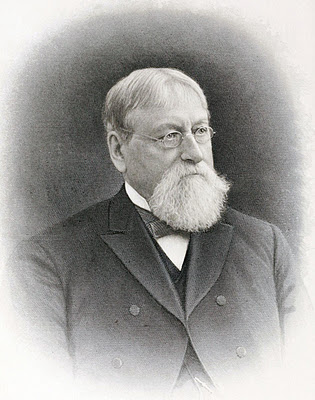

Crosby S. Noyes (Source: Wikimedia Commons)

The paper grew in prestige during the war years, aided by its exclusive connections with an early incarnation of the Associated Press. Through the AP, the Star‘s vivid coverage of the war’s impact on Washington was relayed across the country. The New York Times often reprinted war reports from the pages of the Star, and the paper’s prestige increased. Supposedly, as soon as Abraham Lincoln finished delivering his second inaugural address, he handed the text to Crosby Noyes so that it could be printed in the Star.

In 1867, Wallach retired and the paper was bought by Noyes and four other investors: Samuel H. Kauffmann (1829-1906), Alexander “Boss” Shepherd (1835-1902), Clarence D. Baker, and George W. Adams. Shepherd, who would become governor of D.C. in 1873, sold his share of the enterprise within a few years, as did Baker, and Adams remained a behind-the-scenes investor. That left Noyes and Kauffmann to establish a family dynasty that would preside over the Star for another 100 years. Noyes exercised editorial control, while Kauffmann served as publisher and handled the business side.

Continues after the jump. (more…)


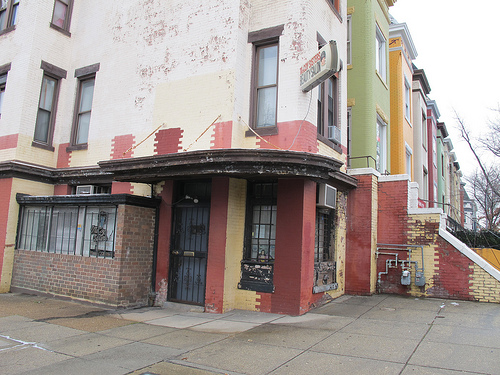
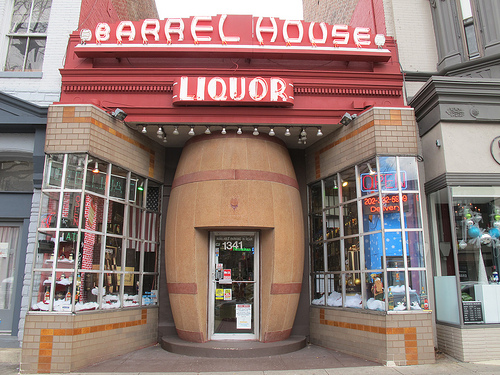
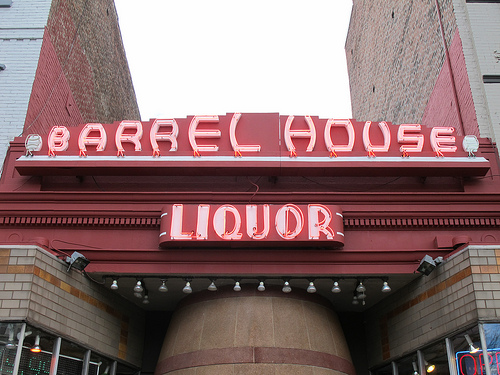
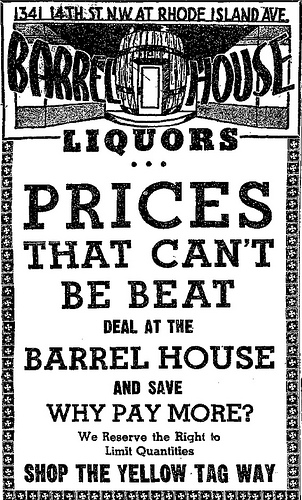
Last Friday we spoke about the strange Burger King in Van Ness and other quirky buildings around town. I have to say that the Barrel House Liquor Store located in Logan Circle at 14th and Rhode Island Ave, NW has to be one of the best in town. It’s got it all, in addition to the great door which we’ve noted before, it’s got one of the few awesome neon signs in DC:

And it’s old. A reader sent the following awesome ad from 1948:


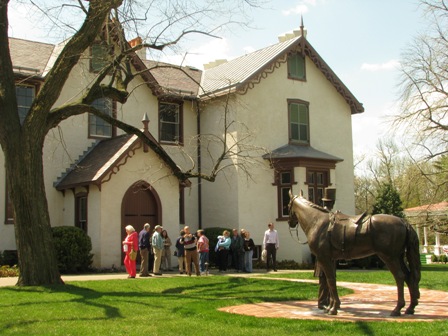
Photo via Lincoln’s Cottage

From a press release:

President Lincoln’s Cottage opened Seat of War: A Panoramic View of Civil War Washington Through Historic Prints early this month in the Robert H. Smith Visitor Education Center. This exhibit illuminates President Lincoln’s Civil War Washington through historic prints from our collection. It will run through the new year and close on January 15, 2012.

More info on Lincoln’s cottage here Directions from the Petworth metro here.


From an email:

“Join us Sunday, November 13th 4 – 6 p.m. for

The BROOKS Family in BROOKland at 1021 – 7th St. NW at the WAREHOUSE THEATER

Gather with host and Brooks’ descendant Molly Murray Ruppert and many other descendants for an afternoon of Brookland history. Featured will be new photos discovered since the recent release of the Brookland book, as well as artifacts from Ann Queen & Jehiel Brooks, including the Colonel’s pocket watch and signet ring, family heirlooms and more. Broad array of presenters, including the authors of Brookland, Rosie Dempsey & John Feeley, as well as Laura Henley Dean, author of “Our Past Before Us, A History of Northeastern Washington Co.” F R E E”


“Dear PoPville,

I wanted to let you know that an application to nominate the Ontario Theatre for local landmark status has been submitted to the Historic Preservation Office. The hearing is scheduled for Thursday, November 17th.

I am working with the team that submitted the nomination to get the word out in the community. While significant in several ways, the theater is of particular importance to Adams Morgan’s historic Latino community, as the site operated as “Teatro Ontario” from 1969-1978. During those years, the Ontario ran exclusively Spanish language films for neighborhood residents – supposedly the only theater between here and Philadelphia to do so. You can read more about the full history of the theater through the links above.

We think the Ontario would be a unique and crucial addition to the local register, as we are reasonably sure that the register does not yet include any sites associated with Adams Morgan’s historic Latino community.

(For the other side of the argument, the owner of the property proposed a five-story, seventy foot mixed use condo development.)

If the building is accepted as a landmark, the defining physical characteristics of the building exterior (the triangular marquee, the store frontage, etc.) would be legally protected. The building interior could be freely altered, although hopefully the lobby interior – which is largely intact – would be preserved voluntarily by the owner. The building exterior could be modified in ways that the Historic Preservation Review Board agrees would not diminish its significant historic characteristics. The use of the building would be totally up to the owner.

On a cultural level, the Ontario Theater would potentially be the first site associated with Adams Morgan’s historic Latino community from the 1960s onward to be included on the local register.

Some other bite-sized pieces of its history:

* When first opened in 1951, the Ontario was one of the last large movie theaters (1,400 seats!) to be built in the city before the emergence of television, drive-ins, and multiplexes in the suburbs began to dominate the popular entertainment culture. It hosted DC’s premiere screenings of Mary Poppins, Lawrence of Arabia, and The Sound of Music, which played at the Ontario exclusively for two years.

* The Ontario is also a site importantly associated with the emergence of DC’s live music scene in the late 1970s and early 1980s, when it hosted such bands as The Clash, U2, Blondie, The Police, and Talking Heads, among many others. Music promoter Seth Hurwitz got his start in the music business programming movies and live shows at the Ontario before taking over the famed 9:30 Club on F Street in the early 1980s.”

Ed. Note: We’ve discussed the potential of this property and lamented its current state of disrepair since Nov. ’08. It has regularly come up in discussion every year since.


As someone admittedly a bit obsessed with DC’s homes I think this site is freaking awesome!

From a press release:

“A new online resource for lovers of literature and history has been launched in the nation’s capital. DC Writers’ Homes, at www.dcwriters.org, celebrates the rich literary heritage of Washington by mapping former homes of novelists, poets, playwrights and memoirists. Some authors remain famous, such as Paul Laurence Dunbar, Zora Neale Hurston, Sinclair Lewis, and Katherine Anne Porter. Others are rediscoveries.

The over 120 homes included on the website represent every major period of Washington’s history and span the range of urban architectural styles. The earliest documented writers’ homes include those once occupied by: Francis Scott Key, the lawyer-poet who wrote the lyrics to the US National Anthem; Horatio King, who served as Postmaster General during the Civil War and hosted a popular literary salon in his home; and Frederick Douglass, whose remarkable autobiographies remain deservedly beloved. The most recent include authors who passed away in the last few years.

The project was conceived, researched, and created by DC writers Kim Roberts and Dan Vera, who spent more than five years tracking down and photo-documenting house locations. Only authors who have passed away, and whose houses are still standing, are included. Most houses are privately owned and not marked by historic plaques. “We wanted to claim our literary forebears,” Roberts states. “We don’t want our history to be lost or forgotten.”

The project is a collaboration among five groups that support or present the literary arts in the city. Split This Rock, whose festivals of “poets of provocation and witness” bring nationally-acclaimed authors to the city, is the sponsor. The Humanities Council of Washington, DC, provided funding. And three other organizations signed on as partners: The American Poetry Museum, Beltway Poetry Quarterly, and Poetry Mutual. Sarah Browning, Director of Split This Rock, calls DC Writers’ Homes “an extraordinary gift to DC.”

Authors are sorted by the geographical location of their houses, as well as by affiliations. Users can easily find authors, for example, who taught at or attended Howard University, served as US Poets Laureate at the Library of Congress, wrote on environmental themes, or were Latino. Every author is cross-referenced into at least two categories.

Kim Roberts and Dan Vera will present a slide/lecture on the making of DC Writers’ Homes on Friday, December 8 at 6:30 pm. This event, at the Institute for Policy Studies, 1112 16th St. NW, Suite 600, is free and open to the public. A reception will follow the presentation.”


View More Stories