“Dear PoPville,

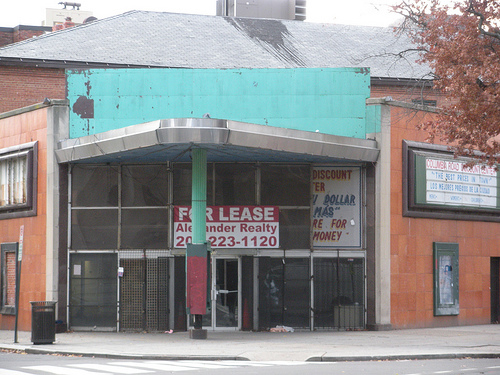
I wanted to let you know that an application to nominate the Ontario Theatre for local landmark status has been submitted to the Historic Preservation Office. The hearing is scheduled for Thursday, November 17th.

I am working with the team that submitted the nomination to get the word out in the community. While significant in several ways, the theater is of particular importance to Adams Morgan’s historic Latino community, as the site operated as “Teatro Ontario” from 1969-1978. During those years, the Ontario ran exclusively Spanish language films for neighborhood residents – supposedly the only theater between here and Philadelphia to do so. You can read more about the full history of the theater through the links above.

We think the Ontario would be a unique and crucial addition to the local register, as we are reasonably sure that the register does not yet include any sites associated with Adams Morgan’s historic Latino community.

(For the other side of the argument, the owner of the property proposed a five-story, seventy foot mixed use condo development.)

If the building is accepted as a landmark, the defining physical characteristics of the building exterior (the triangular marquee, the store frontage, etc.) would be legally protected. The building interior could be freely altered, although hopefully the lobby interior – which is largely intact – would be preserved voluntarily by the owner. The building exterior could be modified in ways that the Historic Preservation Review Board agrees would not diminish its significant historic characteristics. The use of the building would be totally up to the owner.

On a cultural level, the Ontario Theater would potentially be the first site associated with Adams Morgan’s historic Latino community from the 1960s onward to be included on the local register.

Some other bite-sized pieces of its history:

* When first opened in 1951, the Ontario was one of the last large movie theaters (1,400 seats!) to be built in the city before the emergence of television, drive-ins, and multiplexes in the suburbs began to dominate the popular entertainment culture. It hosted DC’s premiere screenings of Mary Poppins, Lawrence of Arabia, and The Sound of Music, which played at the Ontario exclusively for two years.

* The Ontario is also a site importantly associated with the emergence of DC’s live music scene in the late 1970s and early 1980s, when it hosted such bands as The Clash, U2, Blondie, The Police, and Talking Heads, among many others. Music promoter Seth Hurwitz got his start in the music business programming movies and live shows at the Ontario before taking over the famed 9:30 Club on F Street in the early 1980s.”

Ed. Note: We’ve discussed the potential of this property and lamented its current state of disrepair since Nov. ’08. It has regularly come up in discussion every year since.

As someone admittedly a bit obsessed with DC’s homes I think this site is freaking awesome!

From a press release:

“A new online resource for lovers of literature and history has been launched in the nation’s capital. DC Writers’ Homes, at www.dcwriters.org, celebrates the rich literary heritage of Washington by mapping former homes of novelists, poets, playwrights and memoirists. Some authors remain famous, such as Paul Laurence Dunbar, Zora Neale Hurston, Sinclair Lewis, and Katherine Anne Porter. Others are rediscoveries.

The over 120 homes included on the website represent every major period of Washington’s history and span the range of urban architectural styles. The earliest documented writers’ homes include those once occupied by: Francis Scott Key, the lawyer-poet who wrote the lyrics to the US National Anthem; Horatio King, who served as Postmaster General during the Civil War and hosted a popular literary salon in his home; and Frederick Douglass, whose remarkable autobiographies remain deservedly beloved. The most recent include authors who passed away in the last few years.

The project was conceived, researched, and created by DC writers Kim Roberts and Dan Vera, who spent more than five years tracking down and photo-documenting house locations. Only authors who have passed away, and whose houses are still standing, are included. Most houses are privately owned and not marked by historic plaques. “We wanted to claim our literary forebears,” Roberts states. “We don’t want our history to be lost or forgotten.”

The project is a collaboration among five groups that support or present the literary arts in the city. Split This Rock, whose festivals of “poets of provocation and witness” bring nationally-acclaimed authors to the city, is the sponsor. The Humanities Council of Washington, DC, provided funding. And three other organizations signed on as partners: The American Poetry Museum, Beltway Poetry Quarterly, and Poetry Mutual. Sarah Browning, Director of Split This Rock, calls DC Writers’ Homes “an extraordinary gift to DC.”

Authors are sorted by the geographical location of their houses, as well as by affiliations. Users can easily find authors, for example, who taught at or attended Howard University, served as US Poets Laureate at the Library of Congress, wrote on environmental themes, or were Latino. Every author is cross-referenced into at least two categories.

Kim Roberts and Dan Vera will present a slide/lecture on the making of DC Writers’ Homes on Friday, December 8 at 6:30 pm. This event, at the Institute for Policy Studies, 1112 16th St. NW, Suite 600, is free and open to the public. A reception will follow the presentation.”


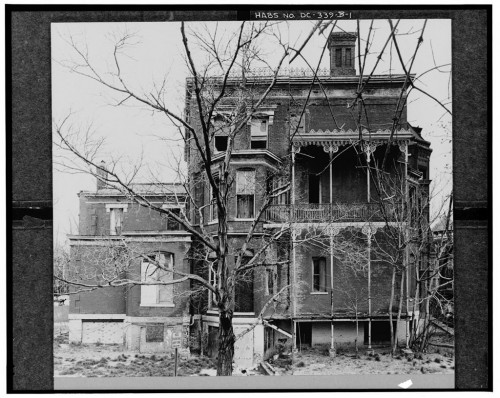
Photo via Library of Congress Prints and Photographs Division

“Dear PoPville,

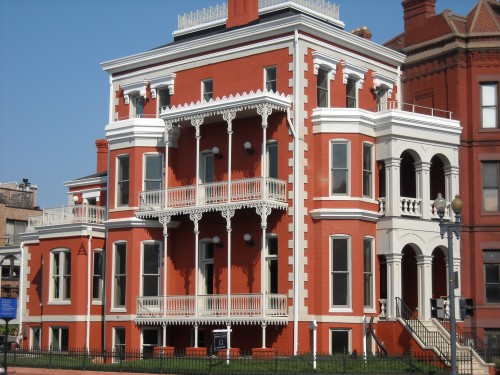
The house at 4 Logan Circle (John Logan House) was documented in 1973 as being in a “dilapidated condition” (you think?) for the Historic American Buildings Survey. (picture from Library of Congress Prints and Photographs Division. Not too long after that, part of the house on this side (13th St), collapsed into the street.”

At the end of last week took a look at this great reno and in addition to the cool history above – I got some details on the plans for the building. According to listing agent Michele Topel from TTR Sotheby’s International Realty:

“There will be four two bedroom condominiums, between about 1500-1700 sq ft with high end finishes, outdoor space and parking. They will initially be offered as rentals at prices around $5000-$5800 per month and we are just waiting for occupancy permits to begin tours of the property, which we hope to have in 30 days.”

I asked Michele when she thought the properties might be sold and she replied 3-5 years. I’m def. looking forward to seeing what the inside looks like but in the meantime you can see the floor plans here:

Logan_Circle_Floor_Plans

And more history here:

Logan_House_History


Photo courtesy of Michele Topel, TTR Sotheby’s International Realty


Photo by PoPville flickr user caroline.angelo

“Dear PoPville,

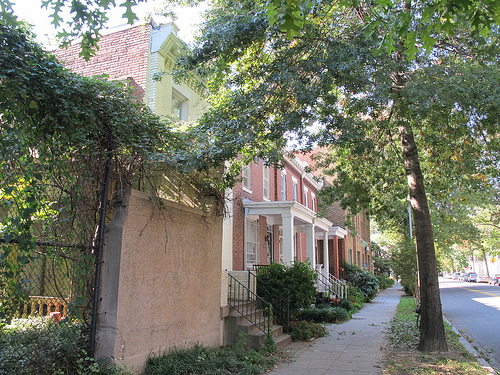
I was wondering if anyone out there knew a good way to find historic information about a house. I’m about to move into a farm house from 1923, and I’d love to find out if it was a model kit offered by Sears, etc like so many around here are. It would be great to have some old ads or blueprints for it. Even some vintage photos of the house or street would be awesome to get.

Any ideas?”

In the past I think some have recommended checking out the Washingtonia room at the Martin Luther King Jr. Memorial Library. Any other suggestions?


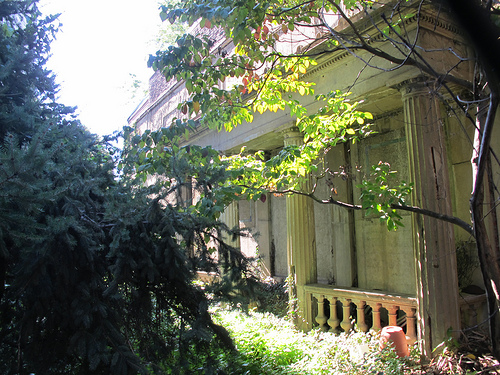
A reader simply asks: “What is this?”

The question of this great garden comes up every year or so. Fortunately in Oct. ’09 The Post’s Answerman dug up the full story. In part:

“Burnap’s 16th Street garden featured an open lawn bordered with shrubbery. A high wall faced Florida Avenue and turned the corner at 16th before stepping down to a low wall and ornamental iron fence. At the rear of the property, four Doric columns held up a hanging garden. Most striking was the intricate latticework that covered most of the interior walls.”

The garden eventually came to be called the Henderson Manor Garden, named after the castlelike mansion on the other side of Florida Avenue. By 1938, 2108 16th St. NW had been closed for a few seasons, although fetes were still held in its garden.

All that remains of his garden are four crumbling columns. Why were they left untouched? That wall might be attached to the rowhouse at 1618 Florida Ave., making it more trouble than it’s worth to remove.

Read the full story here.

It’s easy to walk by without having any idea this cool history exists:


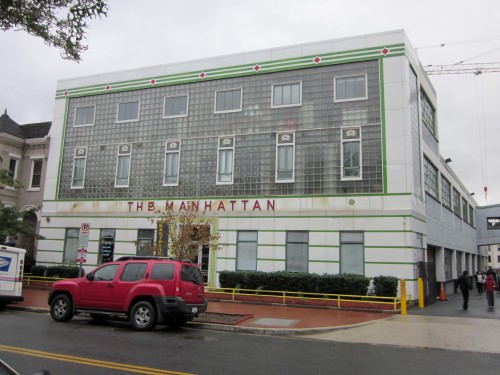
While we’re talking about the future of phenomenal buildings – I’ve also always been in love with The Manhattan located at 1328 Florida Ave, NW. Back in July we learned that the current tenant, the Meridian Public Charter school, would be renovating and moving into the old Harrison School at 13th and V St, NW. Back in 1999 it was home to the first Art o Matic. When the school moves out – what do you think would be the best use for this great building?


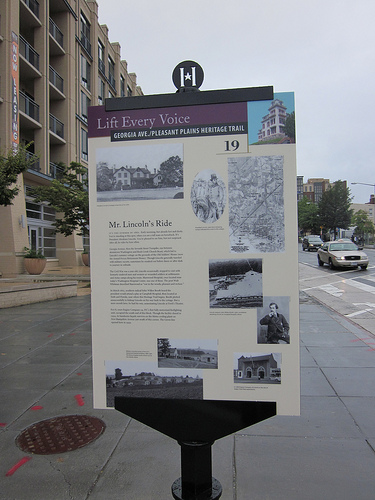
I love these signs. From the Shaw listserv:

“11 out of the 19 signs for the Georgia Avenue/Pleasant Plains Heritage Trail are being installed today! The trail begins at 7th and S and ends at Georgia and New Hampshire Ave. Work on this trail began in 2007 and is now coming to fruition.

Save the date of Saturday October 15th at 11am for the official launch of the Trail on the grounds of Howard University Hospital.”

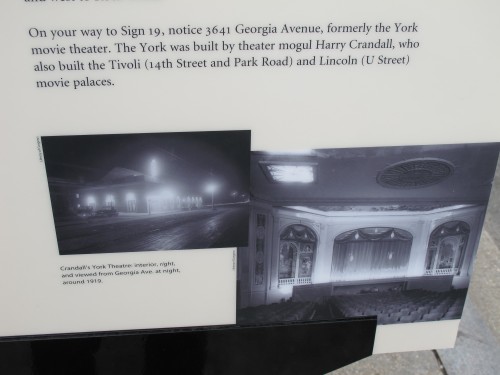
One of my favorite parts so far – a photo of of inside the old York Theater at Georgia and Princeton:


View More Stories