
Photo by PoPville flickr user ep_jhu
So cool! Anyone else get a good view this morning?

Photo by PoPville flickr user Sanjay Suchak
Lots more amazing photos after the jump. (more…)


Photo by PoPville flickr user ep_jhu
So cool! Anyone else get a good view this morning?
Photo by PoPville flickr user Sanjay Suchak
Lots more amazing photos after the jump. (more…)

Logan’s Antiques is located at 3118 Mount Pleasant Street, NW.


Photo by PoPville flickr user mosley.brian
Thanks to a reader for sending this cool report from The Hill:
“NASA announced Monday that the Space Shuttle Discovery will fly approximately 1,500 feet above various parts of the nation’s capital on April 17. As a point of reference, the Washington Monument is about 555 feet tall.
While the exact route is still to be determined, the shuttle — strapped atop the space agency’s custom Boeing 747 — should fly over the National Mall, National Harbor and Reagan National Airport.”
The Preservation Nation blog posted this stunning footage last week.

Don’t see too many old school transoms without stained glass.

New Plantings on the South Lawn.
From the folks at Lincoln’s Cottage:
“On March 31st, President Lincoln’s Cottage, on the grounds of the Armed Forces Retirement Home, held a preservation day event made possible by Penn Mutual. 70 Penn Mutual volunteers came out to perform an array of projects including laying sod, painting, waxing, paving, mulching, and the planting of long blooming native plants. Veterans from the Home were invited to watch the work and enjoy refreshments and snacks on the South Lawn of the Cottage. Additionally, volunteers prepared and dispersed 250 gift bags to the veterans throughout the Armed Forces Retirement Home.”
Nice!

President Lincoln’s Cottage Director Erin Carlson mast thanks volunteers.
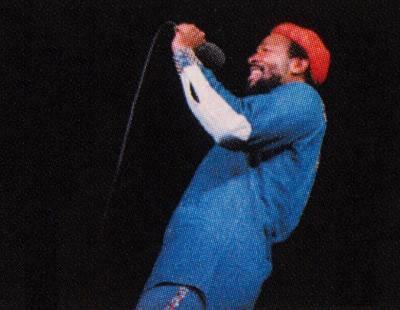
Photo via wikipedia
From an email:
Marvin Gaye Day 2012
Monday, April 2nd 6:00 PM
“Life & Legacy”
Marvin @ 2007 14th Street NWMonday, April 2nd marks the 73rd birthday of Marvin Pentz Gaye, Jr. and this year, the children and grandchildren of Marvin Gaye and Restaurant Marvin and Stella Artois are proud to present, “Life & Legacy; A Celebration”.
The event begins at 6 pm and will feature a concert by Marvin’s original band “The Marquees”, with special guest singer and Marvin’s brother Antwuan, Marvin Gaye guitarist Gordon “Guitar” Banks and Brandon Clark. Marvin’s “Main Ingredient” Monday night DJ Jahsonic will finish the night with a Marvin-centric set.
In an effort to celebrate Marvin Gaye’s legacy, “Life & Legacy” will serve as a fundraiser for Arms Around The Child, www.armsaroundthechild.org, donating all proceeds from the event in his name.
“Life & Legacy” would also like to highlight the Kennedy Center’s “What’s Going On Now” event, marking the 40th anniversary of Marvin Gaye’s performance of said song on the Kennedy Center stage.
Streets of Washington is the brilliant blog covering some of DC’s most interesting buildings and history written by John DeFerrari. John is also the author of the equally brilliant Lost Washington DC. ‘Streets of Washington Presents…’ will feature some fascinating buildings and history from around PoPville.
The former home of the Equitable Co-operative Building Association at 915 F Street NW, completed in 1912, is a small but eminently distinguished bank building. One glance at the facade dominated by four great Ionic columns, and you know what type of business operated here. What’s less obvious is that this was a uniquely progressive financial institution, meant to help the “little guy” save money, and it was founded by one of Washington’s most prominent and civic-minded citizens, John Joy Edson (1846-1935). The unique building—designated as an historic landmark both for its exterior and main banking room—has survived years of neglect as a nightclub and is currently being rehabilitated for retail use by the Douglas Development Corporation. It will be the site of the D.C. Preservation League’s 41st annual gala fundraiser on April 26, 2012, where attendees will have a unique opportunity to enjoy the beautiful former banking room inside.
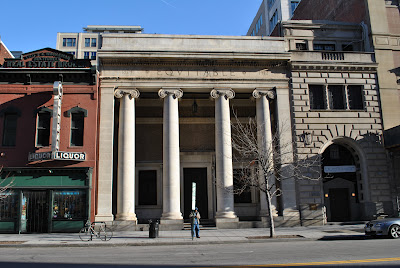
The Equitable Building in 2010. Photo by the author.
Equitable was founded in 1879 by a group of leading citizens, including John Joy Edson, who would become its president in 1893. It was one of the first such associations to be founded in Washington. The intent of these small institutions was to encourage ordinary people to save money and also to make it easier for them to purchase homes by making loans on better terms than traditional banks offered. Members would “subscribe” to one or more shares of the association, pay modest monthly dues on those shares, and receive dividends in return as well as access to low-rate loans.
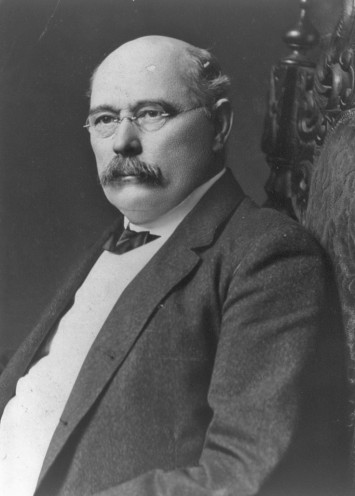
John Joy Edson, circa 1903. Source; Library of Congress.
Edson, Equitable’s leading light, was born in Jefferson, Ohio, in 1846. His family later moved to New York City, where in 1861, at the age of 15, he enlisted in the 61st New York Infantry (he said he was 19). He fought with the Army of the Potomac in several major Civil War engagements, including the Battle of Fredericksburg, where he was wounded. He was taken to the Armory Hospital on the Mall in Washington and discharged in March 1863. Once out of the army, he got a position as a clerk in the Treasury Department and went to school at night, earning a law degree from Columbian College (now George Washington University). In 1875 he went into practice as a patent lawyer and also began his involvement in banking, participating in the organization of several institutions, including Equitable in 1879 and the Washington Loan & Trust Company in 1889. He became president of Washington Loan & Trust in 1894, a year after assuming the same position at Equitable.
Washington Loan & Trust was the first trust company in the city and for many years the largest. It built and occupied the huge Romanesque Revival structure on the southwest corner of 9th and F Street, NW, across the street from Equitable. In running the two institutions, Edson had both the power and prestige of the large savings and loan company as well as the good karma of the smaller cooperative association across the street.
Continues after the jump. (more…)
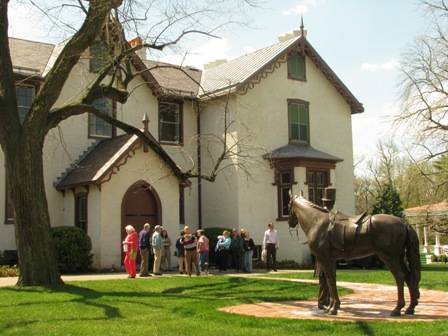
Photo via Lincoln’s Cottage
From a press release:
President Lincoln’s Cottage will host a 150th Anniversary Celebration of DC Emancipation Day on Sunday, April 15, 2012 from 2:30pm – 4:30pm. This free outdoor public program will feature noted Lincoln scholars and a musical program. This event is presented in partnership with the Office of the Secretary of the District of Columbia and the Lincoln Group of DC.
150 years ago, the enslaved people in Washington, DC were freed when President Lincoln signed the Compensated Emancipation Act, for the release of certain persons held to service or labor in the District of Columbia. Featured Lincoln experts will include Harold Holzer, Dr. Edna Greene Medford, and the Honorable Frank Williams. The speakers will discuss Lincoln’s role in the DC Emancipation Act, the media reaction to the act, and the role of the citizens of DC. The program will take place on the south lawn of President Lincoln’s Cottage. The rain location will be in an adjacent building on the property.
President Lincoln lived in the Cottage at the Soldiers’ Home from June-November of 1862, 1863 and1864-totaling one quarter of his presidency. He was living here when he drafted the preliminary version of the Emancipation Proclamation and deliberated critical issues of the Civil War. Since the Cottage opened to the public in 2008, tens of thousands of visitors have engaged in conversations on liberty, justice, and equality, through innovative guided tours, forward-thinking exhibits and quality educational programs. Hours of operation: Tours on the hour, 7 days a week. Visitor Center open 9:30am-4:30pm Mon-Sat, 10:30am-4:30pm Sunday. For more information on President Lincoln’s Cottage, visit: www.lincolncottage.org
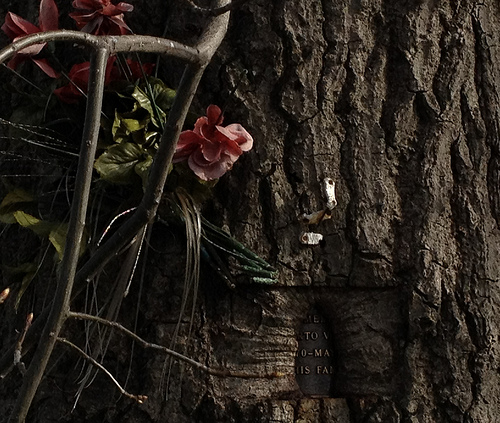
5th and Harvard St, NW on the Reservoir side
“Dear PoPville,
I noticed this a while back while running around the McMillan Reservoir.
Do you have any clue what I presume this memorial in a tree is about? So odd!”
The reader then answered their own question finding this 2005 post from DCist:
There stands a tree — the middlemost tree, in the photo above, sans leaves — and to it is nailed or otherwise affixed a small bronze plaque dedicated to the memory of … well, in the time since it was placed there, the tree has grown around it. “UIS ALBERTO VASQUEZ,” to be sure. And whatever it was happened in mid-1997.
Sometime during the early morning hours of the May 9, an intoxicated 26-year-old Maryland man, Alberto Vasquez, lost control of his Volvo on Harvard Street NW and struck a tree. With him in the car was Louis Alberto Vasquez, his 27-year-old cousin, who died on the scene.
Today you can see the plaque is almost completely swallowed up by the tree.