John Reinhardt is an urban planner, writer, photographer, and urban gardener. An avid cook, John is interested in the intersection of urban design, sustainability, and food systems planning. He currently resides in Washington DC and works for the American Planning Association. He currently writes Grown in the City, a blog about urban gardening and food systems planning.

So it’s June already.  If you’ve been following this feature on Thursdays, perhaps you’ve already built yourself self watering planters or planted an herb garden. If you started early, perhaps you’ve even been able to harvest early producers like lettuce, radishes, snow peas, or zucchini.  But now it’s June and it’s getting hot.  Very hot.  This week saw three scorchers and today is no different – and the summer is only beginning.  So it’s fitting that this column focuses on dealing with the heat.

Washington is known for its hot, muggy summers – but how does this influence your gardening?  For starters, it becomes more important to make sure that your plants have enough water.  When plants begin producing fruit, they become water hogs, (most fruits and vegetables are largely water). Since I water from the bottom using self-watering planters, I check for water levels once in the morning. For the past week, I’ve had to add about half a gallon to each planter, each day.  Keep in mind that smaller planters, such as the yogurt container herb planters, will require more frequent watering.

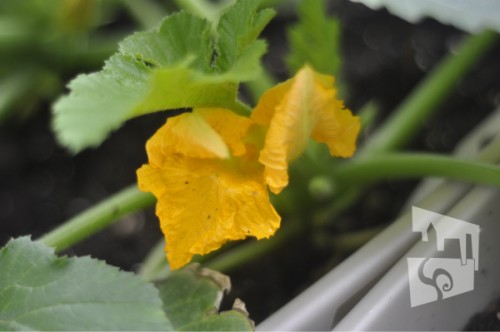
How else might the heat change your plans for a lush, productive garden?  When the temperature rises above 90 degrees, many plants do not tolerate it well.  A whole bunch of things can happen – lettuces, spinach, and herbs can bolt.   Zucchini can drop flowers (which several of mine did, much to my dismay), and tomato pollen can become infertile leading to dry, dead flowers that don’t bear any fruit.

The plants on my balcony are large, because my balcony often gets hotter than the ground temperatures from the reflected sun.  This was great in March and April, when my little seedlings needed the warm temperatures.  Now, it seems like the poor things are baking.  With a week of 90 degree temperatures, I’m a bit worried about a whole round of fruit will not set.  K-State has a great article with more information on “flower drop,” but here’s some quick tips for city dwellers.

1.      If you can, bring the containers inside or put them in the shade.  This doesn’t work for me, as I don’t have a sun room or screen porch.  However, I do have the luxury of moving some of the more heat-sensitive plants into the shade of the shelving unit I put out on my balcony.  The sensitive plants go right to the bottom, where they get the least sun.  The sun lovers, like the lettuce, go on the top shelves.  Because the plants that I keep on the shelving are in small containers, I can move them around if they need more or less sun.

2.      Choose drought tolerant varieties.  For example, Burpee, one of the large seed companies, sells “Heatwave” lettuce, which I am currently using on my balcony.  I sowed this variety a few weeks later than the “gourmet mix”, knowing that it would be hotter when the lettuce matured.  Some varieties of tomatoes and peppers love the heat, as do herbs such as rosemary and oregano, which grow in dry, warm Mediterranean climates.

3.      Pollinate before you have blossom drop, and pinch off any bolting!  If you get to plants such as tomatoes before the heat gets to them, you may be able to pollinate them by hand.  This website has some great information on pollination.  And if you’re growing lettuce, basil, or other leafy vegetable, be sure to pinch off any bolting (when a shoot sticks up and grows flowers).  The bolting of basil may be pretty, but it’s nature’s signal that the plant is in stress or the growing season is coming to a close, and the plant better make seeds to carry on its genes!  Smart, eh?  If you pinch of the stem, however, you can trick the plant into continuing to produce more edible leaves.

If you follow these tips, you can survive a hot DC summer.  Anyone else have any good tips for beating the heat?


John Reinhardt is an urban planner, writer, photographer, and urban gardener. An avid cook, John is interested in the intersection of urban design, sustainability, and food systems planning. He currently resides in Washington DC and works for the American Planning Association. He currently writes Grown in the City, a blog about urban gardening and food systems planning.

Guerrilla gardening is one of my favorite urban gardening topics, and something I am constantly learning all about.  According to some accounts, the term was coined by in the early 1970s by activist gardeners in New York City, but the practice of guerrilla gardening has been going on since recorded history – remember the story of Johnny Appleseed?  By its simplest definition, guerrilla gardening is gardening on land (public or private) that doesn’t belong to you.  Richard Reynolds, one of the most visible members of this movement, has a fantastic website about the topic at Guerrilla Gardening that I highly recommend.

Some people guerrilla garden for food, some to make a political statement, some to beautify an area, and others to make people smile.  There are many in Washington DC, if you keep your eyes open.  Some gardeners do their work anonymously, often at night, throwing seed bombs or planting flowers in tree wells.  Others actively care for their public gardens, encouraging others to tend to the garden and share the bounty.

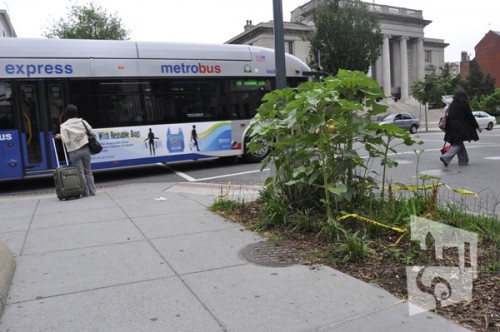
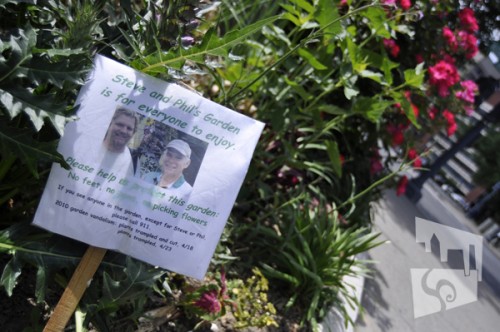
The Dupont neighborhood has quite a few guerrilla gardens.  There is a sunflower garden in the planting strip on the northwest side of 16th and P and in the past I’ve spotted one at 18th and Church, in front of St. Thomas’ Episcopal Church.  There’s also  a full-fledged vegetable, herb,  and flower garden cared for by two guys name Steve and Phil located right on the circle.

Once your eyes are open to guerrilla gardening, you can’t help but see places – everywhere – that could be transformed into edible or ornamental landscapes.


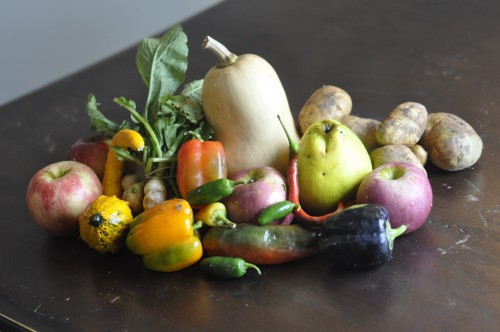
Week 3 of the Licking Creek Bend fall 2009 CSA share included Apples, Hot Peppers, Quince, Butternut Squash, Potatoes, Kohlrabi, and Ornamental Squash – plus greens

John Reinhardt is an urban planner, writer, photographer, and urban gardener. An avid cook, John is interested in the intersection of urban design, sustainability, and food systems planning. He currently resides in Washington DC and works for the American Planning Association. He currently writes Grown in the City, a blog about urban gardening and food systems planning.

So maybe you don’t have the time, space, or inclination to start your own urban garden, but still have the desire for fresh, high-quality local food.  And wouldn’t it be great to skip the lines at Giant, have your shopping for the week done in five minutes, and simultaneously support the local food systems economy?  There’s an option – Community Supported Agriculture.

From the USDA:

Community supported agriculture (CSA) is a new idea in farming, one that has been gaining momentum since its introduction to the United States from Europe in the mid-1980s. The CSA concept originated in the 1960s in Switzerland and Japan, where consumers interested in safe food and farmers seeking stable markets for their crops joined together in economic partnerships.

In basic terms, CSA consists of a community of individuals who pledge support to a farm operation so that the farmland becomes, either legally or spiritually, the community’s farm, with the growers and consumers providing mutual support and sharing the risks and benefits of food production. Typically, members or “share-holders” of the farm or garden pledge in advance to cover the anticipated costs of the farm operation and farmer’s salary. In return, they receive shares in the farm’s bounty throughout the growing season, as well as satisfaction gained from reconnecting to the land and participating directly in food production. Members also share in the risks of farming, including poor harvests due to unfavorable weather or pests. By direct sales to community members, who have provided the farmer with working capital in advance, growers receive better prices for their crops, gain some financial security, and are relieved of much of the burden of marketing.

So where do you find a CSA?  Local Harvest has a fantastic website that provides information about different CSA models, and provides links directly to CSA’s in your area, based on your ZIP code.  I’m a member of Licking Creek Bend Farm, and help support the efforts of a great guy, Michael Tabor.  I get to chat with him each Saturday morning when I go pick up “my box” in Adams Morgan, at the market on 18th and Columbia.  He gives me the inside info on which apples are the best, or how to prepare the kohlrabi that’s in the box.  This past week, they ran a farm tour for subscribers, and they do a Halloween pumpkin patch tour for kids.  As the USDA says, it’s like having a community farm next door, only your farmer neighbor lives in Pennsylvania.  It’s relatively inexpensive as well – each week I got a box of farm-fresh produce (and apple cider in the fall) for what amounted to about $40 a week.  I felt good knowing where my money was going, and where my food was coming from – a true local economy.

Continues after the jump. (more…)


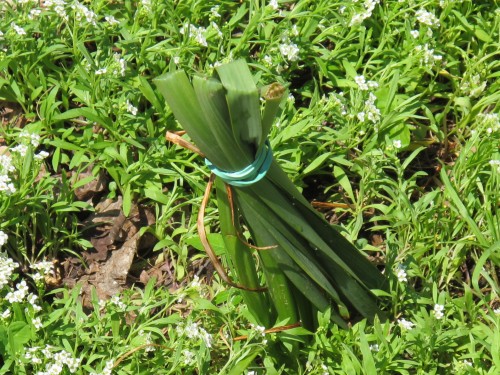
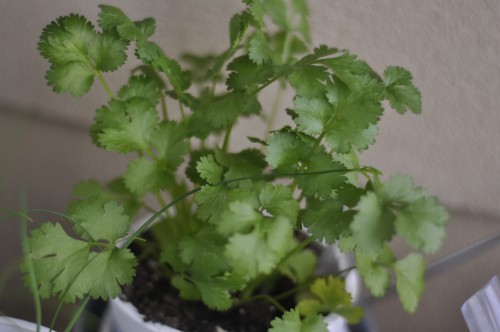
Cilantro

John Reinhardt is an urban planner, writer, photographer, and urban gardener. An avid cook, John is interested in the intersection of urban design, sustainability, and food systems planning. He currently resides in Washington DC and works for the American Planning Association. He currently writes Grown in the City, a blog about urban gardening and food systems planning.

While many of us urban dwellers have dreams of a small peaceful acre out in the countryside where we can garden to our heart’s content, in reality, many of us are lucky to have a sunny windowsill in an English basement.

One of the easiest ways for curious urban gardeners with limited space to test the waters is with a small herb garden.  That said, there are some simple tips to avoid heartbreak and a windowsill of (unintentionally) dried herbs.

Continues after the jump. (more…)


Thanks to a reader for sending word and snapping a few photos of this great development. The reader writes:

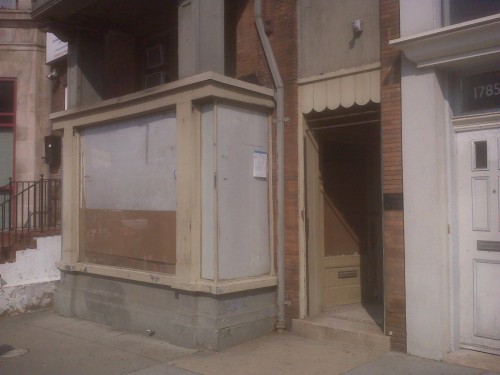
“I saw a Permit sign in the small retail space on Columbia Road right by the BB&T at 18th Street, NW – it used to be a locksmith shop. Well, the sign shows it be slated to become a garden supply shop. That would be pretty sweet. The C of O sign lists the operating name as Urban Sustainable and the retail type as Garden retail.”

Looks like this is 1787 Columbia Road, NW.  I remember the locksmith because they used to have a sweet Dean Martin bobble head in the window. I look forward to checking out the garden store when they open!

UPDATE From their Web site:

“Urban Sustainable Supply is your one-stop shop for hydroponic and urban organic gardening. We carry complete hydroponic kits, hydroponic components, nutrients, gardening tools, High Intensity Dicharge lighting (high pressure sodium, metal halide), fluorescent grow lights, grow medias (soil, rockwool, hydroton, perlite, vermiculite, coco coir, etc) various diagnostic meters, home composting systems, 100% organic seed… virtually everything you need to turn your home, garden, or rooftop into a paradise urban sustainable gardening.”


John Reinhardt is an urban planner, writer, photographer, and urban gardener. An avid cook, John is interested in the intersection of urban design, sustainability, and food systems planning. He currently resides in Washington DC and works for the American Planning Association. He currently writes Grown in the City, a blog about urban gardening and food systems planning.

Gardening in the city can be a rewarding, yet challenging experience.  If you’re lucky enough to have a coveted spot in a community garden, hang on to it!  You can even try sharing backyards (a site I used to connect with some other urban planners who were interested in gardening).  The easiest way, however, is to start container gardening.

Last season I started with tomatoes and herbs out on my balcony in Columbia Heights.  The plants grew marvelously, until about August when I struggled to keep them alive in the DC heat.  I’d water once in the morning, once when I got home from work, and once again in the evening.  I still had trouble keeping up!

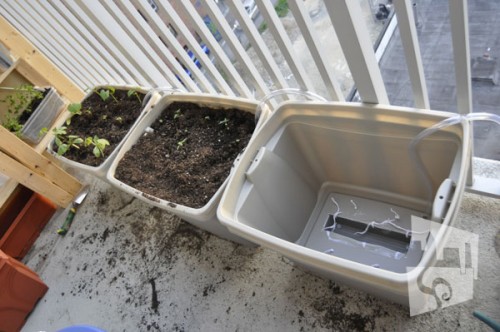
This season, I did some research and learned to make self-watering planters.  I made three sizes – an 18-gallon size that holds tomatoes, peppers, eggplant, zucchini, peas, string beans, and some herbs.  I also constructed a smaller size, made our of recycled yogurt containers, that currently have basil, cilantro, sage, garlic chives, and common chives growing in them.  Finally, I constructed shoebox size containers to house flats of lettuce, radishes, and other similar vegetables that need to be started at different times throughout the season to ensure a long harvest.

I highly recommend the self-watering container method.  For under $20, I was able to construct an 18 gallon tub;  for next to nothing, I was able to use my recycled yogurt containers to grow herbs in.  For those who are in really sunny locations, or who travel for work, these self-watering containers are a must.

Check out the plans and photos at www.growninthecity.com


Photo by PoPville flickr user dullshick

“Dear PoP,

i live in a second floor condo in mt. pleasant….and would love to have a garden. even just a little space to grow tomatoes.

i’ve asked around a bit, but no one seems to know of any unused yard area in the mt. pleasant/columbia heights area that could possibly be adapted for a community garden. i would be willing to rent some space for a reasonable fee.

there must be others around who would like to do the same…any ideas?”

Back in January 2009 I posted about a great group called Sharing Backyards. I think this might be just what you’re looking for. Does anyone have any other recs for a community garden? I’ll gladly repost the info from Sharing Backyards:

“One of the biggest challenges facing urban gardeners is access to land. It’s hard to garden in an apartment, but most of the community gardens in the city have years-long waitlists. So what’s a would-be gardener to do?

Sharing Backyards was created to address that need! The website encourages urban gardening by connecting people who have space to garden and are willing to share with people who would like to have a gardening space. Whether you’re an apartment dweller in search of some good earth or a property-owner with land to share, this site’s for you.

The DC chapter of Sharing Backyards is brand new, and we hope you all will take a minute to visit the website. Go to http://dc.sharingbackyards.com to add your listing to the city map and help us get the project off the ground.”


Photo by PoPville flickr user mustachioed

“Dear PoP,

I was reading the posting about what to plant in DC, and I have a somewhat related question.

We have a row house in Petworth that we are in the midst of landscaping…primarily putting in new grass sod.
I need to cover my 200 sq ft front yard with 4″-6″ of organic topsoil before putting in sod. Problem is my yard (I think like many people’s) is elevated six feet from street level with no option of running a wheelbarrow up the slope (there are steps and stone walls). And as a row house…no option from the back either. Has anyone figured out a way to move/place 3 cubic yards (nearly 6000 lbs!) of topsoil on an elevated front yard? Can you blow it in?

All suggestions welcomed!”

I wonder if this just requires old fashioned labor? Has anyone done a project like this themselves?


Photo from PoPville flickr user fromcaliw/love

“Dear PoP,

I just moved down to the Washington, DC area and have a nice little rowhouse in Columbia Heights. We have a small plot of land, but unlike my place in NYC, I have a tiny little plot of land out front and a porch. I’d like to try my hand at gardening. I am curious if you or any of your readers have tips about gardening in DC. What flowers work well in this climate during the spring/summer/early fall? Where are some good gardening places to visit for supplies and meet fellow flower enthusiasts? Any general tips or inspiring gardens in the city I can check out?”

I know we have some dedicated gardeners who read this site so I’m also looking forward to learning what works best for DC?


View More Stories