Thanks to a reader for sending.
Send your photos/tips to princeofpetworth(at)gmail(dot)com.


Thanks to a reader for sending.
Send your photos/tips to princeofpetworth(at)gmail(dot)com.

Photo by PoPville flickr user number7cloud
Well we’ve made it to noon – how’s everyone holding up? Thankfully, (knock wood, knock wood) power is still holding strong. What’s everyone doing to pass the time?

Terri Maxfield Lipp takes these amazing shots and writes:
“I took some shots Sunday night that I thought were kinda interesting. I didn’t use any filters or color tinting on the sky shots…it’s just when I darkened them a bit, they turned red. Seemingly appropriate for a historically significant storm occurring on the full moon called “The Hunter’s Moon.” Oh, yeah, and it’s Halloween on Wednesday. Yep…they should be red skies, don’t ya think?”

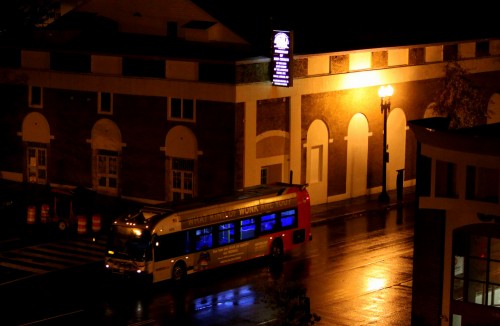
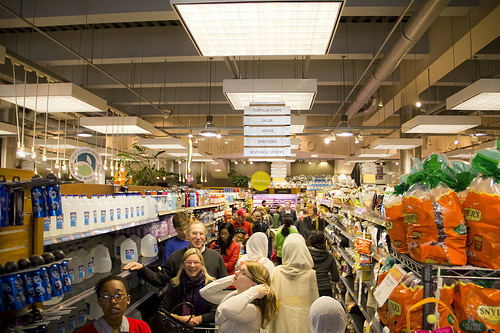
Photo by PoPville flickr user thisisbossi
Send photos, questions, observations or anything related to Hurricane Sandy via email to princeofpetworth(at)gmail(dot)com or via twitter to @PoPville, via facebook to Facebook.com/PrinceofPetworth, or via Flickr to the PoPville pool. Hoping the power stays on and please stay safe everyone!
Sunday around 5:30pm OPM updated their website:
“Applies to: Monday, October 29, 2012
FEDERAL OFFICES in the Washington, DC, area are CLOSED TO THE PUBLIC.”
From WMATA:
“In light of updated forecast information from the National Weather Service projecting higher wind speeds, as well as the closure of Federal Government offices in the Washington area and the possibility of widespread commercial power outages, Metro has announced the following service changes for Monday, October 29, 2012:
• The Metrorail system will be closed on Monday. Rail service on Sunday night will continue operate as scheduled until its normal closing time (midnight). No decision has yet been made on when Metrorail service will be restored after Monday.
• All Metrobus service will be suspended as of the end of the service day on Sunday and remain suspended until further notice.”
From the Mayor’s Office:
Mayor Vincent C. Gray today announced that the District government will be closed Monday, October 29 and said that the District’s agencies and regional, utility and federal partners are preparing the city to weather the effects of Hurricane Sandy.
“Let me be clear: this storm is unique, large, dangerous and unlike anything our region has experienced in a very long time,” Mayor Gray said. “We are likely to suffer significant power outages due to fallen trees and other debris, and we may experience significant street flooding. Let me also be clear about this: the District government is ready to meet this challenge.”
Officials have been working through the weekend to ensure the District’s residents, businesses and infrastructure are as ready as possible for the effects of the storm, which are expected to include heavy rain and street flooding, strong winds and power outages, and the potential for storm-surge flooding along the Potomac River and its tributaries.
Forecasters are predicting 4” to 8” of rain to fall between Sunday night and Wednesday, with bursts of rain falling at a rate of 2” per hour. Sustained tropical-storm-force winds of 40-60 miles per hour with gusts up to hurricane strength (75 miles per hour or more) are possible, and duration of the storm’s peak impact will likely be several hours – with conditions expected to deteriorate rapidly during the day tomorrow and the peak of the extreme winds expected between about noon Monday and the early hours of Tuesday morning, with high winds extending well into the day on Tuesday.
“District residents need to shelter in place during the peak of this storm, preferably on the lowest level of their home and as far away as possible from windows and potential falling trees,” Mayor Gray said.
Preparations
· D.C. Public Schools are closed on Monday, October 29, including all after-school programs and athletic events. Principals, teachers and school-based staff who are not essential personnel do not report to school tomorrow. Central-office staff and essential school-based personnel should refer to the DCPS website for updates about whether they will be required to report to work.
· Mayor Gray has declared a state of emergency in the District and has sent President Obama a pre-landfall request for a presidential disaster declaration, which would provide federal assistance to help the District defray the extra costs the storm will impose on the city. A copy of the request letter is attached to this release.
· DC Water is clearing storm drains citywide.
· The District Department of Transportation (DDOT) is assigning staff and contractors to be ready to collect storm debris starting Monday, October 29, and DPW crews will assist.
· DPW tow trucks will be deployed as necessary to remove vehicles blocking roadways.
· DDOT has generators in place at major intersections. If power is disrupted, traffic signals will continue to work, and DDOT traffic control officers will be deployed to direct traffic where necessary.
· DPW is suspending street cleaning Monday through Wednesday. Bulk garbage collections for Monday and Tuesday will be rescheduled. Also, residents are asked to bag their leaves so they don’t collect in the storm drains and cause flooding.
· Crews from DC Water and District government agencies are being deployed to assist the residents of Bloomingdale and LeDroit Park, a section of the city that has been especially hard-hit by street flooding due to backed-up storm drains during heavy downpours.
Tips for Residents
Dealing with Downed Trees
Residents are reminded to stay clear of broken and hanging tree branches, which can fall at any time.
· Please report any downed tree branches by calling 311.
Residents are also reminded to stay away from downed wires, as they could be energized and electrical contact could be fatal. Report downed wires to Pepco by calling 1.877.PEPCO62
Power and Water Outages
To report a power outage, please call Pepco at 1.877.PEPCO62. Customers may report outages online at pepco.com or download Pepco’s smart phone app, pepco.com/mobileapp to report and track outages. To report a water outage, residents can call DC Water at 202.612.3400
Roadways
Motorists are reminded to treat dark intersections as four-way stops and to avoid driving through standing water.
And if your power does go out here is a good guide from USDA:
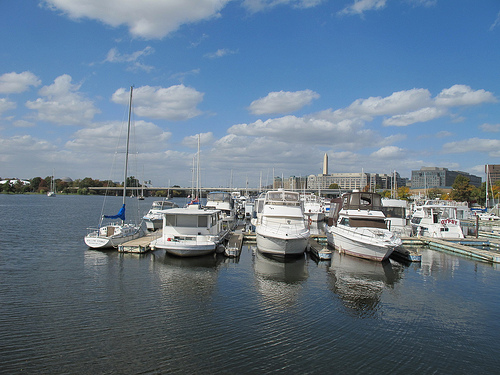
Really hoping all the great boats we saw last week from the SW Waterfront make it through the hurricane ok.


Projection via NOAA
A reader sends in a few words of advice about preparing for the Frankenstorm and some things you might want to have on hand or consider getting in advance of Sandy’s arrival:
Battery operated radios / weather radios or even the hand crank ones. Also if the cable goes out have a digital TV antenna so you can still get news over the air waves.
Bottled water. In extreme cases people can fill there bath tubs with potable water to use.
Flashlights with batteries, candle are good too but they come with a huge fire risk.
Can’t call 911 if cell service is lost or your mobile is dead so know where your nearest fire or police station is.
Have canned food but eat what’s perishable or frozen first if power goes out.
Know where utility hook up and switches are to turn off gas or electricity if supplies lines break or become exposed.
If you live in a managed multi unit building contacting the front desk or management company about their emergency plans would be helpful too.
Pets, pets freak out during storms and even before there are any signs of the storm. They can be sensitive to the low pressures. Make sure to have food and water for your pets too.
List of friends and family on paper with address.
For DC specific stuff
http://eic.rrc.dc.gov/eic/cwp/view.asp?a=1272&q=568018&cat=1
NOAA has a good PDF that explains warnings and preparedness.
Guidelines for a disaster supplies kit.

Photo by PoPville flickr user cyrusrassool
From AccuWeather.com:
Above-normal snowfall is forecast for the major I-95 cities, including New York City, Philadelphia, Baltimore and Washington, D.C., during winter 2012-2013.
The cold is expected to phase with the big storms during January and February with the potential for large snowstorms to make headlines and create travel headaches in the major cities.
Average winter snowfall for DC is said to be 14.6 inches. Above average snowfall in DC could look like this…
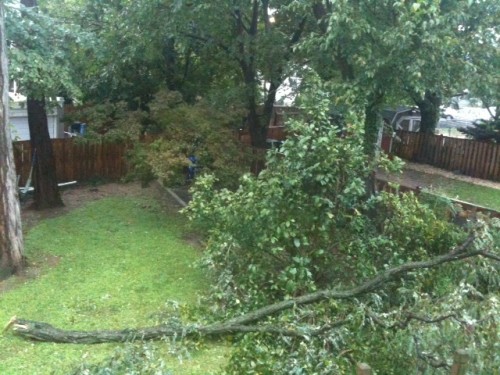
In Petworth, I lost power for about three hours and a huge branch came down in my backyard. How did you guys fare? Anyone else lose power?
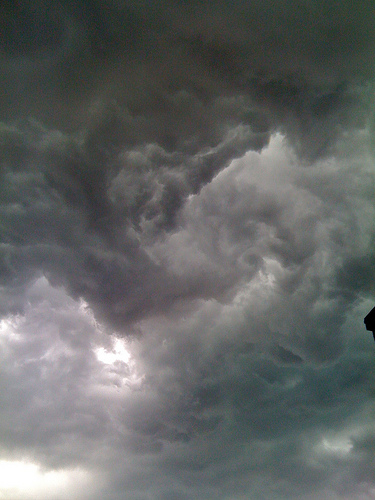
Photo by PoPville flickr user darthfadr
From DDOT:
“Wx Alert: NWS has issued a Tornado Watch until 7:00 PM for the Metro Area including DC. Severe storms expected after 4 pm.”
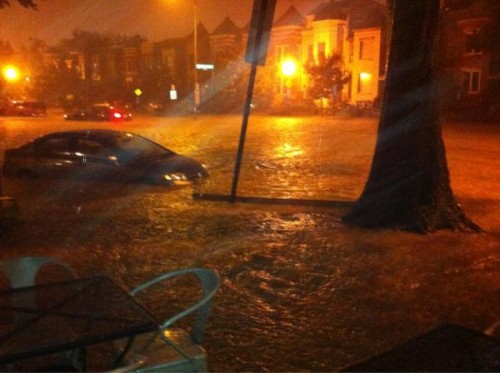
1st and Rhode Island Ave, NW taken by @BoundaryStoneDC
From a Press Release:
Mayor Vincent C. Gray today announced three short-term measures to lessen the impacts of flooding in the Bloomingdale and LeDroit Park neighborhoods. DC Water, the District Department of Transportation (DDOT) and the District Department of the Environment (DDOE) will implement these solutions as part of their work on the Mayor’s Task Force on the Relief of Flooding in Bloomingdale and LeDroit Park.
The two neighborhoods have suffered from overland flooding and sewer backups on multiple occasions this summer because of heavy rains and outdated sewer infrastructure. In response, Mayor Gray formed the task force to identify short- and long-range solutions to the flooding problem. The Mayor named City Administrator Allen Y. Lew and DC Water General Manager George Hawkins as co-chairs of the task force.
The short-term measures include:
· Analyzing the effectiveness of, and installing additional, storm drains in affected areas;
· Installing stormwater-retention features in the affected area to lessen runoff due to heavy rains; and
· Assisting residents in the neighborhood with installation of rain barrels to collect runoff from rooftops during storms, thereby decreasing the stormwater loads that the sewer system must handle.
“DC Water has been busy analyzing the causes of the problem, working with affected homeowners and doing long-term planning,” said Mayor Gray. “These three mitigation efforts represent the first tangible results from the Task Force, which brings DC Water together with other agencies and neighborhood residents. This is a good first step toward some much-needed relief.”
The stretches of road most susceptible to flooding have been the 500 and 600 blocks of Florida Avenue NW and the 100 block of Rhode Island Avenue NW.
“The District is coordinating all appropriate agencies to address this issue as quickly as possible,” said Lew. “The immediate goal is to intervene and redirect some of the overland water flow that caused the flash flooding and prevent it from threatening the homes in these neighborhoods.”
Continues after the jump (more…)