cisis_new_building
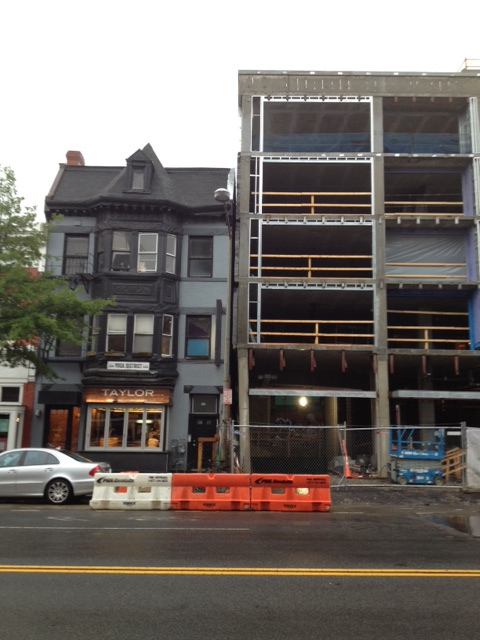
1616 Rhode Island Avenue, NW

From CSIS:

“On September 23rd, CSIS moved into its new headquarters at 1616 Rhode Island Avenue in Washington, D.C. CSIS’ new home is designed to be the premier destination for global dialogue and the development of strategic insights and bipartisan policy solutions.

Our new headquarters is a catalyst for the future—a premier destination that facilitates the union of intellect and opportunity. Behind the striking stone and glass façade, are a world-class, two-story conference space; multiple visitor and staff meeting rooms; modern, flexible office space to support our growing staff; and state-of-the-art electronics and audiovisual facilities. The building’s design and construction was guided by the latest green principles as we seek a LEED Platinum Certification.”

Do you like the way it turned out?


9510718020_da4eceafd5_z

Blurbs from the ‘Burbs is written by Arlington resident Jeff Zeeman. Jeff previously wrote about the Lake Barcroft Community

This month’s Blurbs from the Burbs is courtesy of my wife Reina: Just down the road from the home of the man who built our country is a home designed by one who built for our country. George Washington might have established our lives as Americans, but Frank Lloyd Wright understood how Americans wanted to live.

Pass Mount Vernon on Richmond Highway in Alexandria to get to the Pope-Leighey House, a Frank Lloyd Wright home dating back to 1940. The house was originally located in Falls Church and was later moved to the site of Woodlawn, the plantation of Washington’s niece and nephew.

9510719144_9807925a98_z

The home is a must-see, not for its spectacular nature like Wright’s Falling Water house, but for its livability and genius as a place that all modern folks (with shopping trips to Ikea and even Design Within Reach) are trying to emulate. The house revels in dual purpose, from the planter outside the kitchen window at arm’s length to grab herbs while cooking, to the compressed carport meant to highlight the vastness of the open living room.

The Pope-Leighey House was not built by someone rich — Mr. Pope was forced to borrow $8,000 from his employer, because the bank felt that a Wright house was too risky. And the house contains only two bedrooms plus a den, but therein lies its appeal. The Pope-Leighey House is especially worth a visit if you want to see how things used to be built for Americans; and then compare it to how we live now.


IMG_3560
3414 Volta Place, NW

I haven’t passed by this one in years. I forgot how awesome it is. Officially this is the Volta Laboratory and Bureau:

The current building, a U.S. National Historic Landmark, was constructed in 1893 under the direction of Alexander Graham Bell to serve as a center of information for deaf and hard of hearing persons. Bell, best known for receiving the first telephone patent in 1876, was also a prominent figure of his generation in the education of the deaf. His grandfather, father and elder brother were teachers of speech and the younger Bell worked with them.

Lots more awesome history here and here.

IMG_3559

IMG_3558


dorm_rendering_georgetown
Rendering by Sasaki Associates via change.org

Thanks to a reader for sending this petition – Georgetown University: Solicit new architects’ drawings for the new ‘Northeast Triangle’ dorm:

On July 2, 2013, Georgetown University revealed its plans for a new dorm on campus, across from the last patch of green space opposite Reiss, tenatively dubbed ‘Northeast Triangle’. The plans were developed by Boston-based Sasaki Associates, whose past experience includes developing residence halls at UC Riverside, Purdue University, and California State Polytechnic University.

Students and alumni were unanimous in their opposition to the uninspired, Eastern Bloc-like proposal, completely incongruous with Georgetown’s rich architectural heritage, in addition to taking up one of the last remaining green spaces on campus. The Old Georgetown Board agreed, asking for the University to go back to the drawing board and produce alternatives for the next board meeting in September. (more…)


9141162893_6f8a92f0d0_z
1900 block of 14th St, NW just north of T St.

“Dear PoPville,

I took this photo about a week ago and just don’t see how this is normal — see how crooked the beam that connects the first floor to the ground is? Doesn’t seem like something that can be fixed after the top floors are finished and I was really hoping to take advantage of the Trader Joe’s that’s going in there.”

Can engineers out there explain the slanted beam? It’s designed to support more weight?

Closeup after the jump. (more…)


FilterEdit08
1916 I Street, NW

From a press release (All photos copyright Anice Hoachlander courtesy Studio 27 Architecture):

Be Civilized – Be Urban
Installation and Exhibit at Filter Coffeehouse, Washington DC, through September 2013
Architect: Studio Twenty Seven Architecture
Design Team: John Burke, Jon Grinham, Todd Ray, Sophia Zelov
Location: Filter Coffeehouse, 1916 I Street, NW, Washington DC.

Taking Dr. Spiro Kostof’s dictum “To be civilized is to be urban” as inspiration, Studio Twenty Seven Architecture has launched the first in a series of installations and exhibits with which it hopes to challenge urban norms and encourage non-standard thinking and discourse on our city and beyond. Be Civilized – Be Urban is on display at Filter Coffeehouse at 1916 I Street, NW through the end of September, 2013.

FilterEdit05

This installation focuses on Studio Twenty Seven’s research concerning Washington DC’s most urbanistically fraught administrative quadrant, Southwest.  A neighborhood in its own right, Southwest is markedly different from the rest of Washington DC, a difference that can be attributed almost completely to the rise of the District’s commuter culture.

FilterEdit01

Southwest is bound by federal and civic infrastructure and the Eisenhower era highways that were built to provide easy access to the core for the 20th Century’s newly suburbanized workers. Isolated in this way, the quadrant was further marked by one of the nation’s most concerted federal efforts at urban renewal. National policies that encouraged suburbanization also spurred urban divestment, and the built result of this cycle, along with decades of attempted remediation, are writ large in Southwest. (more…)


View More Stories