

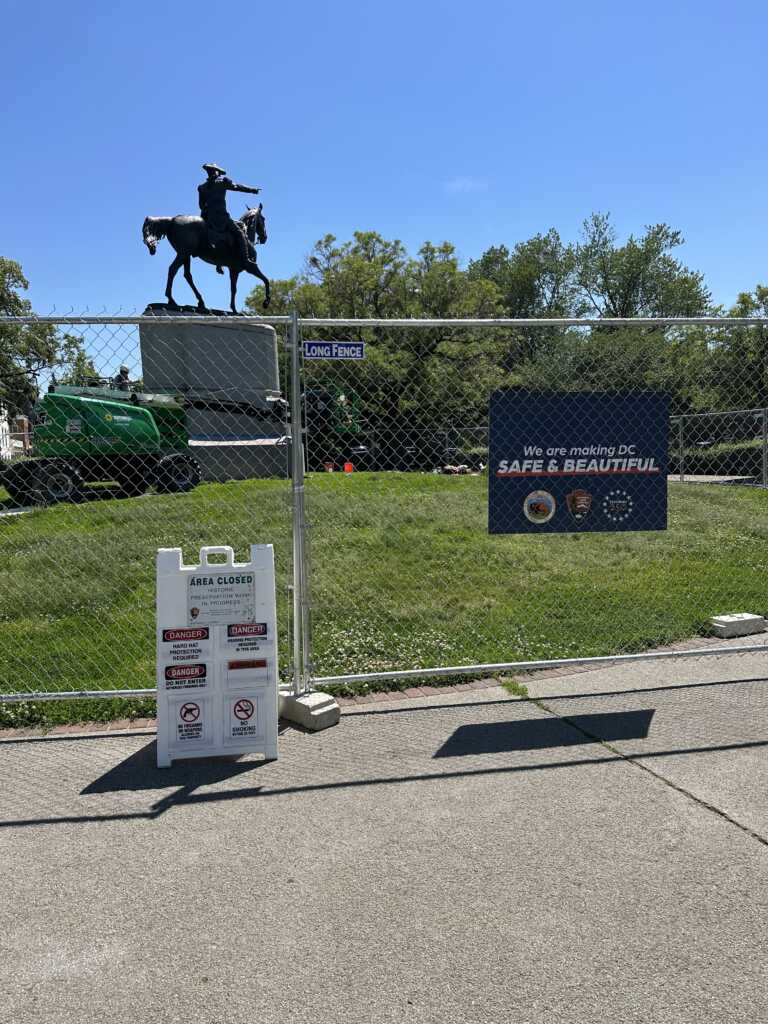
“The center turf area at Stanton Park will be closed for restoration of the General Nathanael Greene statue through mid‑June. Thank you for your patience as we work to preserve this historic landmark.”
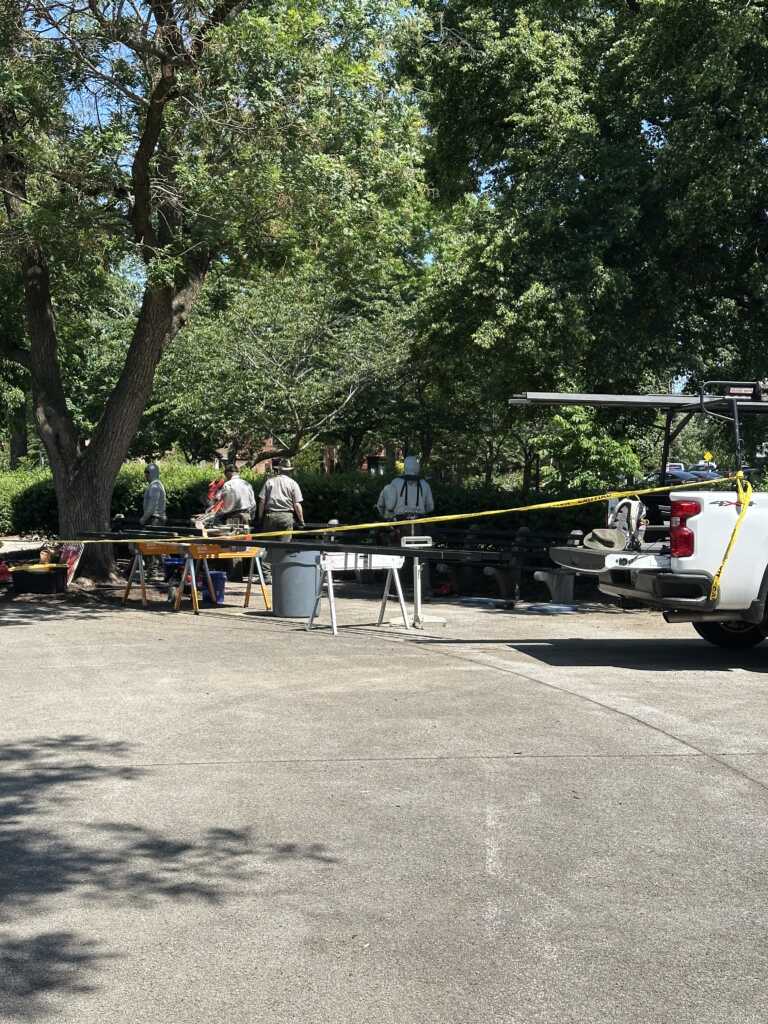
Thanks to Luqman for sending the action at Stanton Park (“located at the intersection of Maryland Avenue and Massachusetts Avenue in the Capitol Hill neighborhood of Northeast, Washington, D.C. It is bounded by 4th Street to the west and 6th Street to the east.”):
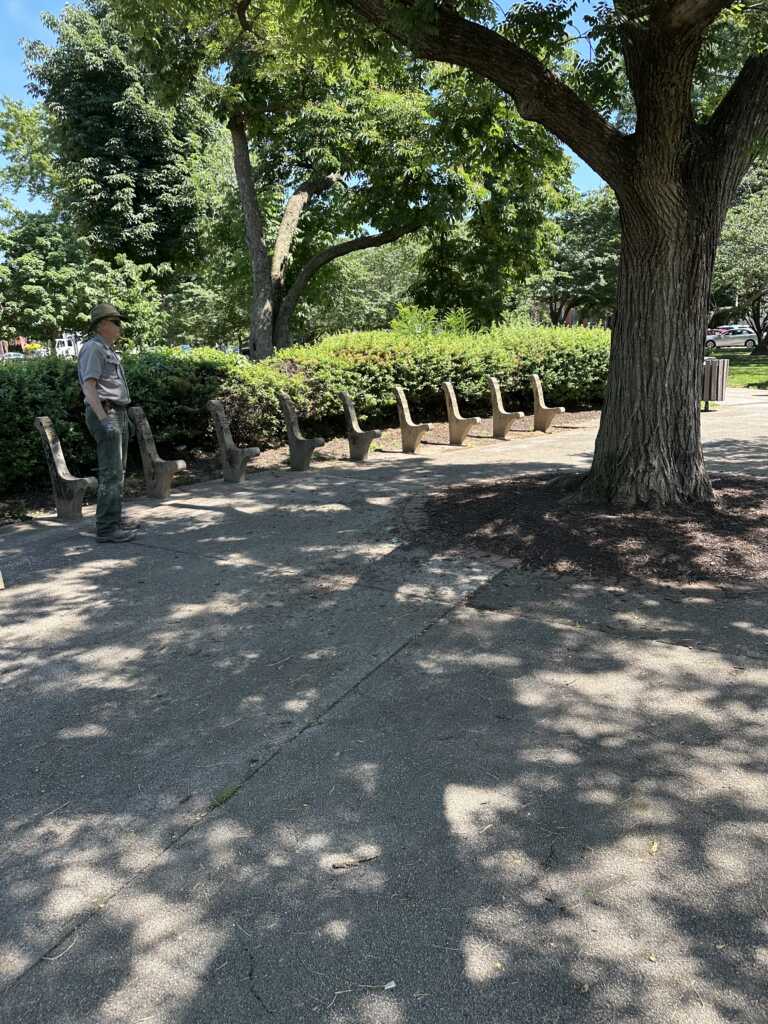
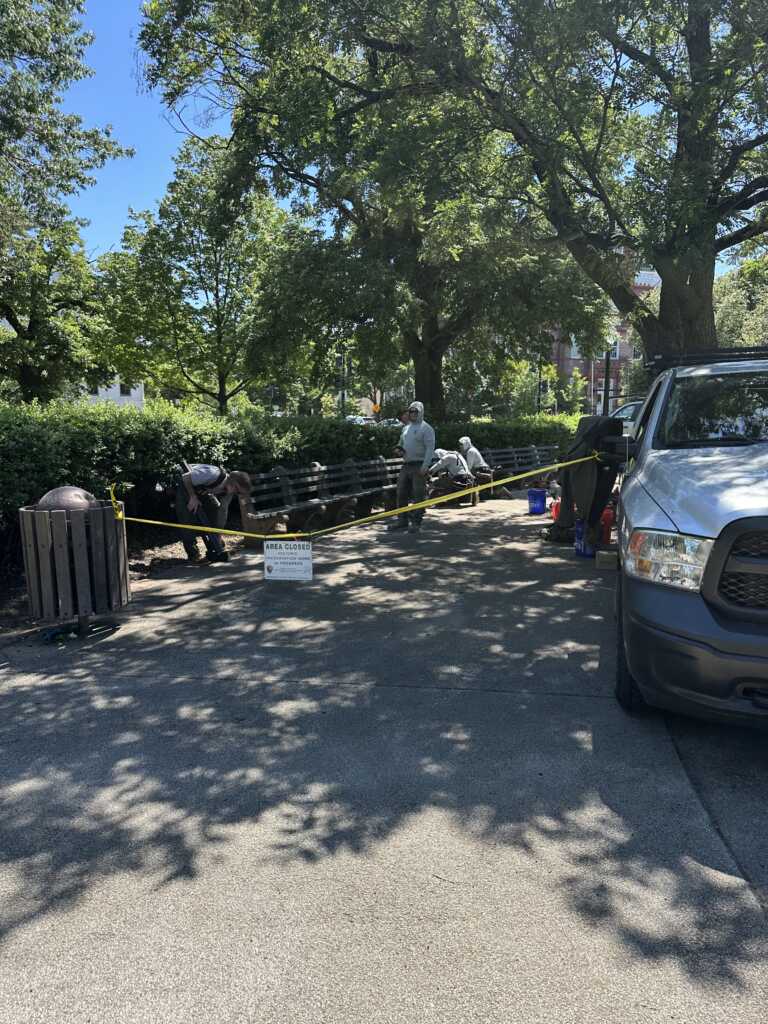
“I wanted to share this with you as I saw during my walk at Stanton Park in NE near Union Station.”
More photos:
From NPS:
“Originally designated as “No.5” by Pierre L’Enfant in 1791, Stanton Park is a designed cultural landscape located in northeast Washington, D.C., its four acres are bordered between 6th Street NE to the east and 4th Street NE to the west, and it is one of the larger Capitol Hill Parks. It has been a public park since the first improvements to the area in the 1870s.
There are three significant periods as they pertain to the Park. In 1791, the District Commissioners acquired undeveloped land that is now Stanton Park as part of the right-of-way for the city’s street and avenue system. The area was not fenced off as a public park until 1867, and in 1871 it became known as Stanton Square after Abraham Lincoln’s Secretary of War, Edwin Stanton.
Born in Steubenville, Ohio on December 19, 1814, Edwin M. Stanton went into law. He was known for being on the defense team of Daniel Sickles who killed Phillip Barton Key (the son of Francis Scott Key) for improprieties with Sickles’ wife. Sickles’ defense was “temporary insanity.” It was the first time used in U.S. jurisprudence, and the jury found Sickles not guilty. (Sickles went on to lead an ill-advised charge off Little Round Top on the second day of battle which could have cost the Union the Battle at Gettysburg.) Stanton is most known for being the Secretary of War in Abraham Lincoln’s cabinet, and he was a driving factor in the Union war effort during the American Civil War. Stanton led the investigation after John Wilkes Booth assassinated Mr. Lincoln. After retiring as Secretary of War he was nominated as an Associate Justice of the Supreme Court, but he died on December 24, 1869, four days after his confirmation by the Senate.
Soon after, Congress authorized a statue of Revolutionary general Nathanael Greene, which was erected in the park in 1878. Nathanael Greene was born in Rhode Island in 1742. After the beginning of the Revolutionary War (already part of a Rhode Island Militia) he was made a Brigadier General by the Second Continental Congress. He was appointed Quartermaster General in 1778 where he was responsible for supplying the Continental Army. On October 14, 1780, and a series of defeats, and with Congress’ authorization, Washington appointed Greene commander of the Southern Theater. Vastly outnumbered by British troops, he would rely heavily on guerilla tactics. Greene proved himself a very adept field commander. Cornwallis surrendered at Yorktown in 1781 although the British still controlled other areas of the country. Greene turned down an appointment to the newly established position of Secretary of War. During the war he realized the sometimes inability of the Continental Congress, and he became an advocate for a stronger national government, another signpost toward the United States Constitution. Military historians rate Greene as the second highest rated general of the Continental Army, second only to Washington.
Today the park is adorned with trees, walkways, and a playground, and it Is conveniently located in walking distance of the U.S. Capitol, Supreme Court, Union Station, and Belmont-Paul Women’s Equality National Monument.”