Gallaudet’s Rat FuneralsThe campus of Gallaudet University is littered with graves. The graves of rats. How did they get there?(Closed captioning here: http://chronicle.com/interactives/college_traditions)

Posted by Chronicle of Higher Education on Tuesday, October 27, 2015

“The campus of Gallaudet University is littered with graves. The graves of rats. How did they get there?”


IMG_0774

Gone but not forgotten.

From American University:

“Matt Shlonsky loved Washington, DC. Since arriving at American University in 2010, Matt had embraced his adopted city, attending historical events, concerts, and other local activities across the district. After his graduation from the School of International Service in May 2014, Matt elected to remain in Washington, starting a career in business communications and consulting. Matt continued to give back to the School of International Service as a generous volunteer and a donor. Matt was already on his way to a successful career with Deloitte and other exciting pursuits outside of his work.

Our hearts are broken to report that Matt’s future of unlimited possibilities ended tragically on August 15, 2015, when he fell victim to gun violence in Washington. Matt left behind a loving family, many hundreds of loyal friends, and a remarkable legacy of caring and kindness that betrayed his 23 years. (more…)


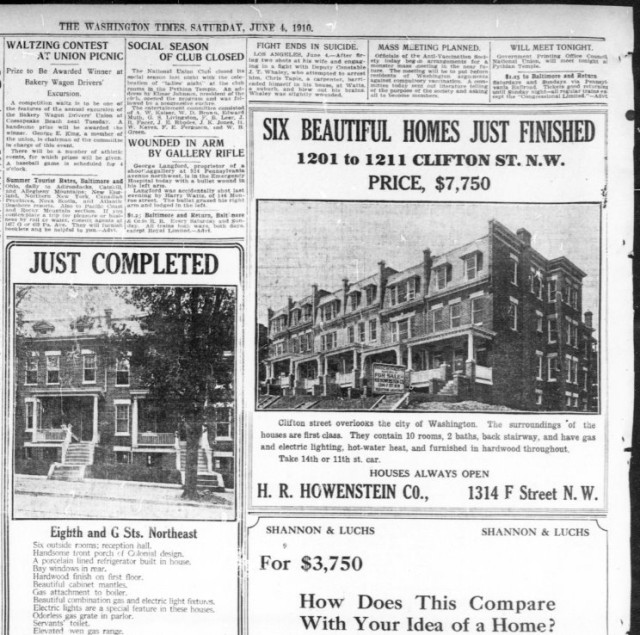
CliftonSale1910

This is awesome – thanks to a reader for sending:

“You listed an apartment @ 1201 Clifton St NW [$1,875/Mo], for a 2 bedroom, 1bath earlier this week. But check this ad from June 4, 1910 from Washington Times. Same place but the whole house for $7,750 and came with gas or electric lighting.

Also 1211 Clifton St, the home on the far left of the original ad just sold this past Sept, 2015 for $1.4 million. So $7,750 in 1910 – $1.4million in 2015, talk about return in your investment!”


Capital Streetcars cover

John writes:

“Washington’s first streetcars trundled down Pennsylvania Avenue during the Civil War. By the end of the century, streetcar lines crisscrossed the city, expanding it into the suburbs and defining where Washingtonians lived, worked and played. From the quaint early days of small horse-drawn cars to the modern streamliners of the twentieth century, John DeFerrari’s new book, Capital Streetcars, tells the story of the dramatic rise and equally dramatic fall of streetcars in our city. John is the author of two previous books about DC history (Lost Washington, DC. and Historic Restaurants of Washington, DC) and is a frequent contributor to PoPville with articles about DC history from his Streets of Washington blog.”

Tuesday, Oct 6, 6:30pm – Busboys and Poets Brookland

Sunday, Oct 11, 6:00pm – Upshur Street Books

Saturday, Oct 17, Noon – National Capital Trolley Museum


house history
Photo courtesy Humanities Council of Washington, DC

From an email:

“The summer edition of HumanitiesDC’s DC Community Heritage Project House History Day will be held on Saturday, August 15. Two free sessions at 10 a.m. and 1 p.m. will give community historians, of any skill or knowledge level, an overview of the myriad of resources available through the collections of the Historical Society of Washington, DC and the DC Public Library Washingtoniana Division. Participants will learn how to research the history of their own homes or any other historical property through sessions on:

▪ Neighborhood Context/DC Digital Museum – Led by Jasper Collier, Curator of Digital Collections, HumanitiesDC

▪ DC Maps – Led by historian and editor of the H-DC listserv Matthew Gilmore

▪ Historic Building Permit Database – Led by historian, author, and tour leader Brian Kraft

▪ Photograph Collections – Led by Anne McDonough, Library and Collections Director, Historical Society of Washington, DC

▪ Online and Microfilm Records – Led by Mark Greek, Collections Coordinator, Special Collections, DCPL Washingtoniana Division

House History Day will be held at The Historical Society of Washington, DC (801 K Street NW, Washington DC 20001).

Registration is required here.”


2006-11302h
Mark Avino, National Air and Space Museum, Smithsonian Institution

From a press release:

“The Smithsonian is embarking on a multi-project partnership with Kickstarter, the funding platform for creative projects. The inaugural project will support conservation of Neil Armstrong’s Apollo 11 spacesuit at the National Air and Space Museum. The funds also will be used to digitize and exhibit the 46-year-old suit.

The campaign start[ed] July 20, the anniversary of the first walk on the moon in 1969.

Kickstarter has enabled more than 88,000 projects to be funded since it began in 2009. Through the Smithsonian’s partnership, a series of crowdfunded projects will launch on Kickstarter throughout the next year. During this pilot year, the focus will be on artifacts, exhibitions and projects that need funding, giving the public a variety of opportunities to support the Smithsonian based on their own interests. Kickstarter adheres to an all-or-nothing method. If the project succeeds in reaching its funding goal, all backers’ credit cards are charged when time expires. If the project falls short, no one is charged.”

Ed. Note: As of 2:30pm on Monday they had already raised $54,571!!


Streets of Washington, written by John DeFerrari, covers some of DC’s most interesting buildings and history. John is the author of Historic Restaurants of Washington, D.C.: Capital Eats, published by the History Press, Inc. and also the author of Lost Washington DC.

Today Foreign Minister Bruno Rodríguez of Cuba once again raises the Cuban flag over the country’s venerable embassy building at 2630 16th Street NW, in the Meridian Hill neighborhood that was once home to many of the city’s finest embassies. Close by are the former Italian, Mexican, and Spanish embassies as well as the current embassies of Poland and Lithuania. For decades the building has quietly served as the Cuban Interests Section of the Swiss Embassy, but before that it had a long social career, hosting many of the city’s classiest balls and receptions.

Cuban+Embassy+07-19-2015
Photo by the author.

The Republic of Cuba had a diplomatic outpost in Washington even before the country existed as an independent nation. In the 1890s, as Cubans mounted their war for independence from Spain, Gonzalo de Quesada (1868-1915) established a legation at the fashionable Raleigh Hotel on Pennsylvania Avenue. A graduate of Columbia University, Quesada had met revolutionary hero José Martí in New York at a rally of Cuban exiles; he quickly became an important figure in the struggle for independence. The movement had the sympathy of many Americans, and on President William McKinley’s inauguration day in March 1897, its flag flew proudly atop the Raleigh. “All sympathizers with the struggling patriots could not suppress a yell of patriotism as they observed the flag of the little would-be republic floating as proudly to the breeze as that of the big, powerful country the strong protection of which is sought,” wrote The Evening Star. (more…)


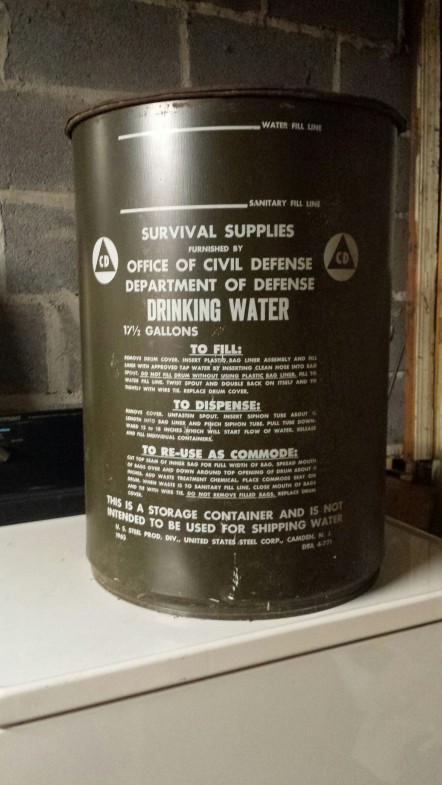
20150715_114957_resized

If you have a photo of a neat find from your house or place of work please send an email to princeofpetworth(at)gmail.com thanks. To those who have sent – I promise I’m working through the queue!

From Logan Circle:

“We inherited this barrel when we bought our house and never paid any attention to it. There was a running joke about what could be in it. Well I moved it for the first time and actually looked at the label. Its from 1963. And its empty. If anybody is interested in it before I throw it away…..”

Ed. Note: Note the Sanitary Fill line.


simpson

This is very cool – from a press release:

“The Office of Planning’s Historic Preservation Office has started archaeological investigation at what is believed to be the burial site of Yarrow Mamout, a prominent African Muslim freeman whose legacy is chronicled in James H. Johnston’s book, From Slave Ship to Harvard: Yarrow Mamout and the History of an African American Family.

In June, City Archaeologist Dr. Ruth Trocolli received permission from the property owner to conduct a thorough survey of the site, located at 3324 Dent Place, NW, in Upper Georgetown. Initial efforts to excavate at the site began in 2012, after modern structures on the site were demolished. Residents in the neighborhood also advocated for an archaeological investigation focused on Mamout’s occupation of the property.

Mamout became famous after Charles Wilson Peale painted his portrait in 1819. A second portrait of Mamout was painted in 1822 by James Alexander Simpson, a Georgetown-born artist, and the portrait now hangs in the Peabody Room at the Georgetown Public Library. Mamout died on January 19, 1823, and his obituary suggests that he was buried at the excavation site.

In 1800 Mamout secured his freedom at the age of 60, and purchased the lot that is being excavated. Little is known of Mamout’s life before being sold into slavery at the age of 16 in Annapolis, Maryland.

“This excavation presents a unique opportunity to shed light on the life of a free African American in Georgetown in the early nineteenth century,” stated Office of Planning Director Eric Shaw. “I am also excited that this project engages District residents, scholars, and amateur archeologists through regular fence talks and the upcoming District’s Day of Archaeology.”

For more information about the project, please visit the project website.

The Office of Planning will hold fence talks daily at 10:15 a.m. and 1: 45 p.m. at 3324 Dent Place NW on days when the archaeologists are on site and weather permitting. Please check the project’s Facebook page for the schedule.

The District’s Day of Archaeology Festival will take place July 18, 2015, at Dumbarton House Museum, 2715 Q St. NW, from 10 a.m. to 3 p.m. For more information please visit the website.”


View More Stories