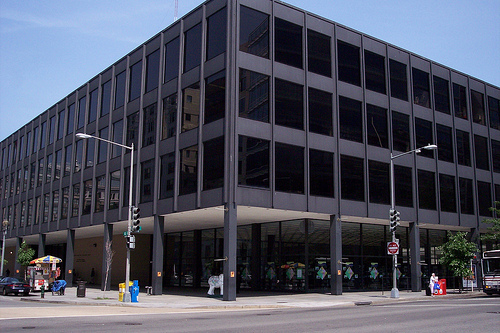
Photo by PoPville flickr user rjs1322

“Dear PoP,

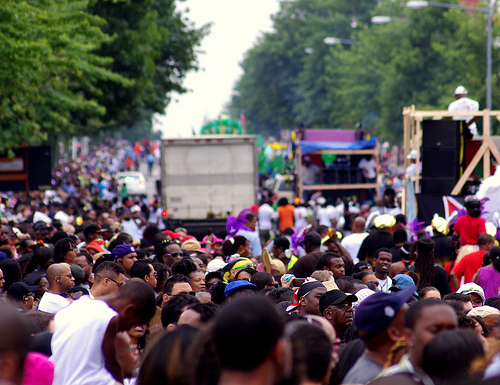
Any follow-up from the Mayor or Councilmembers’ offices on the status of the Caribbean festival?”

Neither the Mayor, CM Bowser or CM Graham responded to my query on twitter. I was later able to inquire, via email, with Pedro Ribeiro, the Mayor’s Communications Director, who told me:

“The District has not received payment and no permit has been issued.”

More info as it becomes available.


Photo by PoPville flickr user jleathers

Office of Planning Study Highlights Innovative Approaches to Successful Commercial Districts

WHAT/WHO: Mayor Vincent C. Gray will announce the release of the District’s Vibrant Retail Streets Toolkit, which evaluates the essential elements required to create and maintain outstanding retail areas and offers a customizable toolbox of strategies and implementation steps to improve retail corridors.

WHEN: Thursday, March 29, 2012
10:00 a.m.

WHERE: Yes! Organic Market
4100 Georgia Avenue NW
(Georgia Avenue-Petworth Metro Station)

BACKGROUND: The Vibrant Retail Streets Toolkit, developed by the D.C. Office of Planning (OP) and its consultant partner Streetsense, incorporates research on best practices and innovative approaches to managing successful commercial districts. The document also uses metrics that assess the level of retail demand, accessibility, location, mix and format. The Vibrant Retail Streets Toolkit is a follow-up to OP’s  Retail Action Strategy and Retail Action Roadmap, released in 2010.

The District’s evolving retail economy is an opportunity for the city to grow its tax base and become more fiscally sound. Retail can create new jobs, enhance neighborhood amenities, provide convenient access to goods and services for residents, generate millions of dollars in new tax revenue and reduce the phenomenon of residents leaving the city to buy what they need or want. Investments in emerging commercial corridors are bringing new retail energy to neighborhoods; however, as with retail areas across the nation, retail streets in the District face a variety of challenges. The Vibrant Retail Streets Toolkit is a guide designed to take advantage of renewed interest in urban markets by retailers as well as the District’s growing population who choose our increasing number of walkable, bikeable, transit-rich neighborhoods to shop and access services in the city.

Study/Toolkit Overview:
The study evaluates the essential elements of outstanding retail areas and offers a customizable toolbox of programs, incentives, and implementation steps to improve retail streets. The toolkit incorporates research on best practices and innovative approaches to managing successful commercial districts and also uses retail metrics that assess the level of retail demand and accessibility and location mix and format. The study offers guidance on key retail issues such as retailers’ site location considerations and decision-making processes, as well as how neighborhoods can measure, gauge and spark retail vibrancy. The analysis and toolkit will equip retailers, landlords, business and neighborhood associations, nonprofits and government agencies with the tools needed to support more dynamic retail streets.


Photo by PoPville flickr user rockcreek

Dear PoPville,

Friends and I want to organize a pop up store where local vendors could sell their products (both crafts and edible products). I am having a hard time figuring out what permits would be needed from the DC government. I read their website and perused through the permit categories and I am super confused. I am thinking that I will definitely need permits because vendors will be selling packaged food and I envision them giving samples. Someone mentioned that I may not need permits if the the event is held at a restaurant or related facility that would already have a food permit. Any help to point me in the right direction would be appreciated.


Photo by PoPville flickr user pjcoleman

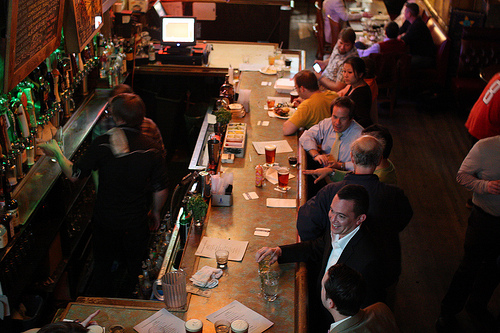
The Washington Post’s Mike Debonis tweeted about the Mayor’s proposed budget:

“New revenue initiatives include ‘expanded sales hours for alcoholic beverages’ ($5.3M) — told sales will be allowed till 4 a.m.”

and a little more detail:

“Gray budget proposal on bars: Weekday close at 3 a.m.; weekend close at 4 a.m. Allow liquor stores to open 7 a.m.”

Good idea for raising revenues?


Photo by PoPville flickr user dcjabbour

From a press release:

Spring is an ideal time to plant trees and Casey Trees offers rebates up to $100 per tree to individuals who plant trees on private property — residential or commercial — in the District.

Small and medium canopy trees — including standard-size fruit and trees — are eligible for rebates up to $50 per tree, as long as the tree reaches 15 feet tall and wide at maturity. Seven genera and 27 species noted for their large canopy and environmental benefits qualify for rebates up to $100 per tree. There is no limit to the number of rebates per property.

Invasive tree species and any species of ash, dwarf trees and shrubs do not qualify for a rebate of any amount.

To help customers identify rebate-eligible tree stock, many D.C.-area nurseries and home improvement centers are promoting the program in their stores with promotional signage and special tree tags. However, trees may be purchased from any store and through landscaping and landscape architecture companies.

The Tree Rebate program is funded by the District Department of the Environment.

Downloadable rebate forms, submission instructions and a complete list of trees eligible for the increased rebate are available at www.caseytrees.org/rebate.


Photo by PoPville flickr user DC@rt

Dear PoPville,

I work in agricultural policy and this was forwarded to me today. The DC Council is proposing some serious restrictions on pesticides that could really limit their use for the treatment of roaches, bed bugs, and other urban pests.

“DC City Council member Mary Cheh (D), chair of the Committee on Environment, Public Works and Transportation, introduced the “Pesticide Education and Control Amendment of 2012.” This measure would require the District Department of Environment to classify all US Environmental Protection Agency (EPA) registered pesticides as either “minimum risk” or “restricted use” pesticides. Under this measure, any conventional pesticide may be classified as a restricted use pesticide, even if such a designation is not given by the U.S. EPA. The bill would forbid any pesticide designated as restricted use from being applied to public property, schools, child-occupied facilities or water-way contingent property. In addition, the legislation contains a definition of integrated pest management that would only allow the use of pesticides only as a last resort. Passage of this ordinance would affect the availability and use of pesticides in the District of Columbia. This legislation could limit the pesticides that could be used in the district to control rodents, bed bugs, cockroaches and other pests often found in DC apartment buildings.”


Ed. Note: If you have a PoP-Ed you’d like published, send an email to princeofpetworth(at)gmail with a quick note about the topic you’d like to write about.

Mayor Gray: No Time for Delays. Send New Food Truck Regs to City Council!

By Kristi Whitfield
Co-Owner, Curbside Cupcakes

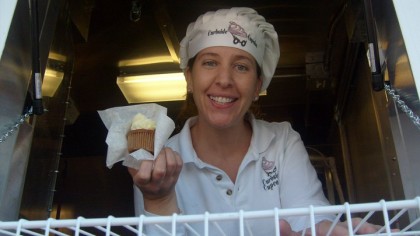
Curbside Cupcakes is Washington DC’s first mobile cupcake truck. When my husband and I maxed out our credit cards and refinanced our house to open Curbside Cupcakes in 2009, there were only a few food trucks serving the District. Since then our numbers have grown substantially because consumers appreciate and support the influx of new and innovative dining options that many food trucks offer. In light of our popular and growing industry of small business owner/operators, Mayor Vincent Gray has proposed new vending regulations that, while not perfect, are a major upgrade from what’s on the books now. If special interest groups succeed in pressuring the Mayor to send these regulations “back to the drawing board”, then fellow “truckers” like Curbside Cupcakes are in danger of not only losing our businesses but our houses and every nickel and dime we scraped together to make our dreams a reality. And all this over what? Competition. Our detractors say that food trucks are “stealing away” customers from storefronts. This attitude reflects a shocking sense of entitlement. Businesses don’t own customers. Businesses earn customers.

In 2010 the District of Columbia Department of Consumer and Regulatory Affairs (DCRA) collected over 2,500 comments on a previous version of proposed regulations. Food truck opponents were more honest then about their concerns, which boiled down to not wanting to compete with food trucks; given the expenses that storefronts incur for brick and mortar shops they figure why should they have to compete with “outsiders” for customers. This position turned out to be very unpopular, so this time around opponents of the legislation say they have “concerns” about crowded sidewalks, limited parking and increased trash.

In our battle for survival, the food trucks are the little guy. Many food truck owners would have liked to start as storefronts, but most of us don’t have the personal or corporate wealth that would allow us access to hundreds of thousands of dollars to invest in restaurant real estate. Lack of wealth should not limit my husband and me from spreading Cupcake Bliss to all areas of the District.

Continues after the jump. (more…)


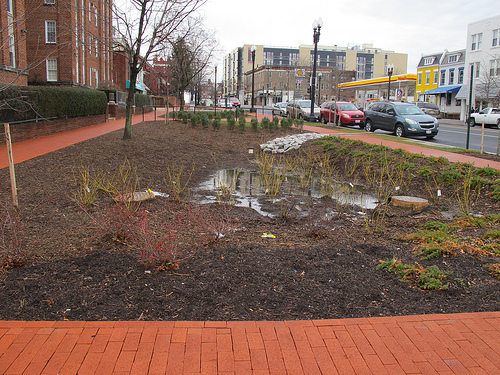
I think someone may have brought this up once in a rant/revel post but I finally saw what they were talking about. This is on Georgia Ave just south of Taylor. I imagine this is gonna breed millions of mosquitos. If this is indeed a flaw – anyone know which DC government agency should fix it?


Photo by PoPville flickr user Mr. T in DC

From a DC Food Trucks Association press release:

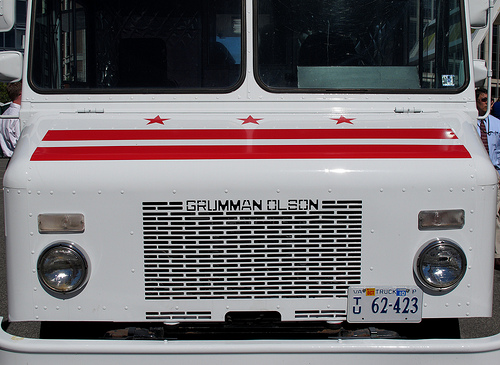
Under current regulations, a proposal for mobile vendors to collect sales tax opens the door for double taxing food trucks and could even make individual employees responsible for the business’s taxes.

“If the Sales Tax Act passed today it would create a scenario on par with requiring each server in a restaurant to collect and submit sales tax for the entire business,” said Che Ruddell-Tabisola, Executive Director of the Washington, DC Food Trucks Association.

“The Sales Tax Act shines a spotlight on how badly we need Mayor Vincent Gray’s proposed new food truck regulations, which update decades-old vending rules and make it possible for food trucks to collect sales tax,” Ruddell-Tabisola said.

Under current food truck regulations, a vending license holder, typically the owner, must be present on the truck for it to operate. For the food truck to operate without the owner, he or she must obtain additional vending licenses for employees. As a result, a single food truck has multiple licenses holders, each of which pays fees as if it were the business owner.

The Sales Tax Act would make each license holder responsible for the business’ sales tax and could possibly require each employee to pay the business’ full amount of tax collected, resulting in a food truck paying double, triple or even more the amount of tax actually collected and threatening the ability of the food truck to remain in business. Moreover, it would unfairly subject individual employees to personal liability for the business’s tax obligations.

Mayor Gray’s proposed new food truck rules would update regulations to require just one vending license per food truck and make it possible for food trucks to collect tax as intended by the Sales Tax Act.

“We don’t believe the Sales Tax Act’s intent is to threaten the viability of food trucks, but obviously it cannot be passed with the current food truck regulations still in place,” Ruddell-Tabisola said. “It only makes sense for the tax act to be adopted in tandem with passage of the Mayor’s proposed new food truck rules.

“The Sales Tax Act is a step in having food trucks treated like real businesses,” Ruddell-Tabisola added. “Our members welcome the recognition that we are real businesses and look forward to serving as a means to provide additional revenue to the District. It’s what we’ve always said – food trucks are good for the District.”


Photo courtesy of DC Library

From a press release:

The Urban Land Institute (ULI) released its final report today after conducting a week-long review of the Martin Luther King Jr. Memorial Library building last November. Based on the results of the ULI report, the DC Public Library will begin an in-depth analysis next month to determine the feasibility and cost of implementing the scenarios.

“The analysis is the next step in a long process that will help us figure out how to make the District’s central library a spectacular place for residents,” said Ginnie Cooper, chief librarian of the District of Columbia.

The ULI report outlined three scenarios for consideration without necessarily recommending one over the other. All scenarios will require significant investment by District government for major improvements to the building, according to the report.

Keep the existing building as a library and lease excess space in the building to another commercial, nonprofit or municipal entity.
Maintain the existing building for complete use by the library.
Sell the building and identify another downtown location for the central library.

The Library will work with nationally recognized architectural firm and architect-of-record for the Martin Luther King Jr. Memorial Library, The Freelon Group, to examine how the MLK Library can be reconfigured for co-tenancy, complete an analysis of how two more floors can be added to the building, and identify, prioritize and provide cost estimates for needed major improvements. The work will follow the historic design guidelines developed by EHT Traceries.

Additionally, the Library will work with the D.C. Office of Planning to explore whether there are viable alternate locations downtown that can accommodate a 225,000 square foot central library. And finally, nationally recognized library experts will be consulted to test the assumption that 225,000 square feet is sufficient space to house a state-of-the-art, cutting edge central library. The analysis is expected to be complete by the fall. The results of the analysis will be used to continue the conversation on the future of the Martin Luther King Jr. Memorial Library with residents, city leaders and other stakeholders.

Continues after the jump. (more…)

View More Stories