

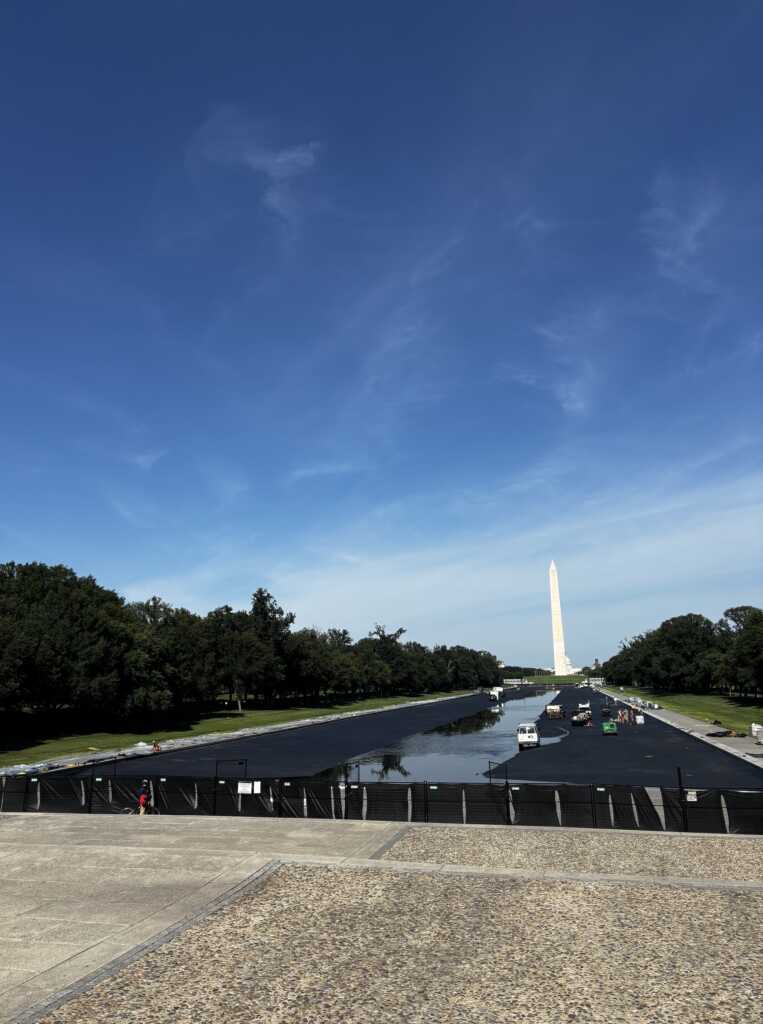
Thanks to M. for sending the water starting to fill at the reflecting pool yesterday.
And thanks to G. for sending below: “the fountains are back on at John Marshall Park.”
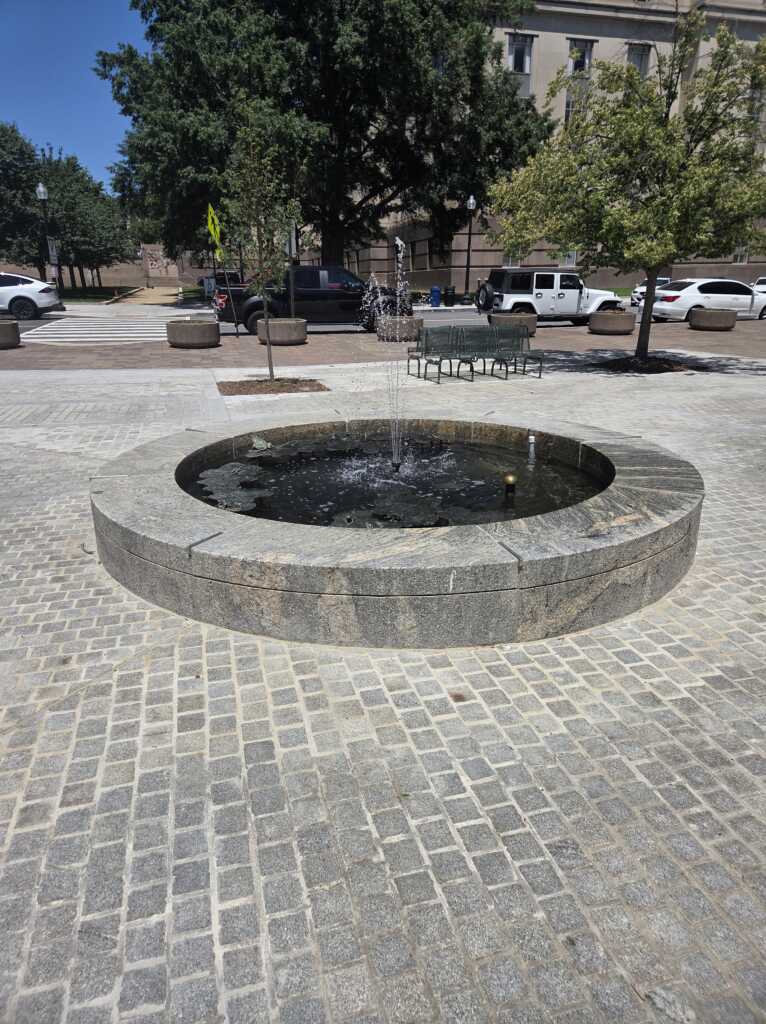
400-448 C Street, NW
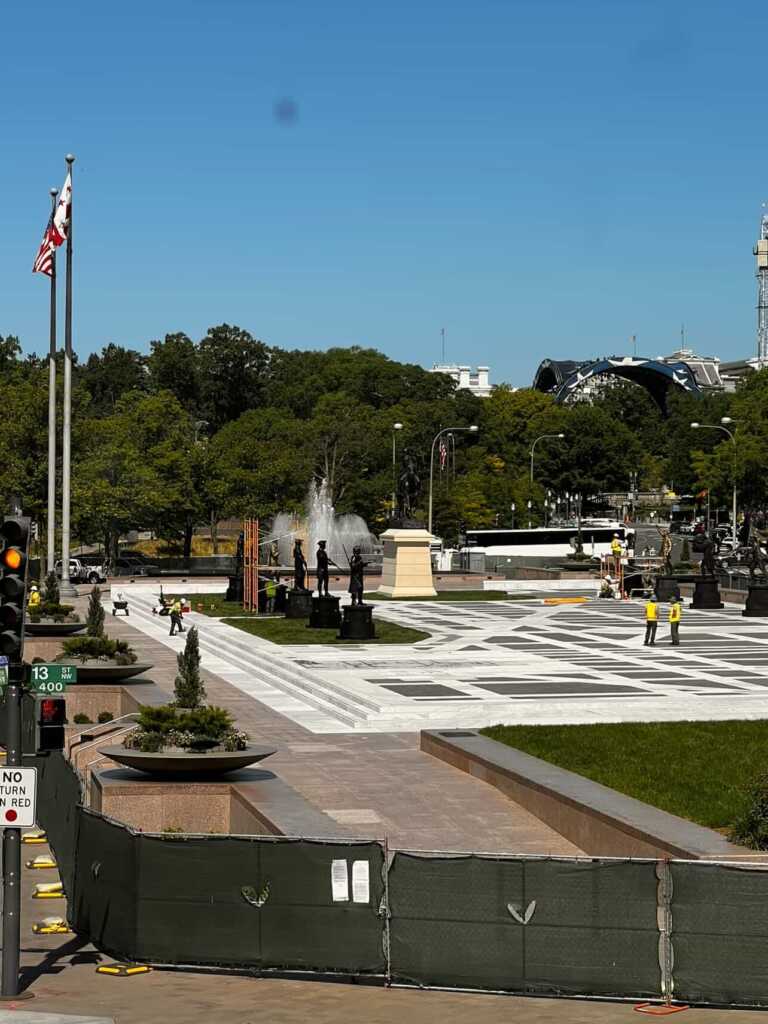
And thanks to another reader for sending below from Freedom Plaza “The fountain works again!”
Background from the National Park Service:
“Freedom Plaza, located along Pennsylvania Avenue NW between 13th and 14th Streets, is one of Washington, D.C.’s most recognizable civic spaces. Completed in 1980 and originally named Western Plaza, the site was renamed in 1988 in honor of Martin Luther King, Jr., who had outlined plans for a “Poor People’s Campaign” on the steps of the Lincoln Memorial and was scheduled to lead a demonstration on the site before his assassination.
The plaza was designed by architect Robert Venturi and landscape architect George Patton as part of the larger Pennsylvania Avenue redevelopment. Its most striking feature is its broad granite and marble surface inlaid with a giant, map-like representation of Pierre L’Enfant’s 1791 plan for the city of Washington. Streets, avenues, and the Potomac shoreline are marked in black granite, while inscriptions and compass points add to the impression of walking across an oversized city blueprint. Bronze plaques set into the pavement highlight key sites and historical references, blending art, cartography, and civic memory.
Freedom Plaza includes raised terraces, low stone seating walls, and planters that frame views toward the U.S. Capitol in one direction and the White House in the other. A large equestrian statue of Kazimierz Pułaski, the Polish-born Revolutionary War cavalry officer, stands at the northeast corner, tying the space visually to the avenue’s string of historic monuments. The plaza’s open layout, with its wide, uninterrupted central expanse, was intended to serve as a grand public forum and event space.
Today, Freedom Plaza functions exactly as its designers envisioned: a flexible gathering place used for rallies, demonstrations, festivals, performances, and civic celebrations. Its prominent location along “America’s Main Street” has made it a frequent site for political expression, from large national marches to small grassroots events. Office buildings, hotels, and federal agencies surround it, giving the plaza a steady flow of workers, visitors, and passersby throughout the day.
Though primarily paved, its edges include shade trees and seating areas that offer respite from the busy avenue. Ongoing maintenance and occasional redesign discussions underscore its importance as both a symbolic and practical public space in the heart of the nation’s capital. Freedom Plaza remains a distinctive blend of historic homage, civic function, and monumental urban design.”
Background from the National Park Service:
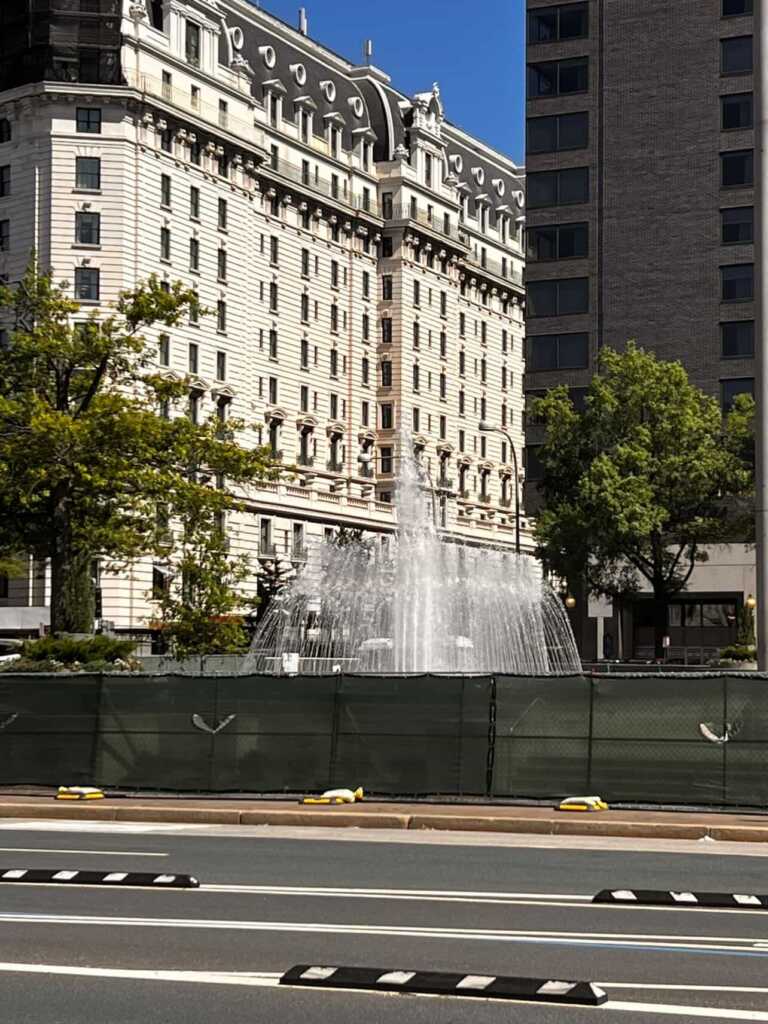
“John Marshall Park is closely tied—both symbolically and physically—to the courthouses that surround it. Situated directly beside the E. Barrett Prettyman U.S. Courthouse and near the H. Carl Moultrie I Superior Court building, the park forms part of a civic landscape centered on law and justice. Its dedication to Chief Justice John Marshall reinforces this connection: Marshall’s legacy as a defining figure in the early Supreme Court mirrors the modern judicial activity taking place just steps away. As a result, the park functions not only as a public green space but also as a quiet extension of the courthouse environment, offering a contemplative setting for attorneys, jurors, staff, and visitors reflecting on ongoing legal proceedings.
At the north end of the park stands a bronze statue of John Marshall, a recast of the 1883 sculpture by William Wetmore Story. The statue depicts Marshall seated in judicial robes on a granite pedestal, his right hand extended as if delivering an opinion while a folded document rests in his left—an apt portrayal of a man who helped define federal judicial power and shape American constitutional law. Because Marshall once lived near this site, the statue and the park together act as a symbolic bridge between the city’s legal-historical foundations and its active contemporary judiciary.
The park’s terraces, fountains, and additional sculptures—such as the life-size bronze “Chess Players”—enhance its atmosphere of reflection and civic dignity, making it a welcoming space for jurists, lawyers, courthouse visitors, and neighborhood residents alike. Designed as a long, linear green space along Pennsylvania Avenue NW, John Marshall Park subtly frames the judicial institutions around it. Its walkways and terraced levels are oriented so that the statue of Marshall occupies a prominent position, facing toward the nearby federal courts. From this vantage point, the sculpture appears to preside over the stretch of Pennsylvania Avenue that links the Supreme Court, the Capitol, and the surrounding federal and district courthouses. The formal character created by broad steps, stone walls, and symmetrical plantings mirrors the architecture of these civic buildings, allowing visitors to experience a gradual transition from open urban space to the solemn world of the judiciary.”