

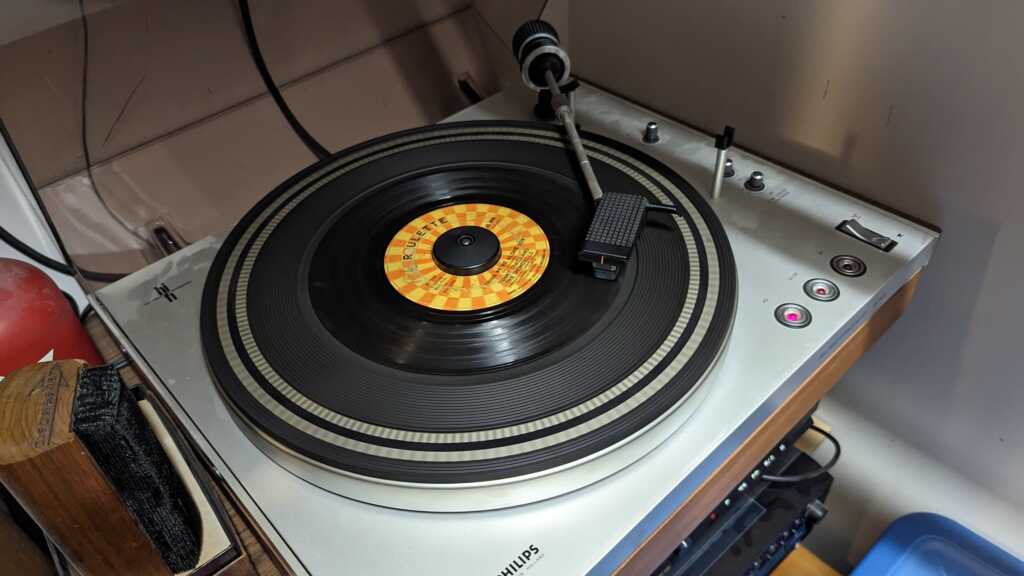
photo by Tim Brown
From the Library of Congress:
“Taylor Swift’s transformative pop album “1989,” Beyoncé’s standout “Single Ladies (Put a Ring On It),” The Go-Go’s debut album “Beauty and the Beat,” Vince Gill’s signature “Go Rest High On That Mountain,” Weezer’s self-titled debut “Weezer (The Blue Album),” Chaka Khan’s crossover hit “I Feel for You,” and Broadway’s original cast album of “Chicago” have been selected as some of the defining sounds of history and culture that will join the National Recording Registry of the Library of Congress in 2026.
Acting Librarian of Congress Robert R. Newlen today named 25 recordings as audio treasures worthy of preservation for all time based on their cultural, historical or aesthetic importance in the nation’s recorded sound heritage.
The 2026 class of inductees span 70 years of music and recorded sound, including: The Byrds’ single “Turn! Turn! Turn! (To Everything There is a Season),” Reba McEntire’s defining country album “Rumor Has It,” Rosanne Cash’s album “The Wheel,” Gladys Knight and the Pips’ “Midnight Train to Georgia,” Ray Charles’ “Modern Sounds in Country and Western Music” and José Feliciano’s beloved Christmas classic “Feliz Navidad.” For the third time, video game music was selected with the soundtrack from Doom. Selected singles from the 1940s and 1950s include Paul Anka’s “Put Your Head on My Shoulder,” Kaye Ballard’s “In Other Words (Fly Me to the Moon),” Pérez Prado’s “Mambo No. 5,” and the earliest recording, “Cocktails for Two” by Spike Jones and His City Slickers from 1944.
“Music and recorded sound are essential, wonderful parts of our daily lives and our national heritage. The National Recording Registry works to preserve our national playlist for generations to come,” Newlen said. “The Library of Congress is proud to select these audio treasures and will work to preserve them with our partners in the recording industry.”
The public made more than 3,000 nominations of recordings to consider this year. Weezer was among the most nominated selections. The 2026 selections mark the first recordings by Swift and Beyoncé chosen for the registry. It also marks the first time a daughter and father have both been included in the registry with the selection of Cash’s “The Wheel.” Her father Johnny Cash’s “At Folsom Prison” was selected in 2003.
The recordings selected for the National Recording Registry this year bring the number of titles on the registry to 700, representing a small portion of the national library’s vast recorded sound collection of nearly 4 million items.
The 2026 selections span the sounds of country, pop, jazz, sports, Latin, folk, funk, R&B and more. The Library of Congress works with partners to ensure each recording will be preserved at the Library or by another entity and available for future generations.
“The sweep and diversity of the National Recording Registry class of 2026 beautifully captures the scope of the American experience as we celebrate our nation’s 250th anniversary,” said Robbin Ahrold, chair of the National Recording Preservation Board. “From icons of R&B to a holiday favorite en Español, from a legendary sports broadcast to this generation’s superstars, it is a thrilling reflection of America at its best.”
Listen to many of the recordings on your favorite streaming service. The Digital Media Association, a member of the National Recording Preservation Board, compiled a list of some streaming services with National Recording Registry playlists, available here: https://dima.org/playlist/
Recordings Selected for the National Recording Registry in 2026
(chronological order)
· “Cocktails for Two” – Spike Jones and His City Slickers (1944) (single)
· “Mambo No. 5” – Pérez Prado and His Orchestra (1950) (single)
· “Teardrops from My Eyes” – Ruth Brown (1950) (single)
· “Fly Me to the Moon (In Other Words)” – Kaye Ballard (1954) (single)
· “Put Your Head On My Shoulder” – Paul Anka (1959) (single)
· “The Blues and the Abstract Truth” – Oliver Nelson (1961) (album)
· “Modern Sounds in Country and Western Music” – Ray Charles (1962) (album)
· “Turn! Turn! Turn! (To Everything There Is a Season)” – The Byrds (1965) (single)
· “Amen, Brother” – The Winstons (1969) (single)
· “Feliz Navidad” – José Feliciano (1970) (single)
· “The Fight of the Century: Ali vs. Frazier” (March 8, 1971) (broadcast)
· “Midnight Train to Georgia” – Gladys Knight and the Pips (1973) (single)
· “Chicago” Original Cast Album (1975) (album)
· “The Devil Went Down to Georgia” – The Charlie Daniels Band (1979) (single)
· “Beauty and the Beat” – The Go-Go’s (1981) (album)
· “Texas Flood” – Stevie Ray Vaughan and Double Trouble (1983) (album)
· “I Feel For You” – Chaka Khan (1984) (single)
· “Your Love” – Jamie Principle (1986) / Jamie Principle/Frankie Knuckles (1987) (singles)
· “Rumor Has It” – Reba McEntire (1990) (album)
· “The Wheel” – Rosanne Cash (1993) (album)
· “Doom” Soundtrack – Bobby Prince, composer (1993)
· “Go Rest High On That Mountain” – Vince Gill (1994) (single)
· “Weezer (The Blue Album)” – Weezer (1994) (album)
· “Single Ladies (Put a Ring on It)” – Beyoncé (2008) (single)
· “1989” – Taylor Swift (2014) (album)
The public can submit nominations throughout the year on the Library’s website. Nominations for next year will be accepted until Oct. 1, 2026. The public may nominate recordings for the registry here.
Vince Gill Says “Go Rest High On That Mountain” Connects with Audience
In an interview at the Library of Congress, Vince Gill reflected on the selection of “Go Rest High On That Mountain” and said it’s a song that people gravitate to when they are going through their hardest times. That’s when the song matters more, he said, and the connection with the audience is deeper.
“I’ve been writing songs for over 50 years, and if you asked me straight up what’s the one song you’d want to be remembered for, I would pick this one, hands down. Wouldn’t even be close,” Gill said. “In my era of success, it was probably the least charting record I’ve ever had, but what this song has gone on to do for other people is what makes it special to me. It was written, me, grieving the loss of my big brother. Truth is, I had never planned on recording it. A fellow I worked with, Tony Brown, heard the song and said ‘you have to record it.’ I said ‘It’s a little too personal.’ And he said, ‘No, the world should hear this song.’”
Members of The Go-Go’s Respond to Selection
Band members from The Go-Go’s, one of the most successful all-female rock bands of all time, said it was an honor to have their work preserved for all time.
“I feel extremely honored to be part of the American artists that are a part of the Library of Congress,” singer and songwriter Belinda Carlisle told the Library. “It’ll be great 100 years from now when someone is doing their research and they see The Go-Go’s in there. I would love that 100 years from now looking back and seeing how the personality of the band that was so important and the music was so important at that time.”
Singer and songwriter Jane Wiedlin recalled how the band blazed new trails for women in music.
“I don’t know that there is a better feeling than knowing that women are raising their daughters and playing them The Go-Go’s. As far as The Go-Go’s legacy, the biggest accomplishment is that we broke the glass ceiling,” Wiedlin told the Library. “I get in a lot of arguments over this, but there is literally no other all-female band that went No. 1 on the charts, play their own instruments and write their own songs. None. That becomes more and more important as time goes on. The idea that it continues on through generations is just astounding.”
Chaka Khan Reimagined Prince’s ‘I Feel for You’ and Made a Hit
While Prince wrote the song “I Feel for You and recorded it himself in 1979, Chaka Khan and her cohorts reimagined it, and the result was a massive crossover hit.
“‘I Feel for You’ was a moment where everything converged, Prince’s genius, Stevie’s harmonica, Grandmaster Melle Mel’s rap, and whatever God put in me that day,” Khan said. “For the Library of Congress to say this recording belongs in the permanent collection of American sound heritage, that means it wasn’t just a hit, it was history. And I am so very grateful to have been part of it.”
José Feliciano Thanks Fans for Listening
Upon hearing of the selection of “Feliz Navidad” for the National Recording Registry, José Feliciano wanted to thank his fans.
“All my life I’ve just wanted to share my music, making others happy, and so I feel blessed that for over 60 years, I’ve been able to do exactly that, around the world. But then unexpectedly it was “Feliz Navidad,” my little carol, that came along to capture their hearts, year after year!” Feliciano said. “The honor of being added into the Library of Congress National Recording Registry is beyond anything I could’ve dreamt of, and so, from the bottom of my heart, I want to thank you and everyone who listens to my music. I sincerely love you all.”
About the National Recording Registry
Under the terms of the National Recording Preservation Act of 2000, the Librarian of Congress, with advice from the National Recording Preservation Board, selects 25 titles each year that are “culturally, historically, or aesthetically significant” and are at least 10 years old. More information on the National Recording Registry can be found at loc.gov/programs/national-
Some registry titles have already been preserved by the copyright holders, artists or other archives. In cases where a selected title has not already been preserved, the Library of Congress National Audio-Visual Conservation Center works to ensure that the recording will be preserved by some entity and available for future generations. This can be through the Library’s recorded-sound preservation program or through collaborative ventures with other archives, studios and independent producers.
In addition to their work with the registry, the Library and board undertake preservation and access initiatives with archives and other organizations throughout the United States. As authorized by the legislation, the Librarian of Congress has appointed seven members to the Board of Directors of the Congressionally-chartered National Recording Preservation Foundation. For more information, visit the Foundation’s web page at: https://www.
The Library maintains a state-of-the-art facility where it acquires, preserves and provides access to the world’s largest and most comprehensive collection of films, television programs, radio broadcasts and sound recordings (loc.gov/avconservation). It is home to more than 10 million collection items.
The Library of Congress is the world’s largest library, offering access to the creative record of the United States – and extensive materials from around the world – both on-site and online. It is the main research arm of the U.S. Congress and the home of the U.S. Copyright Office. Explore collections, reference services and other programs and plan a visit at loc.gov; access the official site for U.S. federal legislative information at congress.gov; and register creative works of authorship at copyright.gov.
(about each selection, chronological order)
“Cocktails for Two” – Spike Jones and His City Slickers (1944) (single)
“Cocktails for Two” was a well-established romantic standard by 1944, making it more than fair game for Spike Jones and His City Slickers to send it up with their full arsenal of cowbells, washboards, shouts, hiccups and raspberries delivered at a breakneck tempo to the languid crooning of vocalist Carl Grayson. By the time the band released the single to the public the last week of 1944, “Cocktails for Two” had been in their repertoire for nearly a year and was a staple of the band’s performance sets, including national radio broadcasts. The release was held up by the American Federation of Musicians’ strike against U.S. record labels begun in 1942. By the time the band’s record label, RCA Victor, settled in November 1944, public demand for “Cocktails for Two” guaranteed that it would be one of the numbers Jones and company would record at their first post-strike recording session and release post-haste. It became one of 1945’s biggest hits and a signature song for Jones and company.
“Mambo No. 5” – Pérez Prado and His Orchestra (1950) (single)
Though now over 75 years old, Pérez Prado’s bouncy, lively, infectious Latin hit sounds as fresh today as it did the day it was written. The work was created in 1949 by the Cuban-born composer, pianist and bandleader, and the worldwide success of his 1950 recording earned him the title “The King of the Mambo.” Prado would remain a creative and performing force throughout the U.S. and Latin America well into the 1980s before passing away in 1989. Too good to remain unheard or undiscovered, Prado’s “Mambo” found a second life when, in 1999, Lou Bega sampled the song’s main structure (and retained its title) for his phenomenally successful international hit, “Mambo No. 5 (A Little Bit of…).”
“Teardrops from My Eyes” – Ruth Brown (1950) (single)
The daughter of a choir director, Ruth Brown got her first taste of fame when she won Amateur Night at the famous Apollo Theater in New York when she was a teenager. In 1949, she was signed to Atlantic Records by Ahmet Ertegun and not long after, began to record a series of affecting torch songs and ballads. This 1950 release, however, was a major departure for her. Up-tempo, swinging and with a strong backbeat, Brown’s song and delivery has been heralded as a feminist turning point in American music. Brown has also since been acknowledged as a vital link in the artistic progression from Ma Rainey and Bessie Smith to the likes of Etta James and Big Mama Thornton. The success of “Teardrops from My Eyes” established her as Atlantic’s most consistent hitmaker for the next several years.
“In Other Words (Fly Me to the Moon)” – Kaye Ballard (1954) (single)
In early 1954, 29-year-old Kaye Ballard was a seasoned performer well known to audiences at New York’s Blue Angel cabaret, but she was hardly a household name. Described by columnist Dorothy Kilgallen as “a gracefully gawky comedienne,” her resumé included a stint with Spike Jones and His City Slickers as a singer, dancer, flautist and tuba player. In 1954, she was cast in the off-Broadway musical “The Golden Apple,” a madcap take on the legend of Ulysses and Helen of Troy, set in the circa 1900 apple country of Washington state. Ballard played Helen as a small-town vamp, and her featured song was the sultry “Lazy Afternoon.” “Apple” was a hit and proved to be Ballard’s popular breakthrough. On April 2, 1954, only three weeks after the show’s premiere, she recorded “Lazy Afternoon” as a single for the Decca label. For the flipside, she chose “In Other Words,” written by Blue Angel pianist and emcee Bart Howard. Over the years, the song has been recorded by the likes of Frank Sinatra, Mabel Mercer, Peggy Lee, Johnny Mathis and Bobby Womack, and has been retitled “Fly Me to the Moon,” the opening line of the song. Throughout the rest of her long career, Ballard rarely sang anything so openly romantic, but her performance of this classic song still stands apart for the depth, warmth and wonder that she brought to it.
“Put Your Head on My Shoulder” – Paul Anka (1959) (single)
The first generation of smooth and crooning male vocalists, including Frank Sinatra, Dean Martin and Tony Bennett, found one of their earliest and worthiest successors in the personage of Paul Anka. Anka was only 17 years old when he offered to the world this soon-to-be musical standard based on one of the loveliest of laments. Though the song, originally produced by Don Costa, has an undeniable doo-wop feel, it has since been embraced by pop and easy-listening audiences, leaving the song’s underlying romanticism always intact. After Anka’s version, The Lettermen, Leif Garrett and even Doja Cat created covers or sampled its charming melody. Meanwhile Anka added “Put Your Head on My Shoulder” as another jewel in his already-impressive crown of serenade music that included “Lonely Boy” and “Diana.”
“The Blues and the Abstract Truth” – Oliver Nelson (1961) (album)
Though only 29 years old at the time, saxophonist Oliver Nelson (1932–1975) was well established as a jazz composer, arranger, soloist and bandleader when he recorded this groundbreaking set in a single day in February 1961. His group included pianist Bill Evans, trumpeter Freddie Hubbard, drummer Roy Haynes, bassist Paul Chambers, alto saxophonist and flautist Eric Dolphy and baritone saxophonist George Barrow. In the liner notes, Nelson stated that all six of the album’s compositions were influenced by the chords and structure of Gershwin’s “I Got Rhythm,” which had been a point of reference for bebop players for many years, as well as for blues players. The heightened interest in traditional blues and folk music in that era informs many of the album’s numbers, such as “Stolen Moments,” “Hoe Down” and “Teenie’s Blues,” but the arrangements, ensemble work and soloing represent the best of jazz at the time and remain impactful today.
“Modern Sounds in Country and Western Music” – Ray Charles (1962) (album)
In the 1950s, Ray Charles was the leading artist in what had recently been dubbed the rhythm and blues genre. Though only in his 20s at this time, he was already a well-travelled musician with a broad range of interests and tastes, and he seamlessly incorporated jazz, pop, swing, blues and gospel into a string of hits on Atlantic Records. These included “I Got a Woman,” “Hallelujah I Love Her So,” “Lonely Avenue,” “What’d I Say” and many others. Charles listened to country and western music since his childhood in Florida, tuning in to the Grand Ole Opry every weekend and even playing in a local country band called the Florida Playboys. After switching labels to ABC/Paramount in 1959, he continued to record hit singles but also used his albums to expand stylistically. When he told producer Sid Feller that he wanted to do a country album, Feller assembled a library of 250 classic songs from which Charles drew a dozen to record. They ranged from the 19th century “Careless Love” to Don Gibson’s “I Can’t Stop Loving You,” which had been a hit only four years earlier but which would prove to be the biggest hit of Charles’ career, and one of the four hit singles released from this album. Though “Modern Sounds” is often described as a crossover success, the album defies easy categorization into one genre and remains an artistic achievement whose broad appeal endures.
“Turn! Turn! Turn! (To Everything There Is a Season)” – The Byrds (1965) (single)
Rather than release another Bob Dylan cover following the success of their singles “Mr. Tambourine Man” and “All I Really Want to Do,” the Byrds recorded a version of “Turn! Turn! Turn! (To Everything There Is a Season)” for Columbia Records in 1965. Written by folk artist and social activist Pete Seeger in 1959, the song’s lyrics were drawn from Biblical verses from the Book of Ecclesiastes, observing the oscillating seasons of life: a time to be born and to die, to weep and to laugh, of war and of peace. The Byrds’ arrangement spiritedly melded folk with rock ’n’ roll through the jangling 12-string guitar riffs of Roger McGuinn, the harmonizing vocals of Gene Clark and David Crosby, and the lively rhythms of bassist Chris Hillman and drummer Michael Clarke. Striking a chord with audiences amidst the escalation of the Vietnam War and countercultural shifts transpiring in the 1960s, the Byrds’ “Turn! Turn! Turn!” became a timely hit that climbed the charts with a timeless message of change.
“Amen, Brother” – The Winstons (1969) (single)
The Winstons were an extremely talented but relatively obscure six-member band out of Washington, D.C. They played a mix of funk and soul with a little infusion of gospel. Their 1969 song “Color Him, Father” was a strong crossover hit. But it was this song, released on the other side of that single, that has given them immortality thanks to its now iconic six-second drum break, performed by band member Gregory Coleman, which has become what may be the most sampled musical riff in history. A drum loop of dynamic intensity and rhythm, the “Amen Break,” as it has come to be called, has gone on to be sampled in works by NWA, Salt-N-Pepa, Aphex Twin and Oasis, among other artists. It’s also a popular “go-to” for TV commercials and all other manner of media.
“Feliz Navidad” – José Feliciano (1970) (single)
One of the few true holiday standards that does not have its origins in Tin Pan Alley or older European traditions, José Feliciano’s “Feliz Navidad” has even bridged any perceived limitations of its primary language to be embraced by music lovers and Christmas enthusiasts worldwide. The Puerto Rican-born musician José Feliciano burst onto the scene in 1962 and soon gained attention for his vibrant guitar playing and impassioned vocals. In 1970, ready to release a holiday album, Feliciano composed “Feliz Navidad” to kick off his collection of yuletide favorites. Said to be having a nostalgic moment and thinking of his island homeland at the time, Feliciano then crafted this beloved bilingual standard. Today, it stands not only as Feliciano’s most famous song out of his already impressive body of work, but also as an undisputed holiday classic.
“The Fight of the Century: Ali vs. Frazier” (March 8, 1971)
On March 8, 1971, for the first time in the history of the sport, two undefeated boxing champions would face each other in a heavyweight title match. In 1967, Muhammad Ali had been stripped of his title for refusing to be drafted but began his comeback when the courts ruled in his favor in 1970. By then, Joe Frazier had emerged as champion after defeating a series of contenders. Their match could be seen only in person or on closed-circuit television in theaters and stadiums. Though boxing matches were still being broadcast on the radio at this time, the fight’s promoters declared that there would be no free live coverage of the event. When the Mutual Broadcasting System announced their plan to air summaries of each round’s action, promoters took them to court but lost their case on the afternoon of the fight. Announcers Van Patrick and Charles King were able to broadcast from a hotel near Madison Square Garden, giving short summaries based on newspaper wire service reports after each round and discussing the styles and life stories of the two fighters. The audio of the match still makes for good listening decades later. Patrick and King were highly experienced journalists who had seen Ali and Frazier fight in person, along with many other greats dating back to the 1930s, and their comments and those of others in the post-fight coverage are a vital part of the historical record. Although Ali lost the fight, the announcers expressed a newfound respect for his endurance and determination against Frazier’s swarming barrage of punches.
“Midnight Train to Georgia” – Gladys Knight and the Pips (1973) (single)
Gladys Knight, often called the “Empress of Soul,” along with her amazing, renowned backup singing Pips, achieved their first number one with this now-classic song: a skillful blend of soul, rhythm and blues, gospel and country-style storytelling. The song, written by Jim Weatherly, has been described as having a slow and deliberate groove, a track upon which the song’s story rides. The song is a journey, as it moves through a variety of issues of great emotional complexity – economic uncertainty, race, upward mobility and the power of personal choice – while never losing its soul and still supplying ample space for the incomparable vocals of the Empress. Since its release and success with a large, crossover audience, the song has become a fixture of both film and television.
“Chicago” – Original Cast Album (1975) (album)
Bolstered by its dazzling 1996 revival on the Great White Way, “Chicago” is now the longest-running musical currently on Broadway. But it began in 1975 when the legendary musical duo of John Kander and Fred Ebb set the criminally-good real-life story of two Roaring ’20s Windy City female hoodlums to music. Stage legends Gwen Verdon and Chita Rivera starred as the show’s two celebrity criminals. Remarkably, everything about this show, from Bob Fosse’s directorial verve to the full-on decadence of such songs as “All That Jazz” and “Cell Block Tango” was somehow captured on its original Broadway cast album.
“The Devil Went Down to Georgia” – The Charlie Daniels Band (1979) (single)
In 1979, “The Devil Went Down to Georgia” became a major crossover hit, earning Charlie Daniels both a Grammy and a Country Music Association Single of the Year award. It brought a country story-song structure that played on the traditional folk ballad theme of a young man pitting his wits against the devil himself while also incorporating elements of both string band and Southern rock instrumentation and arrangement. Daniels, originally from Wilmington, North Carolina, played a variety of styles in his early days but had the most success working in country and rock genres, cutting his teeth as a Nashville session player and playing on Bob Dylan’s “Nashville Skyline” album. Daniels formed his eponymous band in the early 1970s and began charting a path influenced by counter-establishment “outlaw” country acts such as Waylon Jennings and Southern rock bands such as Lynyrd Skynyrd. “Devil” was a major country and pop crossover hit in 1979. The cultural moment was captured with Daniels and his band’s appearance in the film “Urban Cowboy,” where they performed “Devil,” which further expanded their reach to mainstream audiences.
“Beauty and the Beat” – The Go-Go’s (1981) (album)
Formed in Los Angeles in the late 1970s and signed by I.R.S. Records in 1981, The Go-Go’s have the historic distinction of being the most enduring group to emerge from the West Coast new wave scene of the era and one of the cornerstones of that genre. Their debut album “Beauty and the Beat,” bolstered by two mega-successful singles – both bright, effervescent and guitar-driven “Our Lips are Sealed” and “We Got the Beat” – sold over 2 million copies, and their album held its place at No. 1 on the charts for six weeks. The Go-Go’s remain one of the most successful all-female rock groups of all time, and their success as an all-woman band, composing their own material and playing all their instruments, laid the groundwork for future women-led bands like the Bangles, Sleater-Kinney, Haim, Paramore and those associated with the Riot Grrrl movement.
“Texas Flood” – Stevie Ray Vaughan and Double Trouble (1983) (album)
The bulk of “Texas Flood” was recorded during a three-day session in which singer/guitarist Stevie Ray Vaughan, drummer Chris Layton and bassist Tommy Shannon faced each other and played as if they were live. The strategy leveraged skills the group had honed playing nightly in Austin’s burgeoning blues scene where Vaughan had become known as a hotshot guitarist with the feel of blues great Albert King and the uncanny dexterity of Jimi Hendrix. The album’s slower tunes, like “Texas Flood” and “Lenny,” showcase the guitarist’s inimitable, beefy tone which relied in part on the use of very heavy strings and on precise amp and guitar settings known only to Vaughan. Other songs pay tribute to Hendrix (“Testify”), Buddy Guy (“Mary Had a Little Lamb”), and Howlin’ Wolf (“Tell Me”). The power, precise articulation, and ensemble playing of the album’s speediest tune, “Rude Mood,” must be heard to be believed.
“I Feel for You” – Chaka Khan (1984) (single)
The great Chaka Khan – already a luminary for her work with the funk band Rufus and as a solo artist – truly stood out with this 1984 release which, to many, fully captured the cultural moment when rhythm and blues, funk, pop and early hip-hop completely converged. Written by the multi-talented Prince – who recorded the song himself in 1979 – Khan and her cohorts reimagined it and the result was a massive crossover hit. “I Feel for You” stands solidly with such other early hip-hop classics as “Rapper’s Delight” and “La Di Da Di” in its role as an envoy for bringing a hip-hop vocabulary to the mainstream. And though Grandmaster Melle Mel handles the rap duties, the focus of the song remains, in true icon fashion, on Khan, a vocalist that Aretha Franklin once labeled “one of a kind.” The endurance of “I Feel for You” is further enhanced by the clever repetition/reverb of Khan’s own name used as an opening salvo, now too a permanent fixture of the popular culture.
“Your Love” – Jamie Principle (1986) / Jamie Principle/Frankie Knuckles (1987) (singles)
An influential recording in the worlds of electronica and modern club culture, the inescapable dance track “Your Love” began its journey to the dance floor in 1982 from the creative energies of Chicago songwriter, composer and producer Jamie Principle. After being passed around on reel-to-reel tapes and audio cassettes, “Your Love” was published on the Persona label in 1986 with a mix by Principle and DJ Louie Gomez. Reworked by Frankie Knuckles in 1987, this explosive and widely recognized version incorporates additional musical effects and vocal contributions of Adrienne Jett, while still honoring the essence of the original remix. The song’s enduring legacy underscores its importance as a cultural artifact and a groundbreaking work in the history of house music and electronica.
“Rumor Has It” – Reba McEntire (1990) (album)
Thirteen years into her remarkable, Country Music Hall of Fame career, Reba McEntire released this album, an offering that critics frequently cite as both an artistic and commercial peak, a work where her interpretive storytelling, vocal control and thematic boldness fully converged. The album marked McEntire’s first collaboration with country music producing legend Tony Brown. Aided by their mutual gift for outstanding song selection, they crafted a recording that yielded four successful singles, which included the title track and the songs “You Lie,” “Fallin’ Out of Love” and “Fancy.” “Fancy” was a reworking of the classic Bobbie Gentry song whose updated success was emboldened by the powerful and cinematic music video McEntire released with the song. Today, the song is associated with McEntire nearly as much as it is with its composer. The album would achieve multi-platinum status and serve as a rebirth for McEntire as it so successfully blended both her heart-felt country roots and theatrical abilities.
“The Wheel” – Rosanne Cash (1993) (album)
Rosanne Cash was first known as a country artist in the ’70s and ’80s, then as an introspective modern folk performer who wrestled with demons on her bleak but beautiful 1990 album “Interiors.” On “The Wheel,” her 1993 follow-up, she found and formed a livable truce between the two identities. Inspired by water, fire, wind and the moon, Cash crafted a recording that she herself has called “satisfying and truthful.” From the hypnotic joy of the album’s title track, through songs always alive with Cash’s characteristically literary lyrics, “The Wheel” embraces love, memory and redemption. As she opines on the album’s song “Seventh Avenue”: “All of the stories from all of our lives, are not lost from memory on these streets tonight.”
“Doom” Soundtrack – Bobby Prince, composer (1993)
Originally released in 1993, the video game Doom brought a heavy metal energy to MS-DOS systems across the globe, while at the same time pioneering the ever-popular first-person shooter genre. Key to Doom’s popularity was the adrenaline-fueled soundtrack created by freelance video game music composer Bobby Prince. Prince, a lifelong musician and practicing lawyer, was fascinated by the MIDI technology that rose in prominence in the mid-1980s as a means for instrument control and composition, an interest that led to his earliest work composing video games. For “Doom,” Prince took inspiration from a pile of CDs loaned by the game’s chief designer, John Romero, including seminal works by Alice in Chains, Pantera and Metallica. Despite the limitations of the 1993-era sound card drivers, Prince composed the perfect riff-shredding accompaniment for the game’s demon-slaying journey to hell and back. Taking advantage of his knowledge of MIDI, Prince even worked to ensure that the sound effects he created could cut through the music by assigning them to different MIDI frequencies. The “Doom” soundtrack would go on to inspire countless remixes and lay the foundation for future generations of game composers.
“Go Rest High On That Mountain” – Vince Gill (1994) (single)
It is truly rare that an artist releases one of their signature songs almost 20 years into their career. But, in terms of country music stalwart Vince Gill, this occurred in 1994 with the release of his sixth studio album, “When Love Finds You,” and its sixth released single, “Go Rest High On That Mountain.” This Gill composition, which features backing vocals by Ricky Skaggs and Patty Loveless, was recognized at the time as one of the year’s most performed songs, and it has endured. Affected by the passing of his Nashville peer Keith Whitley and his own brother, Bob, Gill’s eulogistic ballad, with its tender chords and powerful lyrics, has proved comforting and cathartic for nearly all who hear it. Now a frequent addition to funeral services and memorials all over America and the rest of the world, the song’s adoption in this enduring manner later inspired Gill to compose an additional verse for the song in 2019, which he ultimately recorded in 2025.
“Weezer (The Blue Album)” – Weezer (1994) (album)
Weezer’s self-titled debut, known as “The Blue Album,” was released in 1994 at the height of grunge. Produced by Ric Ocasek of The Cars, the album broke through the angst-filled sounds of alternative rock and presented a new nerdy geek-rock charm. Featuring such iconic hits as “Buddy Holly,” “Say It Ain’t So” and “Undone – The Sweater Song,” the album is an enduring, essential classic of the alternative rock age. Weezer continues to have critical and commercial success and a dedicated multi-generational fanbase. As of 2026, “Weezer (The Blue Album)” remains their best-selling album, having been certified triple-platinum.
“Single Ladies (Put a Ring on It)” – Beyoncé (2008) (single)
Only a true icon already known by three names – Beyoncé a.k.a. Queen Bey a.k.a. Sasha Fierce – can create a song that spawned a million plays, a whole new catchphrase and its own dance craze all at the same time. A standout single from Beyoncé’s already hit-packed album, “I Am…Sasha Fierce” (which also contains the songs “Halo” and “If I Were a Boy”), “Single Ladies,” along with its now epochal music video, became the cultural moment of 2008 and most of ’09 as well. Beyoncé’s blockbuster found itself embraced by all generations and fans of almost every musical style.
“1989” – Taylor Swift (2014) (album)
In 2014, Taylor Swift was already one of the most important, influential artists in popular music throughout the world when she released “1989,” her fifth studio album. This work took its title from the year she was born, signifying to her a time of rebirth, not only for herself in the musical mainstream, but also when she felt she had reached her own musical maturity. Always a prolific songwriter, Swift began writing the songs for this album while on tour with her previous release, “Red.” As she does so well, Swift used the songs in “1989” to examine matters of the heart. Seven singles, including the perennial favorite “Shake It Off,” were released from this phenomenally successful album.”