

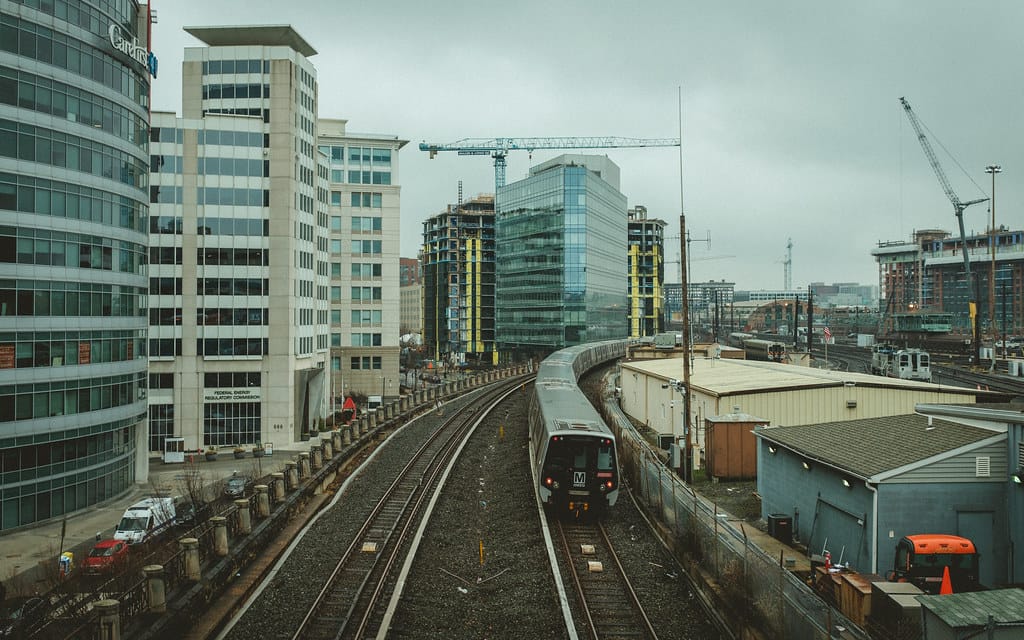
photo by Eric P.
From WMATA:
“The Washington Metropolitan Area Transit Authority (WMATA or Metro) and Kawasaki Rail Car, Inc. (KRC) today announced their resolution of several ongoing contract disputes regarding, among other things, the 2021 Blue Line derailment of a 7000-series railcar which led to the entire 7000-series fleet being grounded. A multiparty investigation, led by the National Transportation Safety Board (NTSB) and that included WMATA and KRC, found that wheel migration in the 7000-series railcars contributed to the derailment.
Following the 2021 derailment, and with support from Metro and KRC, the NTSB investigated the root cause. The NTSB investigation did not assign responsibility for the cause of wheel migration, and Metro and KRC both deny responsibility or contractual liability for the wheel migration and other technical issues that are now resolved as part of a global contract resolution. The agreement reflects a mutual desire to resolve these issues without litigation, while maintaining a strong and successful partnership for the 7000-series program.
WMATA’s General Manager and Chief Executive Officer Randy Clarke hailed the parties’ agreement as an important milestone in Metro’s return to service plan, and thanked KRC’s leadership for their support during Metro’s return to service efforts. “Their technical expertise and ongoing support have been invaluable,” said Clarke. “We look forward to continuing our collaboration with them to ensure our customers receive safe, frequent, and reliable service. We are happy to put this chapter behind us which will free up valuable resources for Metro to use for other capital and service projects.”
As part of the global settlement to resolve wheel migration and other matters unrelated to the 2021 derailment, the parties agreed to reduce Metro’s remaining contractual payment obligations by up to $35 million, which will offset Metro’s costs to implement technical changes to the 7000-series railcars, address wheel migration mitigation and other unrelated efforts, and allow Metro to reallocate funding to other projects. In recognition of KRC’s strong contribution to the design, manufacture, and delivery of the 7000-series railcars, Metro also agreed to release contractual payments to KRC for successfully achieving reliability and maintainability testing benchmarks and to reduce the amount of KRC’s required performance bond. “We believe our commitment demonstrates our confidence in KRC as a partner to deliver vehicle reliability throughout the lifecycle of our 7000-series fleet,” said Clarke.
KRC’s President and Chief Operating Officer Yusuke Hirose also praised the deal as a sign of the company’s longstanding support for Metro’s 7000-series program: “The state-of-the-art 7000-series railcar has been in service with Metro for over a decade demonstrating a high-level of reliability and safe operation that are essential for Metro to serve the riding public. KRC looks forward to continuing to provide Metro with the engineering expertise and technical support it needs to maximize the operational life of each 7000-series railcar.”
This year marked 15 years since Metro awarded the contract to KRC to design, produce and deliver the 7000-series railcars. KRC has delivered all 748 railcars. Based on the recommendations of engineering experts involved in the NTSB review, Metro developed a plan to press wheels on the 7000-series fleet in-house at a higher standard. Metro and KRC disputed, among other issues, whether the original standard had been a design specification or was developed in response to a performance specification. The remediation effort has been underway at Metro since 2023 and is expected to be completed in second quarter 2026.”