

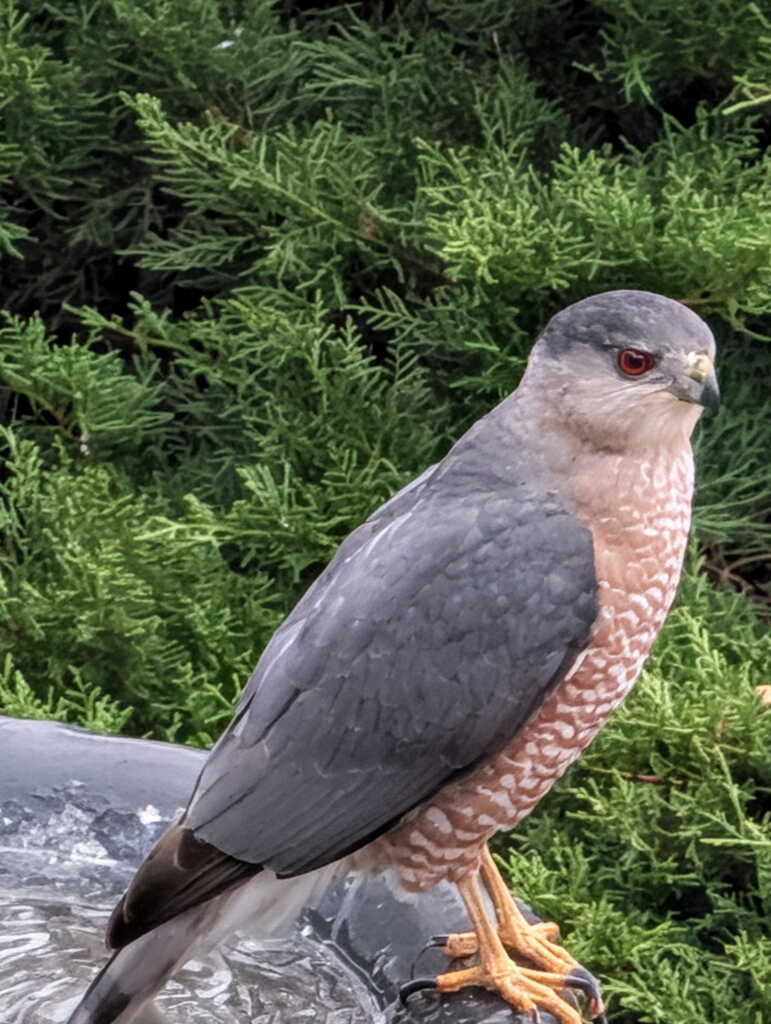
Thanks to Sid for sending this beautiful Falcon or Juvenile Hawk(?) from Chevy Chase, DC.
If you spot a hawk, any interesting wildlife or celebrity skateboarder Tony Hawk, and get a good photo please send in an email where you spotted them to [email protected]. Thanks! Hawks around Town is made possible by a generous grant from the Ben and Sylvia Gardner foundation.
From All About Birds:
“Peregrine Falcons are the largest falcon over most of the continent, with long, pointed wings and a long tail. Be sure to look at shape as
well as size—long primary feathers give the Peregrine a long-winged shape. As with most raptors, males are smaller than females, so Peregrines can overlap with large female Merlins or small male Gyrfalcons.
Adults are blue-gray above with barred underparts and a dark head with thick sideburns. Juveniles are heavily marked, with vertical streaks instead of horizontal bars on the breast. Despite considerable age-related and geographic variation, an overall steely, barred look remains.
Peregrine Falcons catch medium-sized birds in the air with swift, spectacular dives, called stoops. In cities they are masterful at catching pigeons. Elsewhere they feed especially on shorebirds and ducks. They often sit on high perches, waiting for the right opportunity to make their aerial assault.
Look for Peregrine Falcons perching or nesting on skyscrapers, water towers, cliffs, power pylons, and other tall structures. If a mudflat full of shorebirds and ducks suddenly erupts from the ground, scan the skies. A Peregrine (or Merlin) is probably in the area. Peregrines can be seen all over North America, but they are more common along coasts.
Merlins are small, fierce falcons that use surprise attacks to bring down small songbirds and shorebirds. They are powerful fliers, but you can tell them from larger falcons by their rapid wingbeats and overall dark tones. Medieval falconers called them “lady hawks,” and noblewomen used them to hunt Sky Larks. Merlin populations have largely recovered from twentieth-century declines, thanks to a ban on the pesticide DDT and their ability to adapt to life around towns and cities.”