

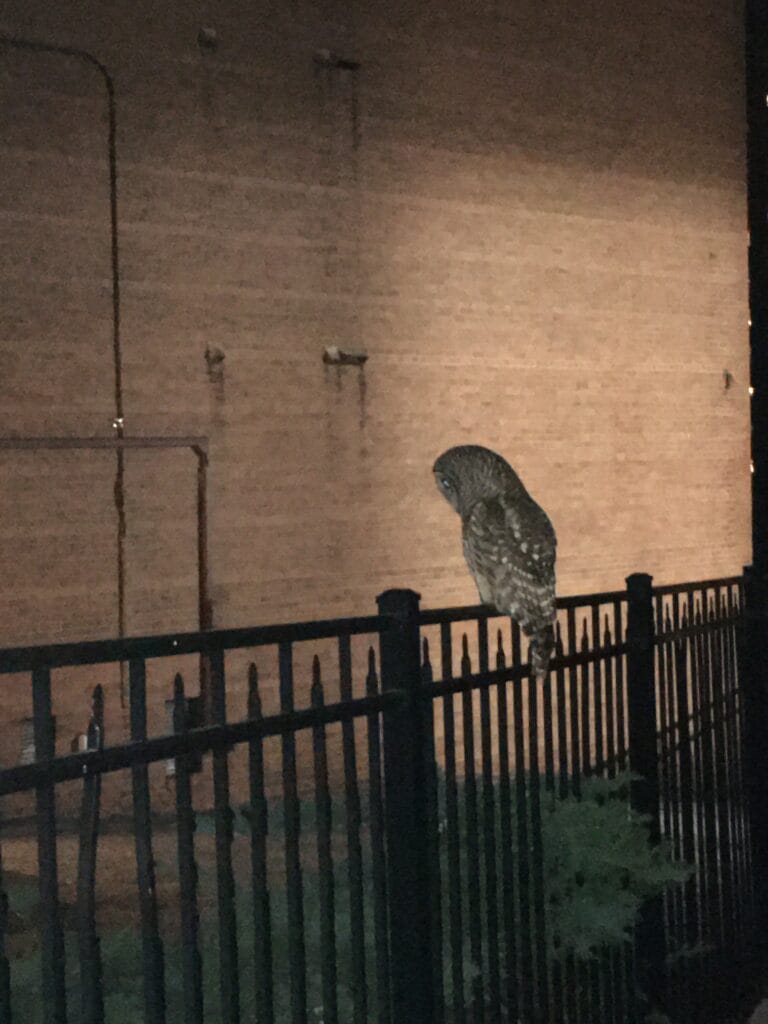
Thanks to W. for sending: “Managed to get this shot just outside my building near the Klingle Valley trail last night before the subject flew away.”
If you spot a hawk, any interesting wildlife or celebrity skateboarder Tony Hawk, and get a good photo please send in an email where you spotted them to [email protected]. Thanks! Hawks around Town is made possible by a generous grant from the Ben and Sylvia Gardner foundation.
From All About Birds:
The Barred Owl’s hooting call, “Who cooks for you? Who cooks for you-all?” is a classic sound of old forests and treed swamps.
But this attractive owl, with soulful brown eyes and brown-and-white-striped plumage, can also pass completely unnoticed as it flies noiselessly through the dense canopy or snoozes on a tree limb. Originally a bird of the east, during the twentieth century it spread through the Pacific Northwest and southward into California.
Cool Facts
The Great Horned Owl is the most serious predatory threat to the Barred Owl. Although the two species often live in the same areas, a Barred Owl will move to another part of its territory when a Great Horned Owl is nearby.
Pleistocene fossils of Barred Owls, at least 11,000 years old, have been dug up in Florida, Tennessee, and Ontario.
Barred Owls don’t migrate, and they don’t even move around very much. Of 158 birds that were banded and then found later, none had moved farther than 6 miles away.
Despite their generally sedentary nature, Barred Owls have recently expanded their range into the Pacific Northwest. There, they are displacing and hybridizing with Spotted Owls—their slightly smaller, less aggressive cousins—which are already threatened from habitat loss.
Young Barred Owls can climb trees by grasping the bark with their bill and talons, flapping their wings, and walking their way up the trunk.
The oldest recorded Barred Owl was at least 26 years, 7 months old. It was banded in North Carolina in 1993, and caught due to injury in 2019.”