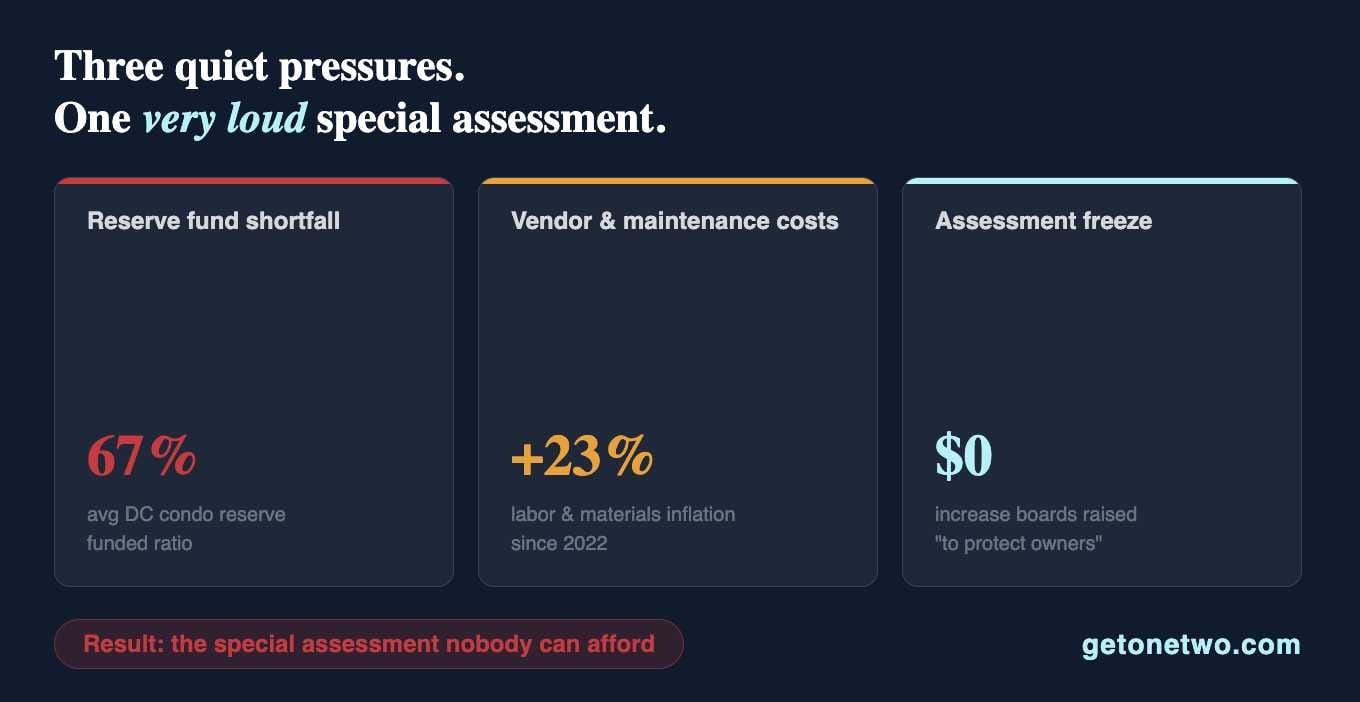
Right now, condo boards across DC are sitting on a fiscal problem they can’t see yet — not because anyone did anything wrong, but because three separate pressures have been building quietly for years, and a softening economy is about to make them visible all at once.
Reserve funds. Most DC condo associations are underfunded relative to their actual capital replacement schedule. The numbers in the spreadsheet look passable — until the roof needs replacing, the elevator fails, or the boiler goes. Then the gap between what you have and what you need becomes a special assessment. In a market where owners are watching every dollar, a surprise $4,000–$8,000 hit isn’t just painful. It’s a board credibility crisis.
Vendor and maintenance costs. Labor is more expensive than it was three years ago. Materials are up. Insurance premiums have jumped significantly across DC. Boards that set their annual budget in 2022 and haven’t stress-tested it against current vendor quotes are likely running a quiet deficit — spending down reserves without realizing it, because the line items look familiar even though the real costs have shifted underneath them.
The assessment freeze trap. Politically, raising assessments during an economic downturn is hard. Boards delay. Owners push back. The freeze feels responsible in the short term — and it is, if your reserves are genuinely healthy. But if they’re not, every month of frozen assessments compounds the shortfall. The longer it goes, the larger the eventual correction has to be.
When a board finally sees the gap clearly, the instinct is to reach for the bluntest instrument available: a special assessment. But that’s rarely the only option — and in most cases, it’s not even the best one. There are three paths a board can take:
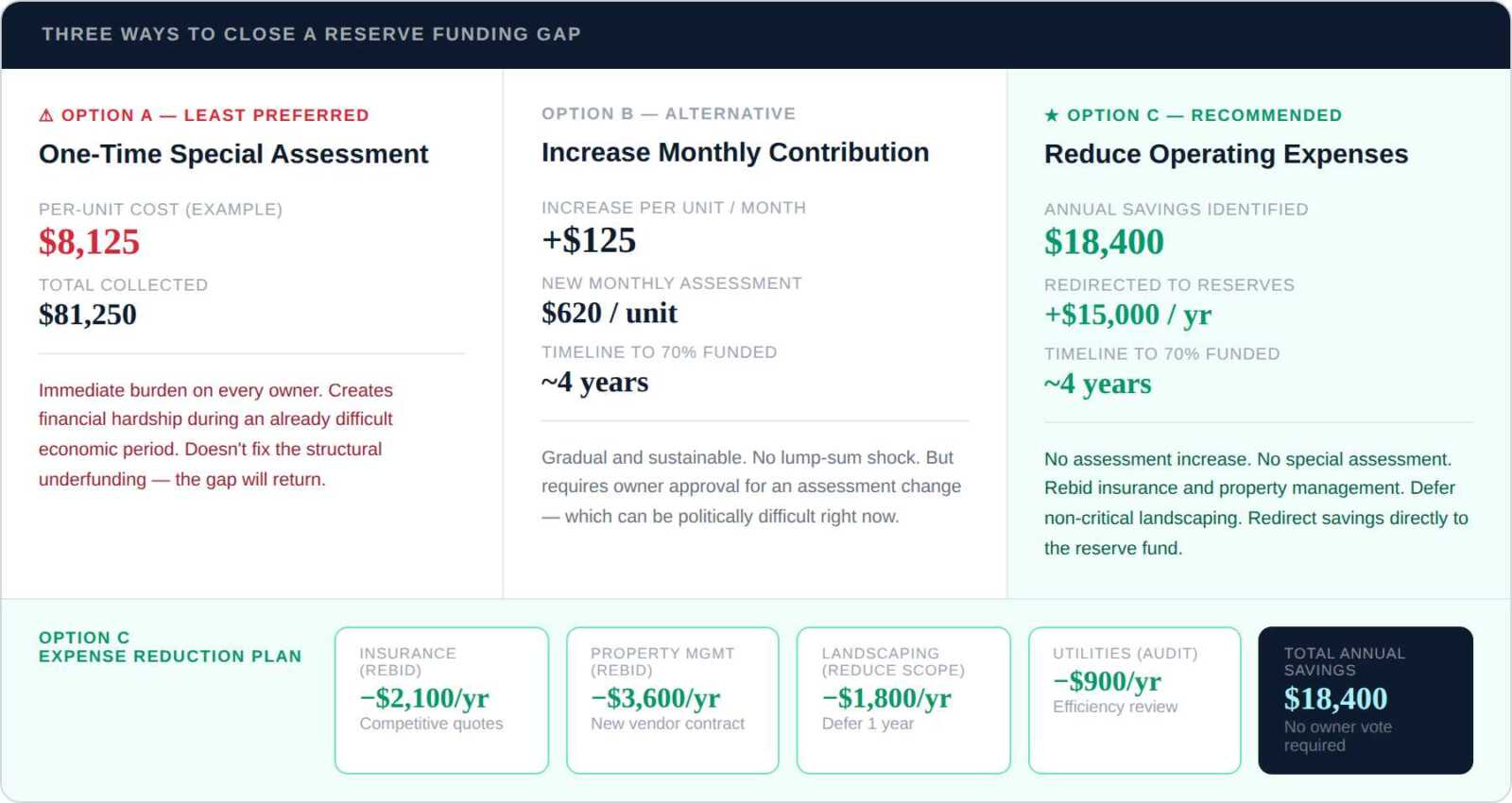
Most boards never reach Option C because they don’t have the financial visibility to see it. They don’t know which line items are overpriced, which vendors haven’t been rebid in years, or how much redirected savings would actually move the needle on reserve health. The answer to a reserve crisis isn’t always more money from owners — sometimes it’s spending less on the wrong things.
ONE two gives your board the fiscal visibility to navigate all three. Real-time budget vs. actuals, reserve health tracking by capital item, vendor cost monitoring, and a governance workflow that turns the reserve gap from a vague anxiety into a tracked, assigned, resolvable case. The goal isn’t to raise assessments unnecessarily. It’s to know, with confidence, which path is actually available to you.
A board that governs well doesn’t surprise its owners. It protects them.
ONE two is operations software built specifically for DC condos.
ONE two is a compliance-first platform designed for the reality of volunteer condo governance in Washington, DC — boards made up of homeowners with full-time jobs who shouldn’t need a property management degree to run their building correctly. The platform covers every dimension of board operations: financial oversight with real-time budget tracking and reserve health monitoring, case management for resident issues and violations, compliance tracking for DC’s regulatory requirements, community communications, and governance record keeping. Everything a board needs, built in — not patched together from spreadsheets and email threads.
Fiscal health inside ONE two at a glance
Our Fiscal Lens solution gives your board a living view of your building’s financial health — reserve status, budget vs. actuals, and a narrative your building can actually read.
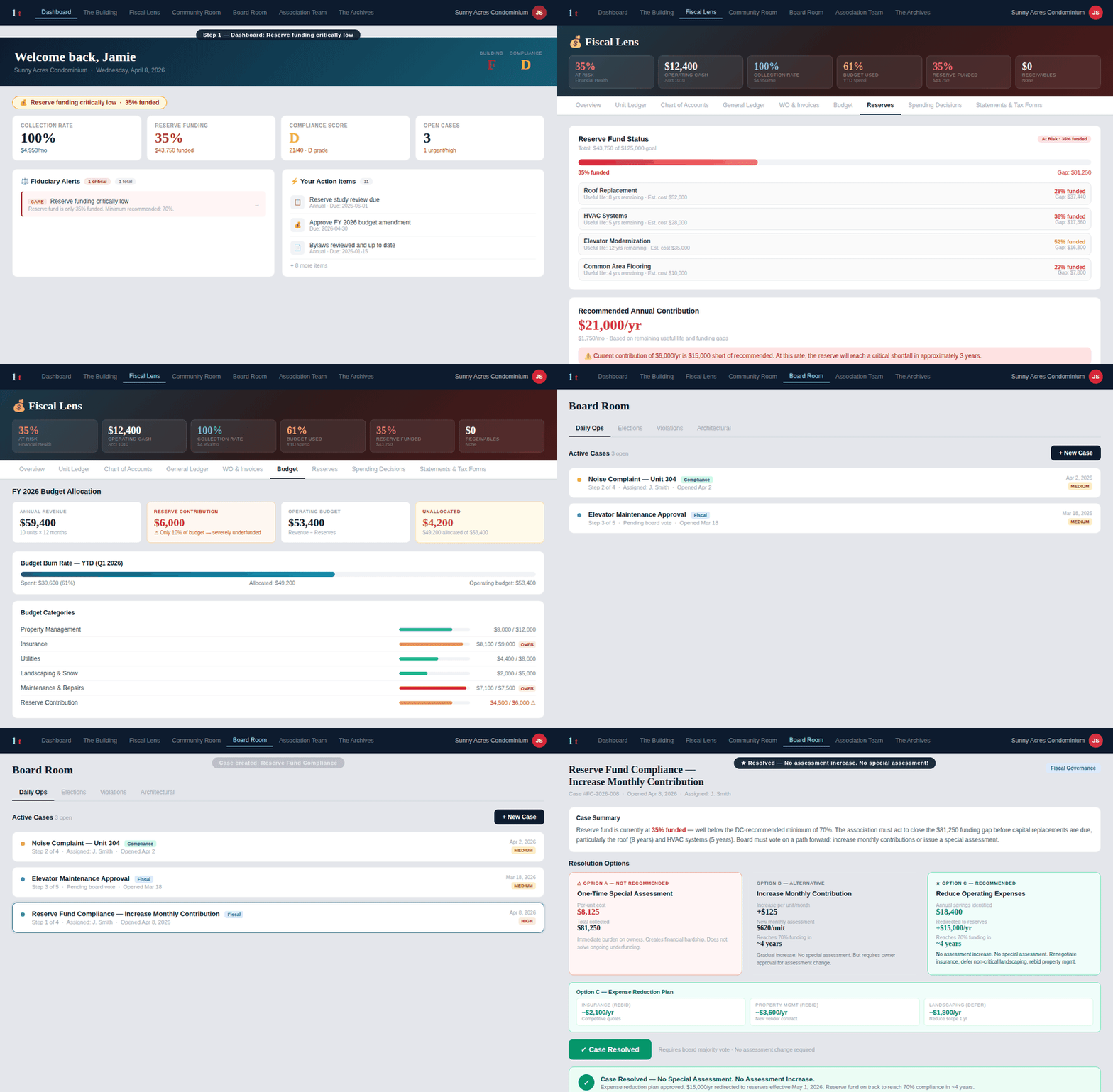
Every number is live. Every flag is actionable. And the executive summary writes itself — so your whole board is working from the same picture, not three different spreadsheets.